
Into the Deep overview & highlights
Into the Deep media kit
Into the Deep takes Aquarium guests on a five-part journey into a mysterious but important oceanic environment. Highlights of the experience follow.
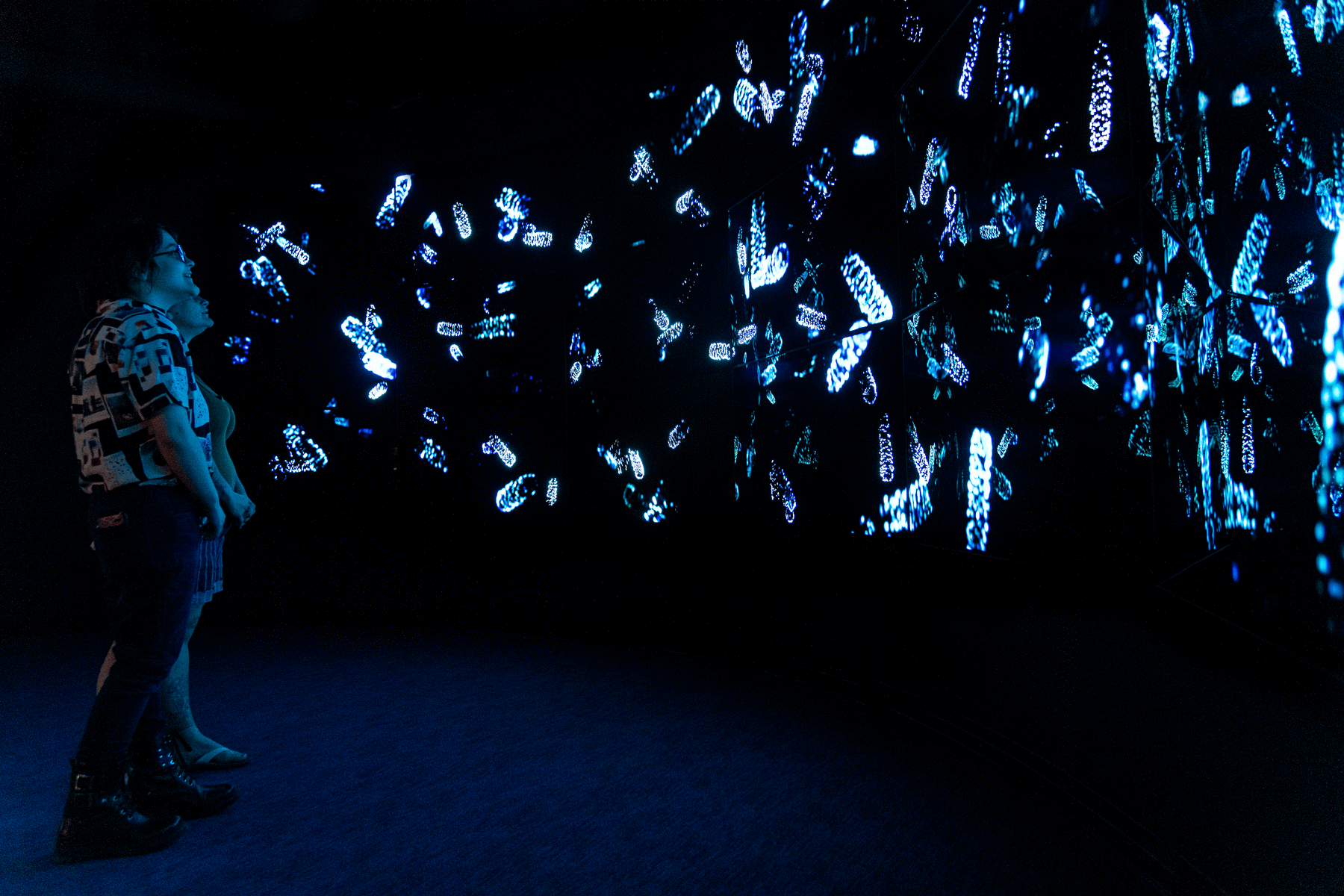
Entering the Deep
- Visitors enter the exhibition by walking down a hallway that transitions from lighter to darker, creating a sense of descent into deeper waters.
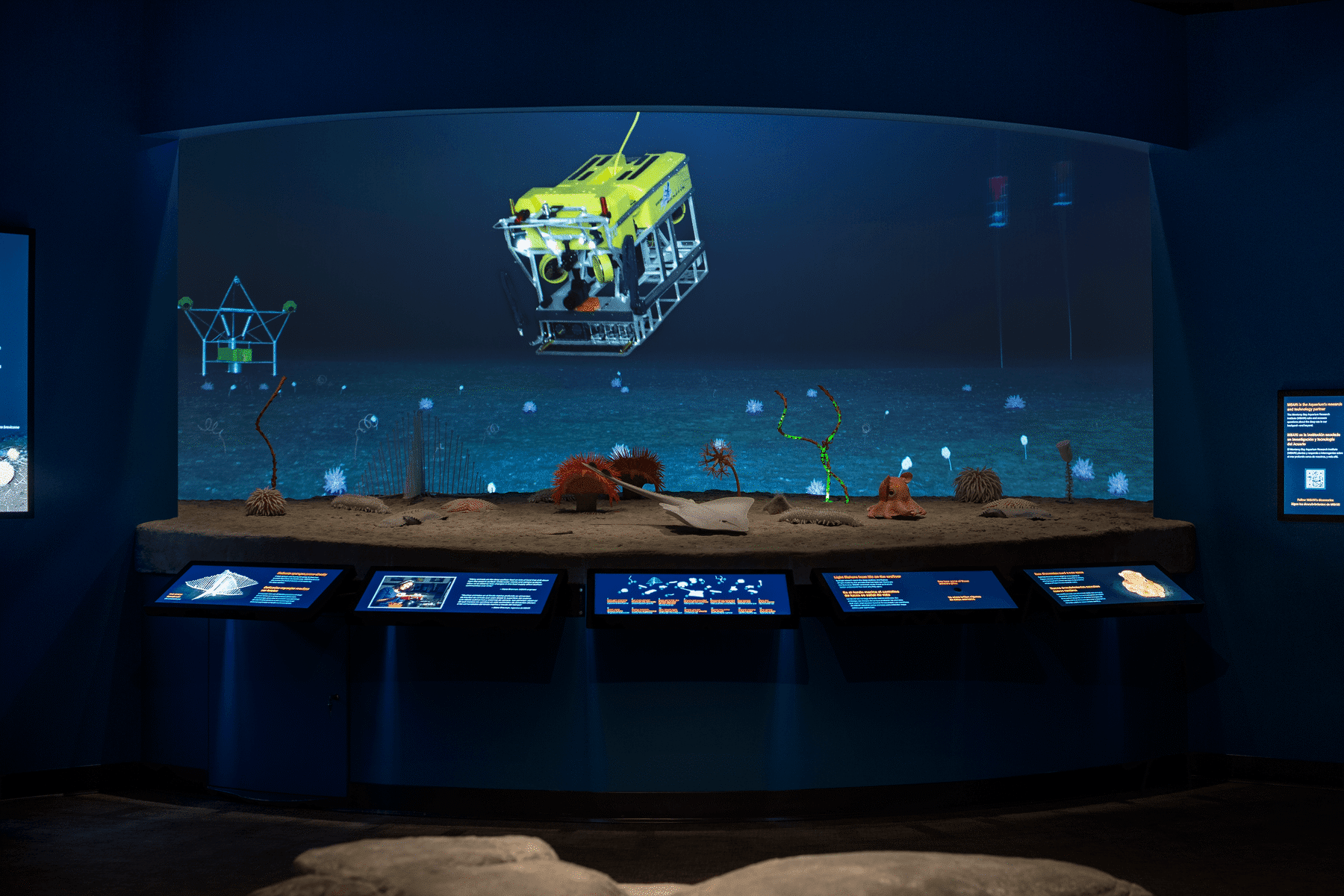
Down to the Deep
- Meet MBARI
Visitors are introduced to the Aquarium’s partner, the Monterey Bay Aquarium Research Institute (MBARI). A dynamic video experience shares imagery of MBARI scientists and engineers, MBARI technology, and deep-sea animals and habitats. - Monterey Canyon
Visitors can interact with a large topographic model of Monterey Bay, showing the underwater canyon where MBARI and Aquarium researchers study the deep sea. - Open Sea gallery
A window into the Aquarium’s largest exhibit, the one-million-gallon Open Sea, is this section’s centerpiece. Here, visitors begin to understand how the ocean’s surface is connected to the deep sea below by learning how tunas, sharks, and other animals near the ocean’s surface dive deep to find food. - Global deep
Visitors encounter a large map of the world showing the vast, global extent of the ocean and the deep sea, which communicates how it spans the globe and is the largest living space on Earth. - Deep sea introduction
Visitors begin their descent with a mosaic of projected imagery of deep-sea animals showing the diversity of life in the deep sea.
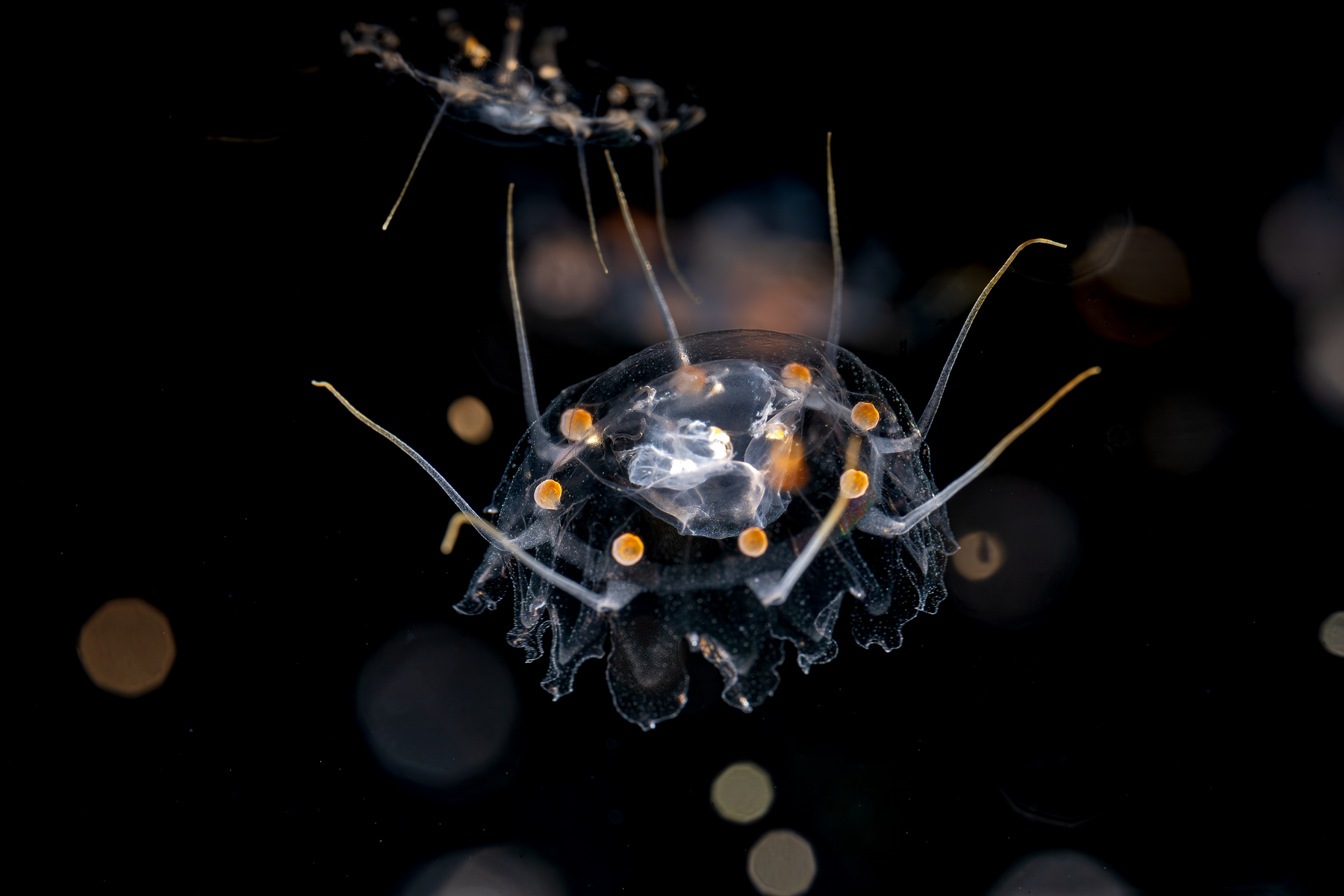
Coronatae jelly
The Midwater
- Midwater gallery
In the midwater gallery, meet animals that are adapted for survival in the exposed midwater, which doesn’t offer any shelter. For example, one display features animals with red body parts and allows visitors to turn on a red light and reveal how these animals are camouflaged in the deep sea because red light doesn’t penetrate the ocean’s depths. And another features undescribed animals discovered by MBARI in Monterey Bay. - Midwater discoveries
Interactive stations show how MBARI and the Aquarium have made amazing discoveries in the midwater and how humans’ actions on land affect midwater animals. - Midwater survival
Visitors can play a large-scale video game where they play a midwater animal struggling to find food while also avoiding becoming a meal for hungry predators or eating plastic. - Bioluminescence room
Visitors discover that many animals in the deep sea can make their own light and are immersed in a room of brilliant bioluminescent displays by midwater animals.
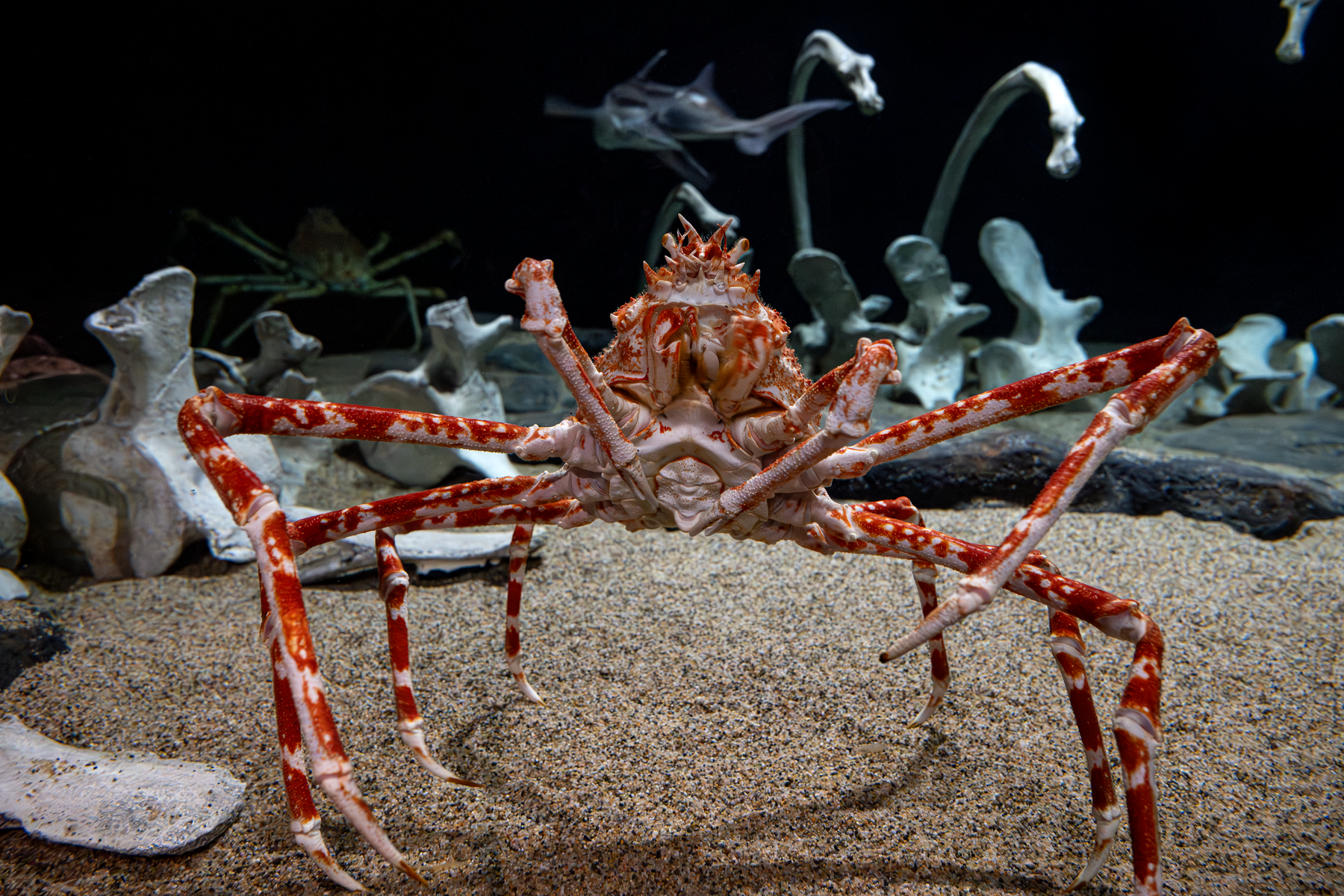
Japanese spider crab
The Seafloor
- Seafloor gallery
Visitors step into a rotunda ringed with live-animal exhibits showcasing seafloor animals and interpreting their adaptations for surviving at the bottom of the ocean. - Muddy plains diorama
This display recreates life on muddy plains with realistic, life-sized models of animals sitting on top of an artificial muddy seafloor. A projected backdrop shows the benthic rover, ROV, and other technology that MBARI uses to discover and study the animals. - Seamounts
Visitors learn about these underwater mountains that support an array of invertebrates and fishes and ancient coral on their slopes. - Hydrothermal vents
Realistic models and video footage are integrated to recreate this remarkable habitat, which spews hot water and supports an astonishing community of animals. - Whalefall
Visitors discover how whale carcasses on the seafloor provide the foundations for thriving communities and feed a variety of animals. This 12,500-gallon display (20 feet wide, 12 feet deep, and 7 feet tall) recreates the natural event with Japanese spider crabs, fishes, and invertebrates bustling around a fabricated sperm whale skeleton. - Isopod station
Visitors have the opportunity to learn about giant deep-sea isopods and their natural history. - Bone-eating worms
Visitors see bones covered in tiny bone-eating worms, which were first discovered on whalefalls in Monterey Bay.
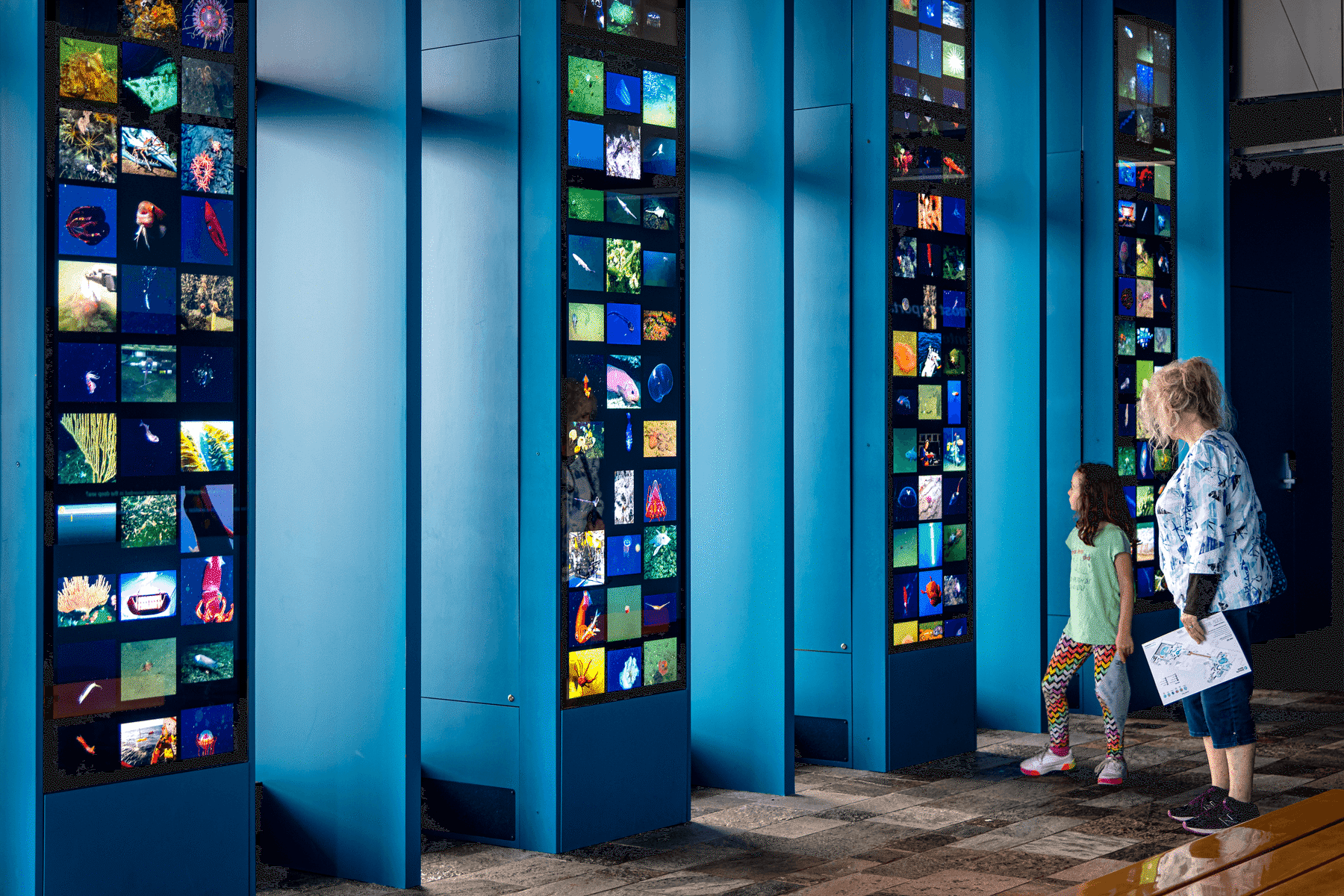
Guests pause for a moment upon exiting the Into the Deep
On the Horizon
- As visitors metaphorically resurface, they see how much we are still learning about the deep sea through interactive images they can scroll through and select to get more information.
More Into the Deep media kit
Dive into the Aquarium media kit

About us
Aquarium introduction & history
Learn more about the mission, vision, and history of the Aquarium in this introduction.
Read more – Aquarium introduction & history