
Into the Deep featured species
Featured species listed by gallery
This is only a select list of animals featured in the exhibition. Animals on exhibit will periodically change over the course of its run.
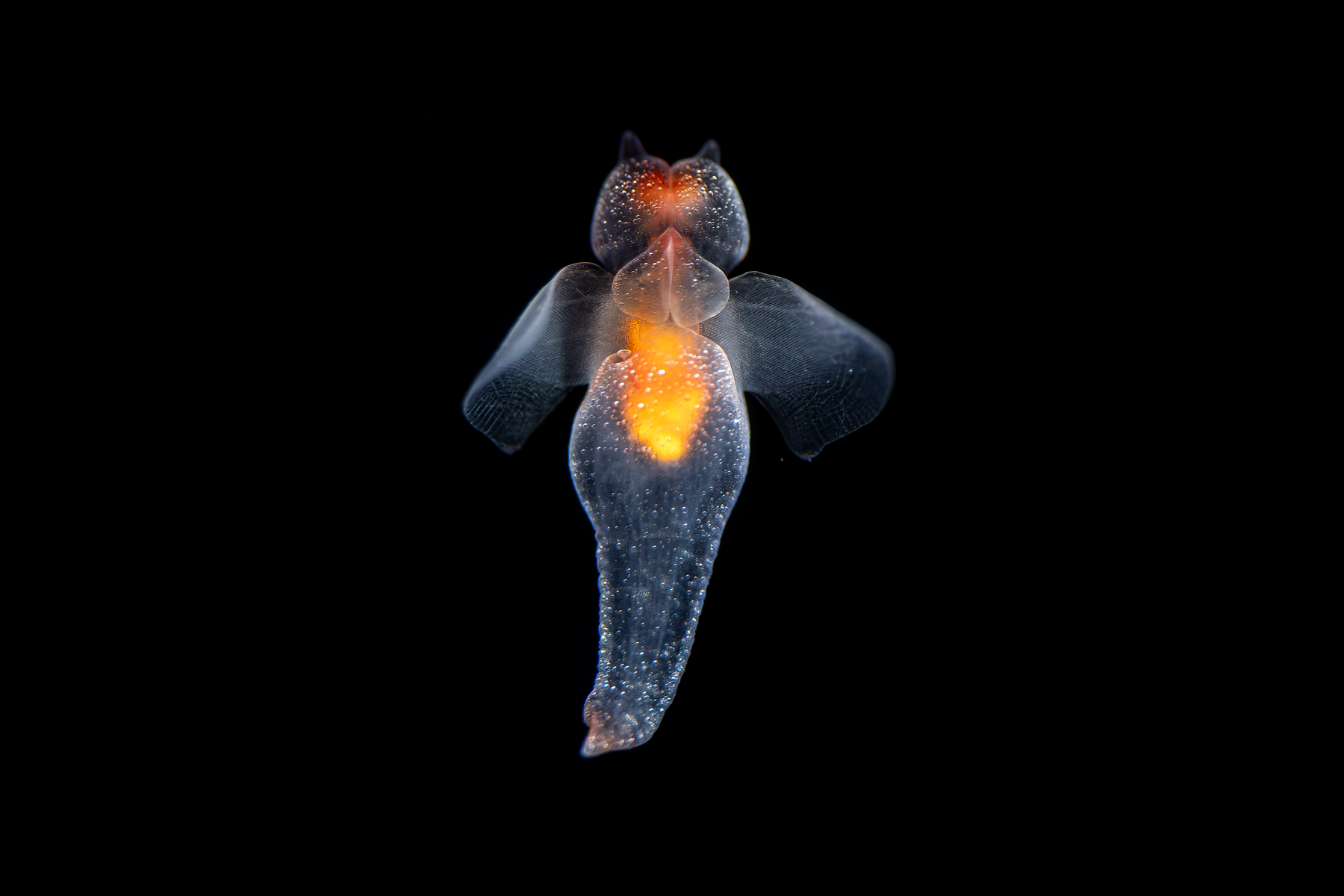
Sea angel
Midwater gallery
- Sea angel (Clione spp.)
- Bloody-belly comb jelly (Lampocteis cruentiventer)
- Snow globe jelly (Modeeria rotunda)
- Common siphonophore (Nanomia septata)
Midwater gallery of animals discovered in Monterey Bay (featured animal rotates):
- Lobed comb jelly (Bolinopsis infundibulum)
- Red X comb jelly (undescribed species)
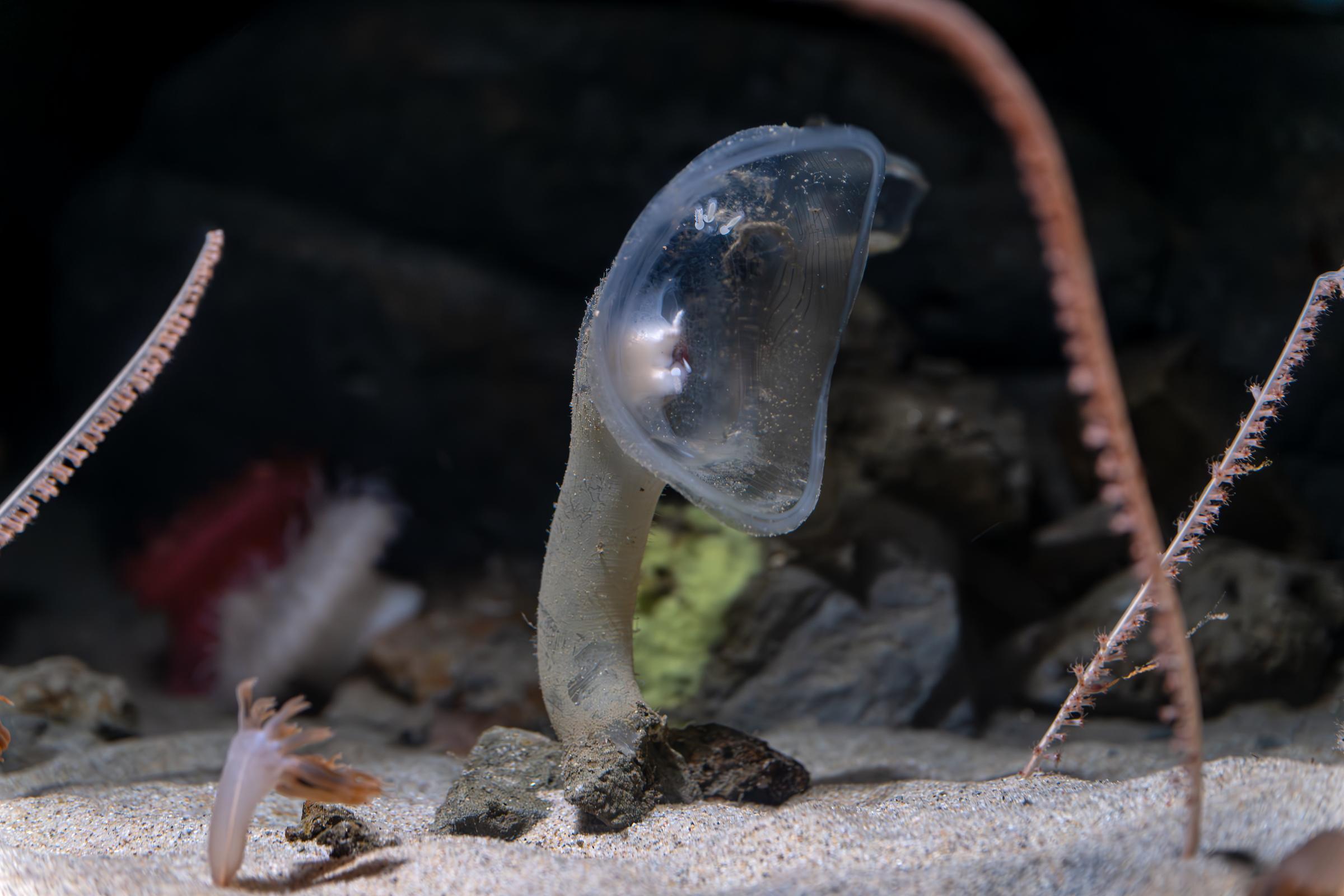
Predatory tunicate
Seafloor main gallery
- Pacific hagfish (Eptatretus stoutii)
- Pom-pom anemone (Liponema brevicorne)
- Salmon snailfish (Careproctus rastrinus)
- Oregon spiny king crab (Paralomis hystrix)
- Snakehead eelpout (Lycenchelys spp.)
- Predatory tunicate (Megalodicopia hians)
- Glowing sea cucumber (Pannychia moseleyi)
- Droopy sea pen (Umbellula spp.)
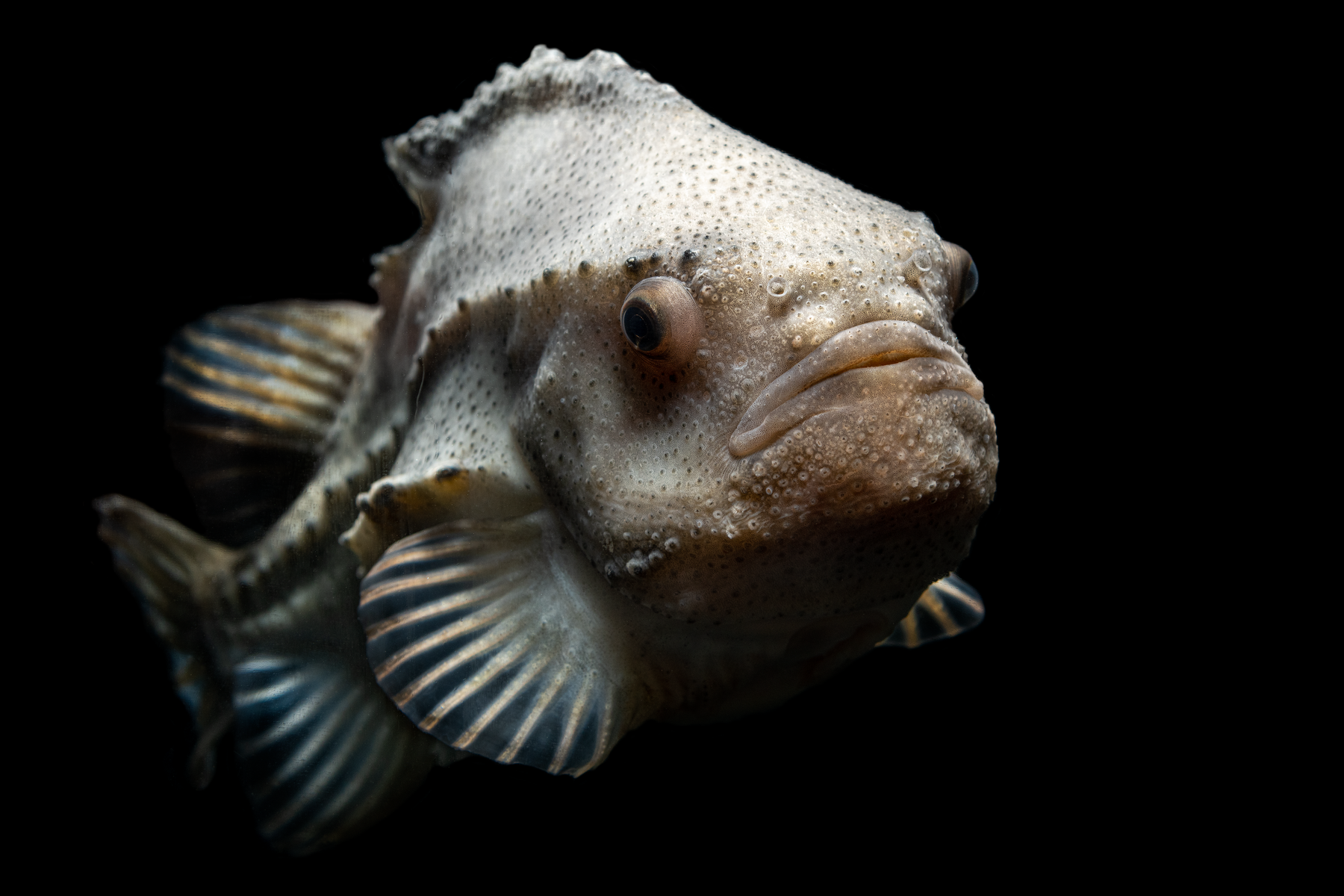
Lumpfish
Seafloor seamount galleries
- Bubblegum coral (Paragorgia spp.)
- Mushroom soft coral (Heteropolypus ritteri)
- Deep-sea cauliflower coral (Sibogagorgia cauliflora)
- Deep-sea carnation coral (Gersemia juliepackardae)
- Red sea fan (Callistephanus kofoidi)
- Basket star (Gorgonocephalus eucnemis)
- Feather star (Florometra serratissima)
- Lumpfish (Cyclopterus lumpus)
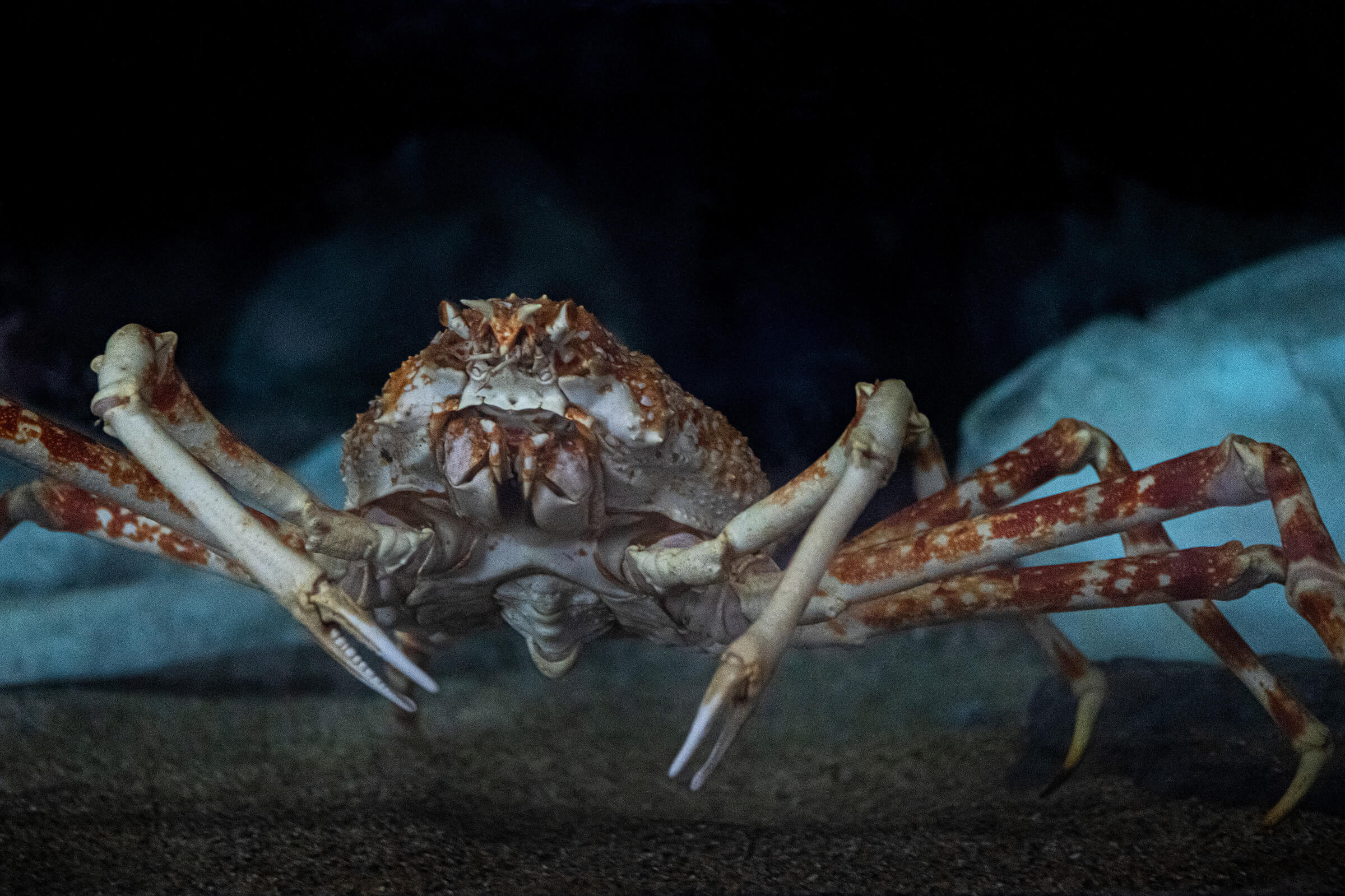
Japanese spider crab
Seafloor whale fall gallery
- Japanese spider crab (Macrocheira kaempferi)
- Sablefish (Anoplopoma fimbria)
- Japanese armorhead (Pentaceros japonicus)
- Shortspine thornyhead (Sebastolobus alascanus)
- Longspine thornyhead (Sebastolobus altivelis)
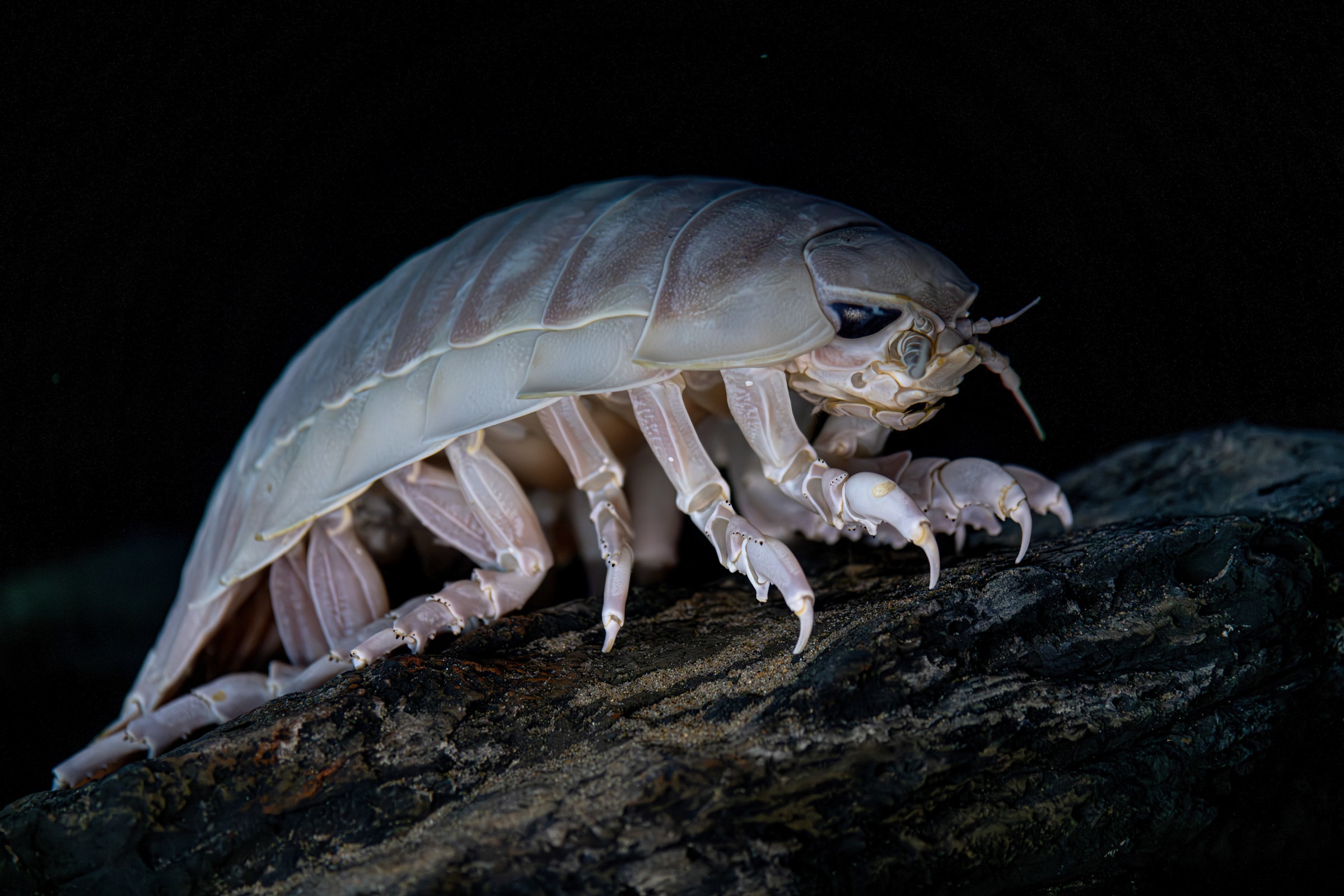
Giant isopod
Seafloor isopod
Seafloor bone-eating worms gallery
Story bibliography
Webpage
Videos
- Why Do Deep-Sea Animals Look So Weird?
- Is The Deep Sea Dark? How Animals Use Bioluminescence In The Ocean
- The Top 10 Deep-Sea Animals (according to Monterey Bay Aquarium Research Institute scientists)
- Some Like It Hot: Explore The Wild World of Hydrothermal Vents with a Deep-Sea Biologist!
- What creatures live in the "Midnight Zone" of the deep sea?
- Monterey Bay Aquarium Explores Magical Gardens Of Deep Sea Life Off The Big Sur Coast
MBARI stories
- Autonomous robotic rover helps scientists with long-term monitoring of deep-sea carbon cycle and climate change
- Genetic probes give new clues about the stunning diversity of comb jellies
- Vertical migration timing illuminates importance of predator pressure in the ocean's twilight zone
- Seeing Sur Ridge: New animation transforms deep-sea mapping data to reveal the majesty of an underwater oasis
- New laser system provides 3D reconstructions of living deep-sea animals and their mucous filters
- New study finds microplastic throughout Monterey Bay
- Unique field survey yields first big-picture view of deep-sea food webs
- New study shows that three quarters of deep-sea animals make their own light
Monterey Bay Aquarium stories in the media
- The Deep Sea May Soon Be Up for Grabs
New York Times, June 8, 2018 - Bringing the Ocean’s Midnight Zone Into the Light
New York Times, September 22, 2020 - A Fish With a Transparent Head Was Seen Near Monterey
NBC Los Angeles, December 14, 2021 - How an Aquarium Collects Curious Creatures From the Deep
Wired, December 23, 2021 - Monterey Bay Aquarium announces date for long-anticipated deep sea exhibition
Monterey County Weekly, January 11, 2022 - Never-before-seen Deep Sea Creatures Are Coming to This California Aquarium's New Exhibit
Travel + Leisure, January 20, 2022 - New Monterey Bay Aquarium exhibit to feature deep sea creatures that look out of this world
SFGate, February 11, 2022 - Monterey Bay Aquarium to unveil new ‘Into the Deep’ exhibition
Monterey Herald, February 22, 2022
MBARI stories in the media
- Why Was This Ancient Mammoth Tusk Discovered at the Bottom of the Ocean?
The New York Times - This Intrepid Robot Is the WALL-E of the Deep Sea
WIRED - Taking the Pulse of the Ocean's Comb Jellies
The New York Times - Can Scientists Map the Entire Seafloor by 2030?
Smithsonian Magazine - New $50 million research ship to be named for Silicon Valley pioneer
The Mercury News
Notable stories about Into the Deep
- People are connected to the deep sea, and for our survival, we need it to be healthy. While most people think of the deep sea as a distant place that is unconnected to their lives, the deep sea is incredibly important to life as we know it on the planet. The largest living space on Earth, the deep sea is integral in cycling nutrients, heat, and oxygen all over our planet, so the health of the deep sea is tied to all life on Earth—even us.
- Bringing the Deep Sea to Life has required unprecedented research, development, and engineering from our staff. Our team has created the most ambitious and technologically advanced exhibition in our history. This will be the first time any aquarium has put some of these species on exhibit, and to do that, we have to carefully replicate their favorite ocean conditions. This has resulted in the most sophisticated water treatment system ever designed at the Aquarium, which can finely adjust temperature, oxygen levels, and pH.
- We need to protect and conserve the deep sea. Even though the deep sea is unlike more familiar surface ocean habitats, human activity still puts it at risk: fishing pressure, habitat destruction, plastic pollution, mining, and climate change. And because conditions in the deep have remained stable for millennia, it may not be as resilient to human-driven disturbances.
- The deep sea has mysterious secrets yet to discover. It is a cliché, but there are better maps of the surface of the planet Mars than there are of our own planet’s seabed. Estimates vary, but experts think we’ve only explored about five percent of our oceans. With the deep sea comprising the largest living space on Earth, there is so much more out there to find.
- Monterey Bay Aquarium and our partner MBARI are uniquely equipped to tell the story of life in the deep because the deep sea is literally in our backyard. Since its founding in the 1980s, MBARI has continuously explored the mile-deep submarine canyon, which begins at its headquarters in Moss Landing and stretches westward under the waves of Monterey Bay. A global leader in deep-ocean research MBARI researchers are revealing the deep sea right here in Monterey Bay. They have discovered and described several of the species that will be on exhibit and study how climate change and plastic pollution are affecting this fragile ocean habitat.
More Into the Deep media kit
Dive into the Aquarium media kit
About us
Aquarium introduction & history
Learn more about the mission, vision, and history of the Aquarium in this introduction.
Read more – Aquarium introduction & history