

Garden eels
These snake-like fish resemble gardens when grouped
It's a worm! It's a snake! Nope. That, friends, is a garden eel!
Garden eels are mesmerizing to watch. Find two species of this enchanting animal gently swaying like blades of seagrass in our exhibit, Ocean in Motion / La Danza del Mar. To feed on plankton, these fish generally orient in the same direction, resembling a “garden” of eels.
Burrow builders
Garden eels build burrows with their tails. When threatened they retreat tail-first back into their burrows. To make a sturdy home in the sand, garden eels coat the sandy walls of their burrow with mucus that acts like cement to stabilize it.
The splendid garden eel—one of the two garden eel species on exhibit in Ocean in Motion / La Danza del Mar—remains in its burrow for most of its life.
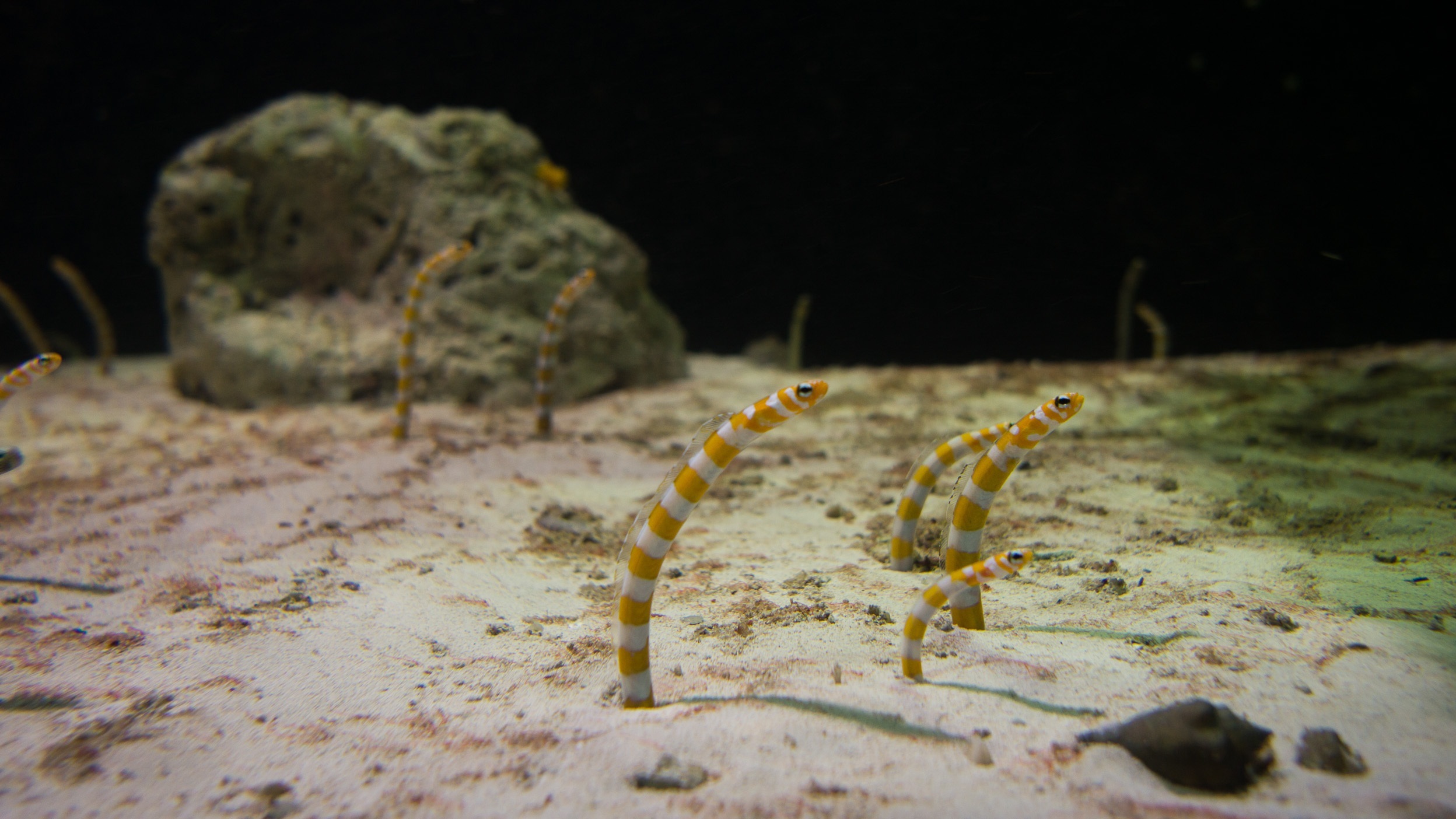
A splendid garden eel digs into the sand tail-first and lines its burrow with mucus, which holds the burrow's walls together.
Splendid garden eels
Splendid garden eels have long, snake-like bodies with large eyes, small pectoral fins, a long dorsal fin, and a striking color pattern of alternating white and brownish-orange to yellow bands. They can range up to about half of inch wide and can grow up to 16 inches long!
Splendid garden eels live in sandy bottom areas or rubble around reefs. They can be found in the Indo-pacific, Maldives, Philippines, Indonesia, Papua New Guinea, Australia, and Fiji.
Splendid garden eels have a, shall we say "splendid", way of mating:
- They mate while remaining partially submerged in burrows with adjacent males and females stretching to spawn.
- After mating, females release fertilized eggs into the currents.
When threatened by their common predators, skates and rays, splendid garden eels will retreat into their burrows.
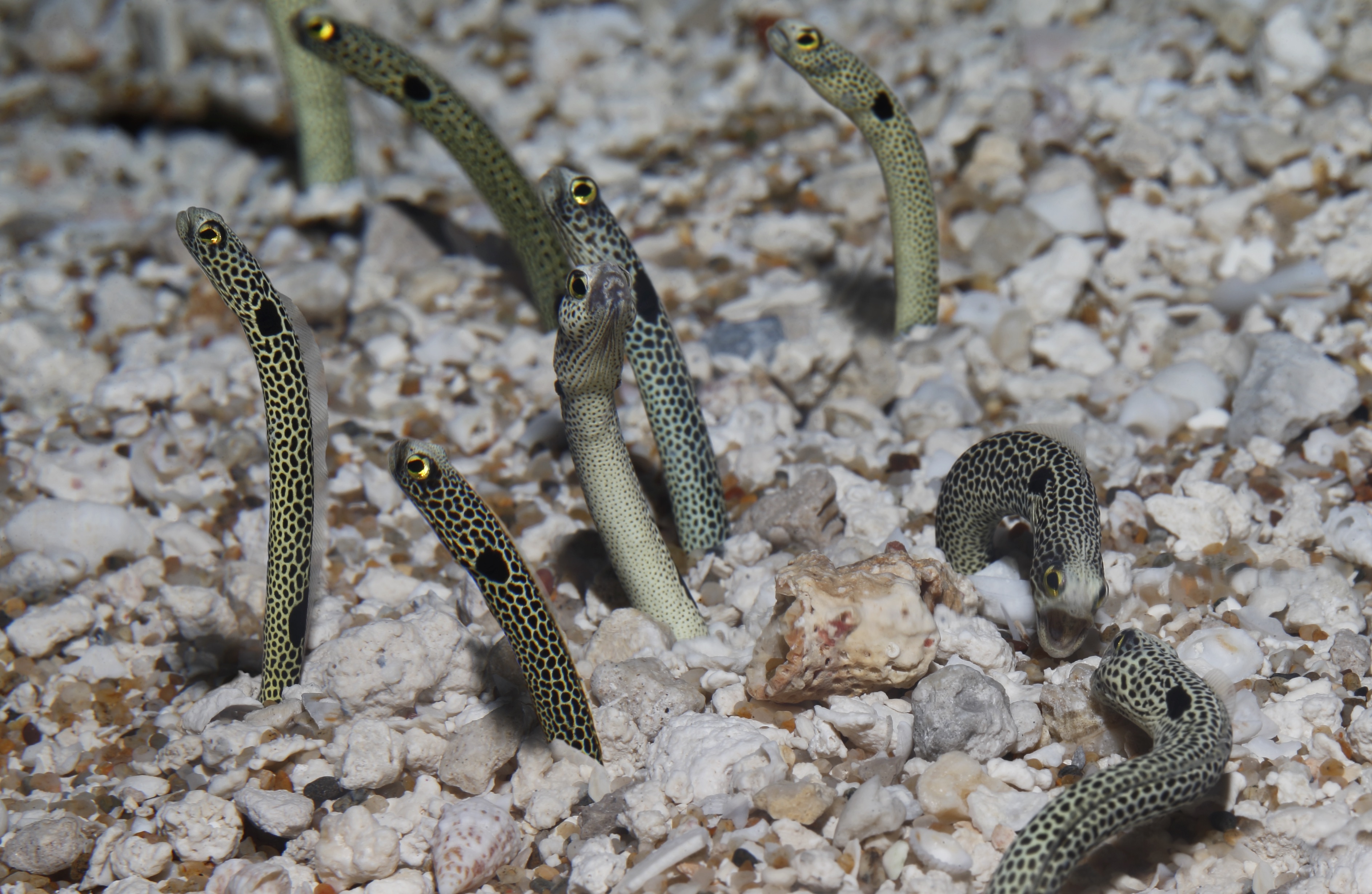
Garden eels spend almost their entire adult lives without fully leaving their burrows, and that includes mating.
Spotted garden eels
Spotted garden eels have whitish bodies covered in small black spots with three prominent black patches along the body. Juveniles are entirely black. They can grow up to 24 inches long but are more commonly the size of about 14 to 16 inches long. Spotted garden eels form colonies of up to several hundred individuals on sandy bottoms.
Each spotted garden eel will form its own permanent, separate burrow, where they conceal most of their body except their head. These burrows help the eel evade predators like snake eels and triggerfish. Spotted garden eels completely bury themselves at night, retreating tail-first into their tiny dwellings.
This species of garden eel lives in the tropical waters of the Indo-Pacific. They make themselves at home in sandy flats, slopes, coral reef bottoms, and sometimes seagrass beds.
Frequently asked questions
Can garden eels bite?
No! Garden eels have small mouths and tiny teeth built for snapping up passing plankton, and they're extremely shy: when a diver or anything else gets close, the whole colony pulls back into their burrows long before contact is possible.
What's the different between the two species on exhibit?
Spotted garden eels are pale with scattered black spots, including two large dark patches near the head, while splendid garden eels are striped in bright orange and white bands. They also live in slightly different ocean environments.
What do garden eels eat?
Plankton! They sway with the current in order to catch animal plankton.
Related videos
12 minutes of garden eel feedings

The garden eels are fed via turkey baster a diet of small shrimps—brine and mysid shrimps in particular. Should they decide to duck out of their new year resolutions, special burrows allow them to hide completely under the sand!