
Answers to frequently asked questions about Seafood Watch’s latest assessments for fisheries using gear that pose significant risk to the endangered North Atlantic right whale
These FAQs are in response to questions on the recent assessments involving the North Atlantic right whale.
Why did Seafood Watch assess U.S. and Canadian fisheries using trap/pot and gillnet gear along the East Coast?
In 2017, the U.S. federal government declared an Unusual Mortality Event due a significant die-off of the endangered North Atlantic right whale, primarily from entanglements in fishing gear and vessel strikes in Canada and the U.S. To ensure our Seafood Watch assessments reflect the most current, science-based information, we began the process of updating assessments of all fisheries along the East Coast using gear that pose a high entanglement risk.
How did Seafood Watch make these assessments?
These assessments are part of Seafood Watch’s science-based process to evaluate the current environmental performance of fisheries. Our eight-step assessment process is rigorous, transparent, and accessible—and is conducted in consultation with scientific, government, industry, and conservation experts. To give external stakeholders an opportunity to share additional research and data points, our process includes a public comment period. We reviewed all the comments we received as part of the assessment process.
Visit SeafoodWatch.org to learn more about our science-based assessment process
What information did Seafood Watch consider when making these assessments?
In our fully referenced, science-based assessments, Seafood Watch reviewed all available data, including the latest government stock assessments, peer-reviewed science, and all state, federal, and provincial management measures. The Seafood Watch program also gathered input from scientific, government, industry, and conservation experts, and through a public comment period.
Visit SeafoodWatch.org to learn more about our science-based assessment process
Did your ratings take into account current mitigation and management measures?
The new Seafood Watch assessments include descriptions of mitigation measures in each fishery at the date of publication unless otherwise indicated. See the fully-referenced individual assessments for more detail.
Which fisheries were included in these assessments?
In September 2022, Seafood Watch updated 14 assessments of Canadian and U.S. fisheries that use gear that pose risks to the endangered North Atlantic right whale. All fisheries were evaluated consistently according to the Seafood Watch Standard for Fisheries.
Download these assessments (PDFs) covering the following fisheries:
1. Canada American Lobster
2. Canada Jonah and Rock Crab
3. Canada Snow Crab
4. U.S. American Lobster
5. U.S. Atlantic Croaker
6. U.S. Atlantic Cod, Haddock, and Pollock (Gulf of Maine and Georges Bank)
7. U.S. Atlantic Flatfishes (flounders, Atlantic halibut, Atlantic plaice)
8. U.S. Atlantic Winter Skate
9. U.S. Black Sea Bass
10. U.S. Bluefish
11. U.S. Goosefish (monkfish)
12. U.S. Jonah and Rock Crab
13. U.S. Summer Flounder
14. U.S. White Hake
What does it mean when a seafood product is red-rated?
According to Seafood Watch standards, when fisheries pose a high risk of harm to marine life or the environment and appropriate management measures are not in place, they are assigned a red rating.
Businesses and consumers use Seafood Watch ratings to inform their purchasing decisions. Some businesses may choose not to source from fisheries with a red rating due to the associated environmental risk.
When will these ratings be reviewed and updated?
Seafood Watch is committed to updating the Seafood Watch assessments as measures are designed and implemented that quickly reduce the risk of serious injury and death to the endangered North Atlantic right whale caused by entanglement in fishing gear, including reducing risks below the federally prescribed levels and meeting all legal requirements of the Endangered Species Act and the Marine Mammal Protection Act.
Why are these fisheries a risk to North Atlantic right whales?
The North Atlantic right whale is an endangered species at high risk of extinction, and entanglement in gear using vertical lines is the leading cause of injury and death to these whales. Current management measures do not go far enough to mitigate entanglement risks and allow the North Atlantic right whale to recover.
For the North Atlantic right whale to recover, NOAA determined that less than one whale per year can be seriously injured or killed. Data show that North Atlantic right whale mortalities from fishing entanglement continue to occur at levels five times higher than the species can withstand.
Are these U.S. fisheries in compliance with the Endangered Species Act and the Marine Mammal Protection Act?
A U.S. District Court ruled in July 2022 that, despite management measures taken to date, all pot/trap and gillnet fisheries in this region with vertical lines in the water are in violation of the Endangered Species Act and the Marine Mammal Protection Act.
Update: In December 2022, Congress passed the 2023 Consolidated Appropriations Act, which included provisions that delay the deadline for new protective regulations and extend the risk to the North Atlantic right whale for six years. With this exemption, Congress “deemed” current regulations related to U.S. lobster and Jonah crab fisheries in full compliance with the requirements of the Endangered Species Act and the Marine Mammal Protection Act until 2028.
How did Seafood Watch determine which fisheries are responsible for whale entanglements?
The reality is that whales, including the North Atlantic right whale, are being entangled in fishing gear using vertical lines such as traps/pots and gillnets in both U.S. and Canadian waters. In fact, since the September 6 release of our Seafood Watch red ratings, a North Atlantic right whale called Snow Cone was observed entangled in fishing gear and is not expected to survive.
This letter from leading whale experts helps to correct the misinformation circulating on whale entanglements and risk. The North Atlantic right whale lives along the east coast of the U.S. and Canada with year-round presence throughout the range.
According to the most recent stock assessment, entanglement in fishing gear that uses vertical lines is the leading cause of serious injury and death to the North Atlantic right whale. The U.S. government has made it clear that “the fact that right whales have not been identified in any recent interactions with lobstermen does not mean mortalities don’t occur.”
In the U.S., NOAA apportions responsibility to all fisheries that pose risk to the North Atlantic right whale—an approach supported by a recent court ruling. Seafood Watch used NOAA’s information in these assessments as it represents the best available science.
Update: On January 8, 2023, an aerial survey team sighted a heavily entangled right whale approximately 20 miles east of Rodanthe, North Carolina. There were several wraps of line around the mouth and tail, with additional line trailing behind the whale. After reviewing documentation of this new entanglement case, NOAA Fisheries biologists made a preliminary determination that it meets the criteria of a “serious injury.” This means the whale is likely to die from this injury. Scientists with the New England Aquarium identified the whale as right whale #4904, a 4-year-old juvenile female that was last spotted in May 2022, in the Massachusetts Bay. She had no entanglements at that time.
Since this incident, several additional whale entanglements have occurred. Access the latest North Atlantic right whale updates from NOAA.
What would make these fisheries safer for right whales?
We are encouraged that NOAA is developing new regulations that aim for a 90 percent reduction in risk to these whales, and we are hopeful that the states and industry will work with NOAA to ensure these changes happen quickly.
We are also hopeful that new technological developments will further reduce the risk to North Atlantic right whales.
Are ship strikes in Canada the biggest threat to these whales?
No. According to the most recent stock assessment, entanglement in fishing gear that uses vertical lines is the leading cause of serious injury and death to the North Atlantic right whale.
What is Seafood Watch’s response to the provisions recently adopted by Congress as part of the 2023 Consolidated Appropriations Act with regard to their impact on North Atlantic right whale protections?
We are disappointed that Congress included exemptions to the Endangered Species Act and the Marine Mammal Protection Act in the year-end federal spending bill. In September 2022, Seafood Watch identified that U.S. and Canadian fisheries management measures do not go far enough to protect the endangered North Atlantic right whale from risks related to fishing entanglement. The legal exemptions created by this legislation extend the risk to these whales for another six years.
How do the provisions included by Congress in the 2023 Consolidated Appropriations Act impact Seafood Watch assessments of U.S. lobster and Jonah crab fisheries?
The legislation does not reduce the risks of entanglement, serious injury, or mortality for the North Atlantic right whale posed by these fisheries. Rather, it delays the deadline for new protective regulations until at least 2028.
Seafood Watch will maintain the existing ratings per our assessment process and remains committed to reviewing new, relevant information that indicates reduced entanglement risks to the North Atlantic right whale.
How does the June 2023 District Court of Appeals opinion impact the Seafood Watch red rating?
This ruling does not change our assessment, and Seafood Watch stands by its red rating.
In reading the court’s opinion, the judges’ decision does not take issue with or dispute any of the underlying science about the dire status of the North Atlantic right whale. Rather, the court limited its findings to the approach used by NMFS in drafting the biological opinion, not the evidence used by NMFS to develop that biological opinion. Current regulations do not reduce the risk of mortality or serious injury from entanglement consistent with targets set by NOAA scientists. NOAA will need to develop a new biological opinion, which sets a time-bound risk reduction target to reduce the risk of entanglement and meet the requirements of the Endangered Species Act and Marine Mammal Protection Act by 2028.
We remain committed to reviewing new, relevant information that demonstrates reduced entanglement risks to the North Atlantic right whale.
More resources
- Read our statement on newly released assessments for U.S. and Canadian fisheries using gear that pose a significant level of risk to the endangered North Atlantic right whale
- Read our response to misinformation about red ratings of U.S. and Canadian fisheries that pose a threat to the endangered North Atlantic right whale
- Read the assessment for U.S. American lobster (PDF)
Updated July 7, 2023
More from the newsroom
Press release
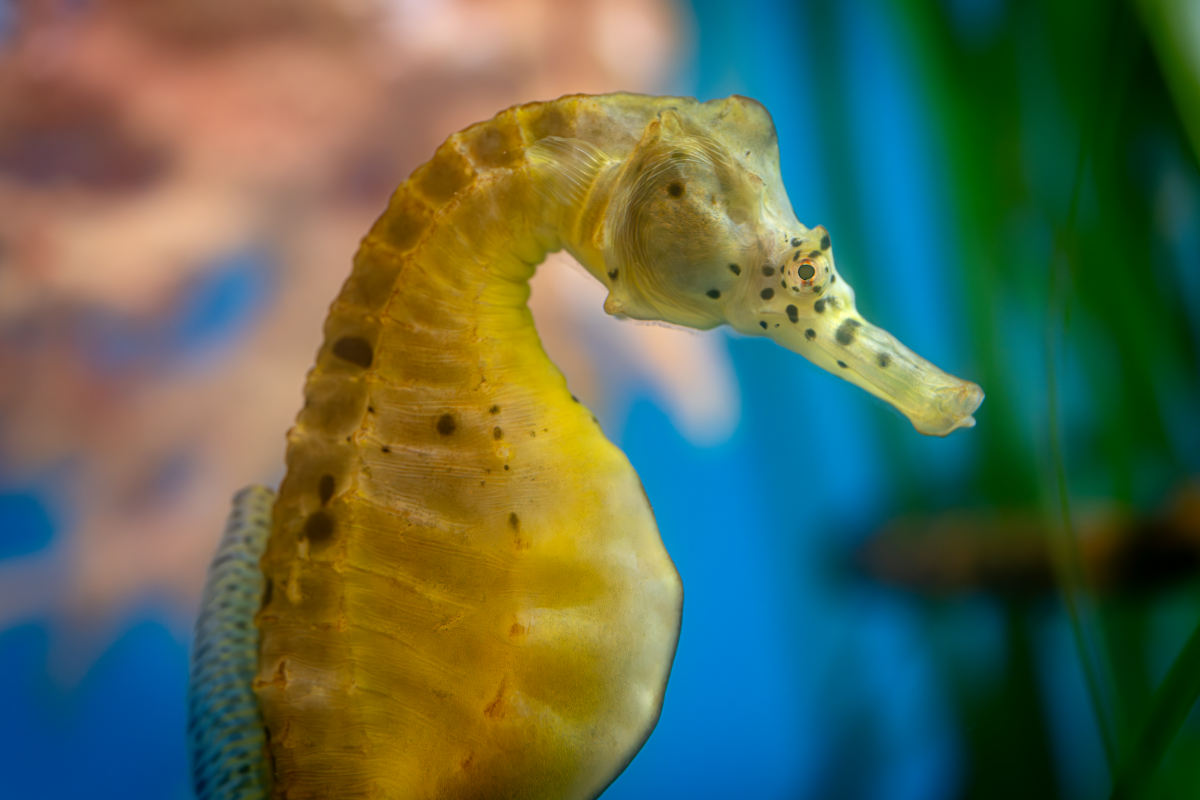
Ocean in Motion / La Danza del Mar opens November 7, 2026
The exhibit features an expanded African penguin habitat, big-bellied seahorses, and colorful coral reefs.
Read press release – Ocean in Motion / La Danza del Mar opens November 7, 2026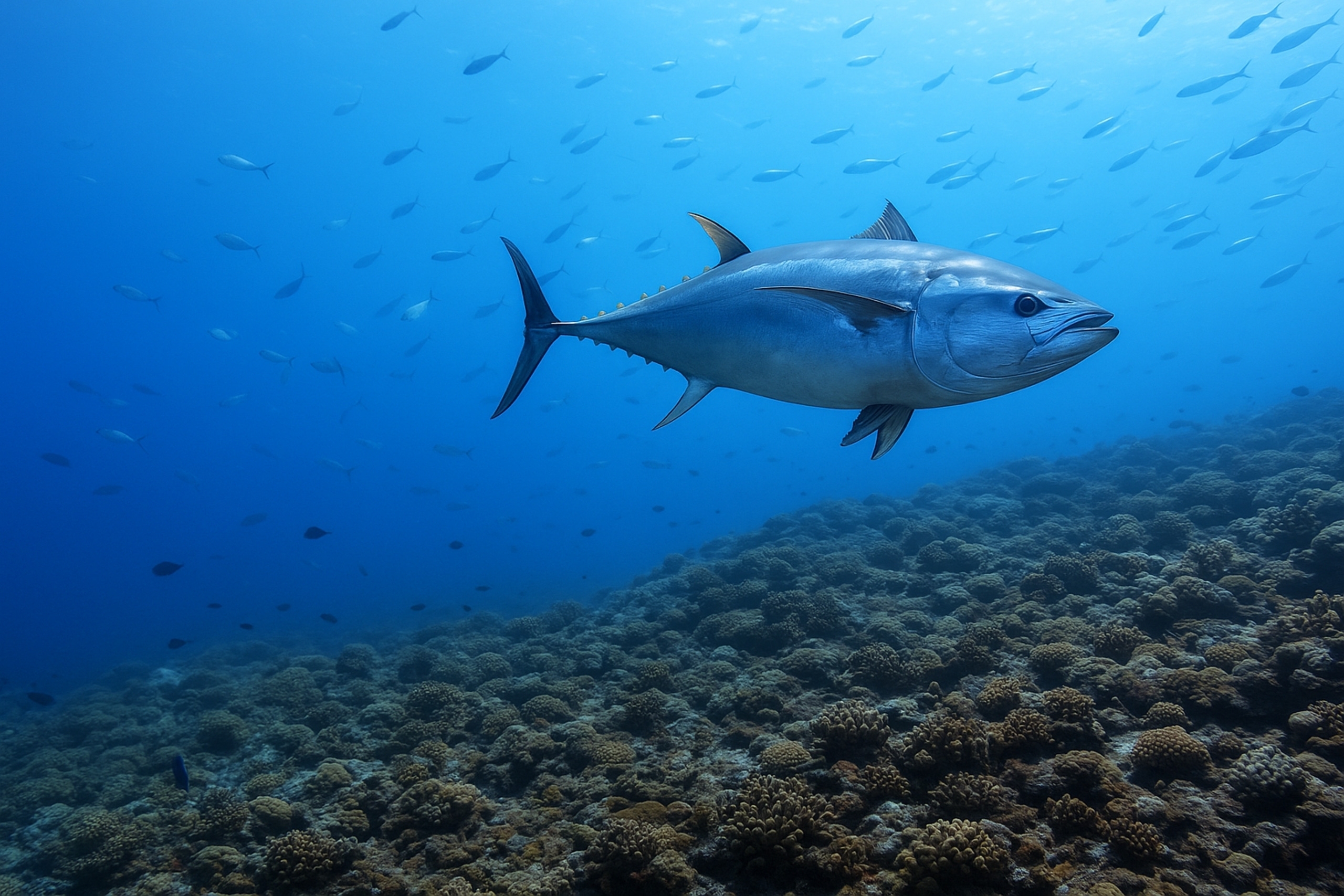
Statement
Nations advance landmark harvest strategy for Pacific bluefin tuna
Last-minute negotiations result in historic deal supporting science-based recovery.
Read statement – Nations advance landmark harvest strategy for Pacific bluefin tuna
Press release
Sandy Trautwein joins as Vice President of Animal Care
Trautwein joins the Aquarium beginning September 21, 2026, following a nationwide search.
Read press release – Sandy Trautwein joins as Vice President of Animal Care
Story
Reducing plastic packaging: How partnerships help keep plastic out of the ocean
We work with partners to reimagine processes and packaging to reduce ocean-bound plastic and protect ocean…
Read story – Reducing plastic packaging: How partnerships help keep plastic out of the ocean