

Pitter, patter, pitter, patter…
I woke up to a rainy, foggy, and cold August morning. As I rolled out of bed to get my dive gear ready, I rushed to check my email, hoping that the morning’s dive training had been canceled.
Yeah right, a little rain and cold temps don’t stop these Monterey divers.
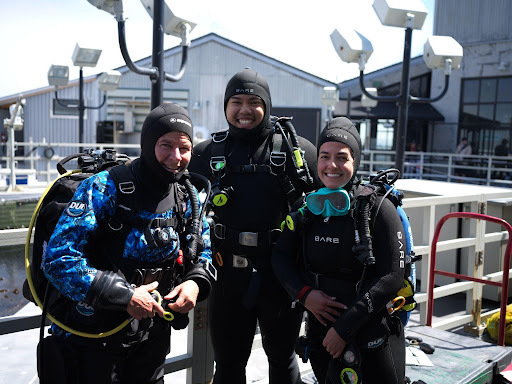
Staff and researchers at the top of the Kelp Forest exhibit completing their rescue scuba dive qualification at the Aquarium
Diving in
I was deep into a rigorous rescue diver training program at Monterey Bay Aquarium, and the foggy, cold mornings were not something I was jumping for joy about, as a scuba diver used to warm tropical diving!
As an employee on the Aquarium’s Marketing team, I knew that earning my staff diver qualification would open new avenues to capture immersive, behind-the-glass content of our exhibits. I was motivated and excited to give our online audiences an up-close and personal look at our resident animals and their personalities, offering new opportunities to connect with the wonder of ocean life.
My love for the ocean
My love for the ocean started in middle school; we’d visit beaches along the Florida Gulf Coast, like Destin and Hilton Head, for spring break. I remember being mesmerized by the glass dolphin sculptures and paintings in the gift stores.
On one of those trips, we ran into an enormous 1,400-ft-long whale mural along the streets of Destin called 'Marine Life of the Gulf.' The artist just so happened to be the same one who made the sculptures and paintings I loved so much, Robert Wyland.
I never realized how much those Florida coast trips influenced my path in life and how Wyland piqued my curiosity to explore the ocean and find those angelic creatures.
Later in life, I was home one summer from college when my mom brought me a documentary called The Cove. I was devastated yet inspired to do something about it, so I started speaking around my college campus, and later started a blog writing about environmental films that inspired me.
And so began my journey with ocean storytelling; I was fascinated with the power to make a difference for the ocean using my voice through film, photography, and writing.
New diver path
We certify four cohorts of people at the Aquarium: Staff, such as husbandry aquarists; volunteers who help us maintain our exhibits; Conservation and Science field divers who carry out scientific tasks in the field; and media divers who collect digital assets of our exhibit environments and document scientific diving in the field. All divers at the Aquarium are required to have a baseline of a recreational rescue certification, as well as pass the medical evaluations, complete online learning, and get trained up for their occupational tasks. It’s the Aquarium’s responsibility to make sure all divers meet the American Academy of Underwater Sciences (AAUS) Standards for Scientific Diving Certification and Operation of Scientific Diving Programs, state and federal Occupational Safety and Health Administration (OSHA), World Recreational Scuba Diving Training Council (WRSTC), and the AZA Accreditation Commission.
To get trained up as a staff diver at the Monterey Bay Aquarium, I joined a cohort of aquarists and volunteers to get rescue dive certified. This involved months of strict training, evaluation, and hands-on experience.
First, I had to pass a medical evaluation, including blood work, X-rays, an EKG, and a spirometry test to make sure my lungs were dive-worthy.
Next, pool time!
Passing the swim evaluation wasn’t so nerve-racking since I grew up on the neighborhood swim team. Some swim tests I had to pass included:
- Swim underwater without swim aids for 25 yards without surfacing.
- Swim 400 yards in less than 12 minutes without swim aids.
- Tread water for 10 minutes, or 2 minutes without the use of hands, without swim aids.
- Transport another person of equal size 25 yards in the water, without the use of swim aids.
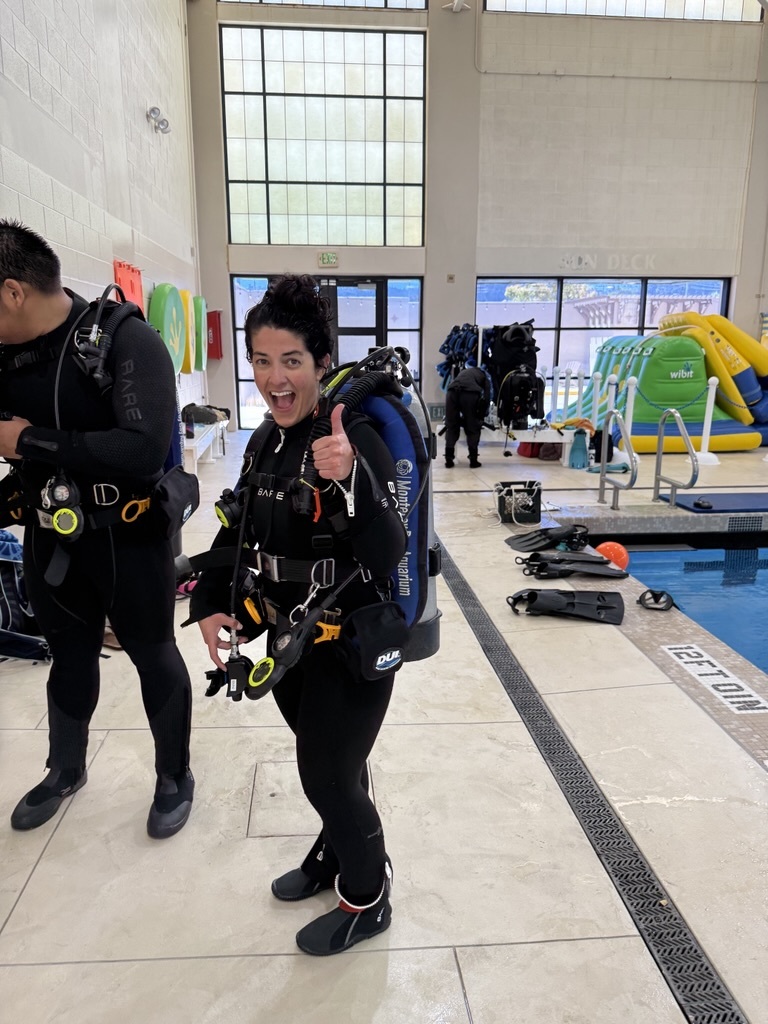
My dive buddy and I gearing up for our pool session at the Monterey Sport Center.
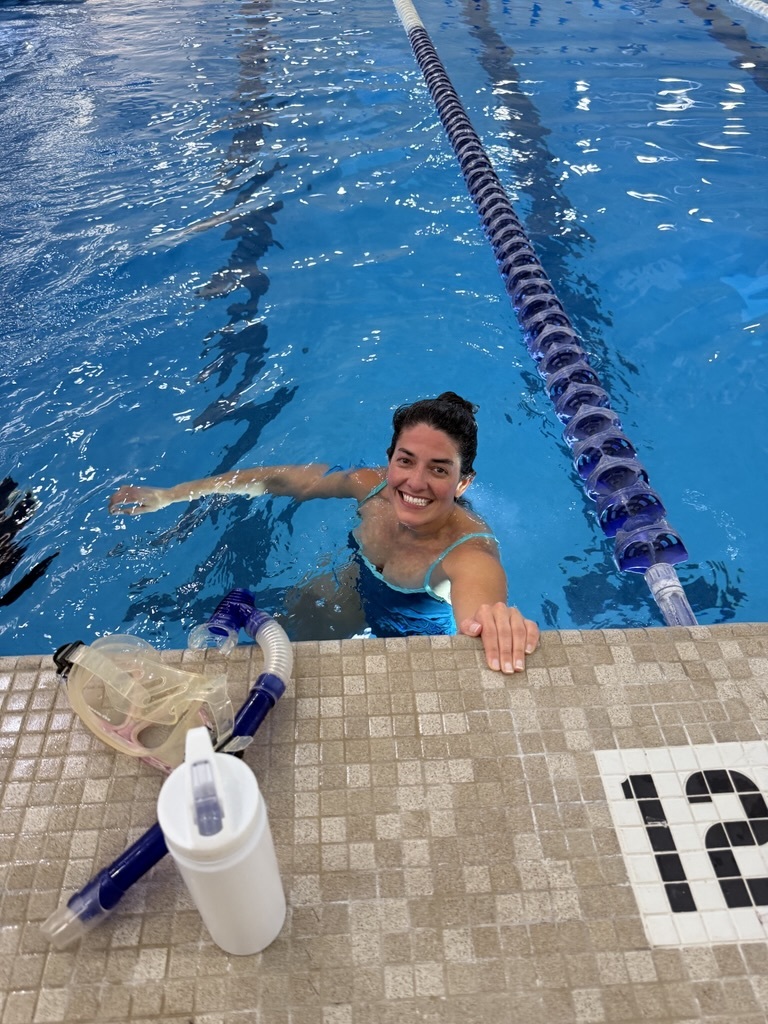
Many laps were swum to demonstrate our swimming abilities.
Then we took a First Aid certification course covering basic life support skills, emergency oxygen, CPR, and AED use. We also took online learning courses to get trained up on Monterey Bay Aquarium’s dive fundamentals.
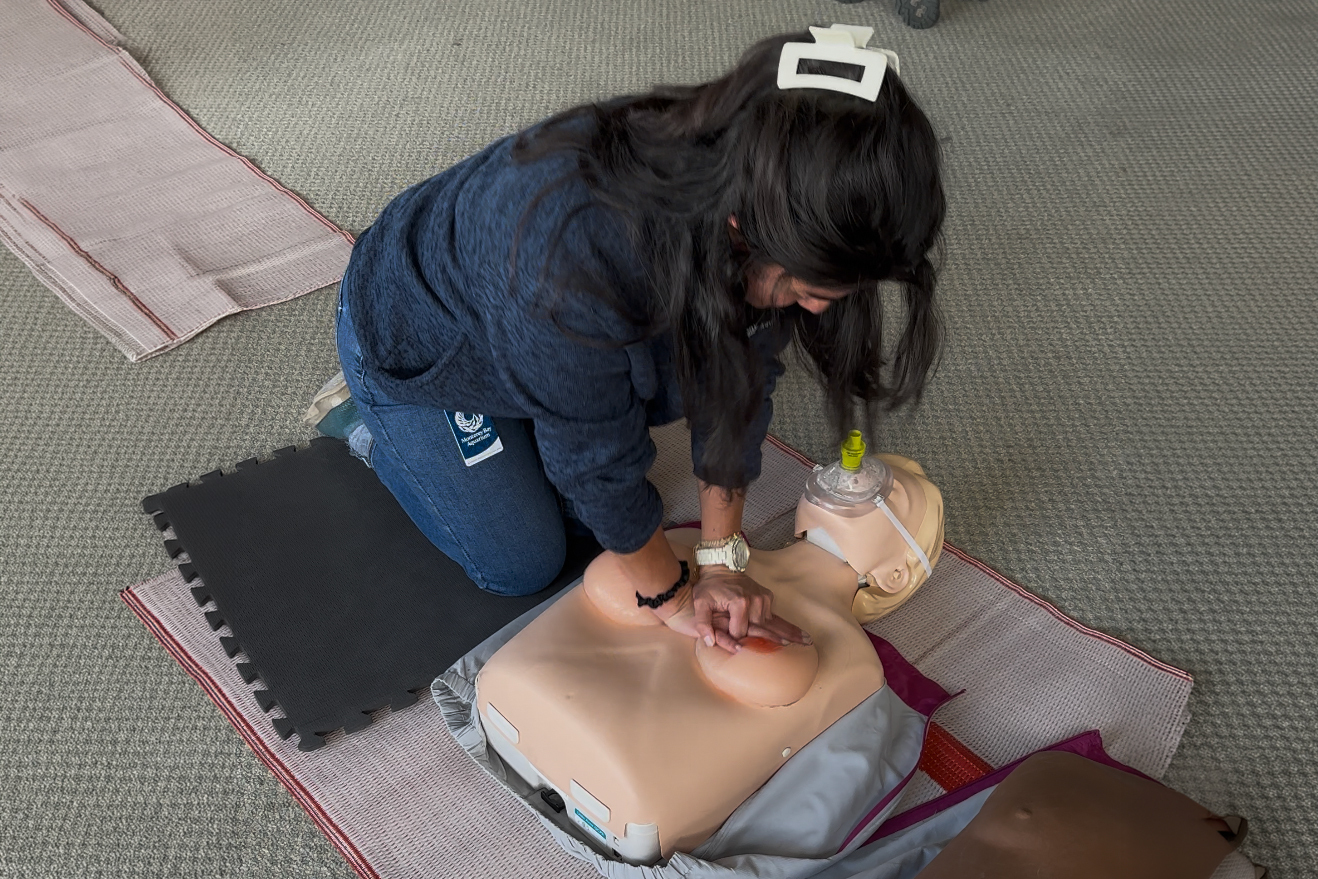
Here I am performing CPR on a mannequin to complete my First Aid certification.
The final, most difficult test was demonstrating all the rescue skills we learned, both in the open ocean and in our exhibits. Some of the crucial skills we needed to pass were:
- Assist a diver panicking at the surface.
- Assist an unconscious diver in the water, bringing them up to the surface, and getting them to a platform.
- Demonstrate a lost-diver search using a search pattern appropriate for the underwater environment and conditions.
- In full scuba gear, make an entry, swim a minimum of 21 yards (20 m) to the simulated victim; retrieve the victim from the bottom in 20 feet (6 m) to 30 feet (9 m) of water using a controlled ascent. Establish buoyancy, signal for help, and remove gear as necessary while transporting the victim to an exit.
During one of my training dives in the Monterey Bay Habitats exhibit, I swam around the hourglass-shaped exhibit, noticing children on the outside looking in with big smiles as they waved and laughed at our bubbles surrounding the animals swimming past us. I waved back and initiated high-fives through the glass; the kids were eager to press their hands up to us. Experiences like these, small moments of connection with children, are what give me the energy and passion to keep doing what I’m doing, inspiring conservation of the ocean for our future generations.
Diving in the underwater forest
After months of training, I finally passed and officially became a Monterey Bay Aquarium staff diver!
As I dropped below the surface of the Kelp Forest exhibit for the first time, I felt the chilly, 50-degree water begin to soak through the neoprene layers of my wetsuit. A silvery, slender leopard shark cruised right past me, and colorful fish drifted through the water peacefully, weaving in and out of the swaying kelp fronds.
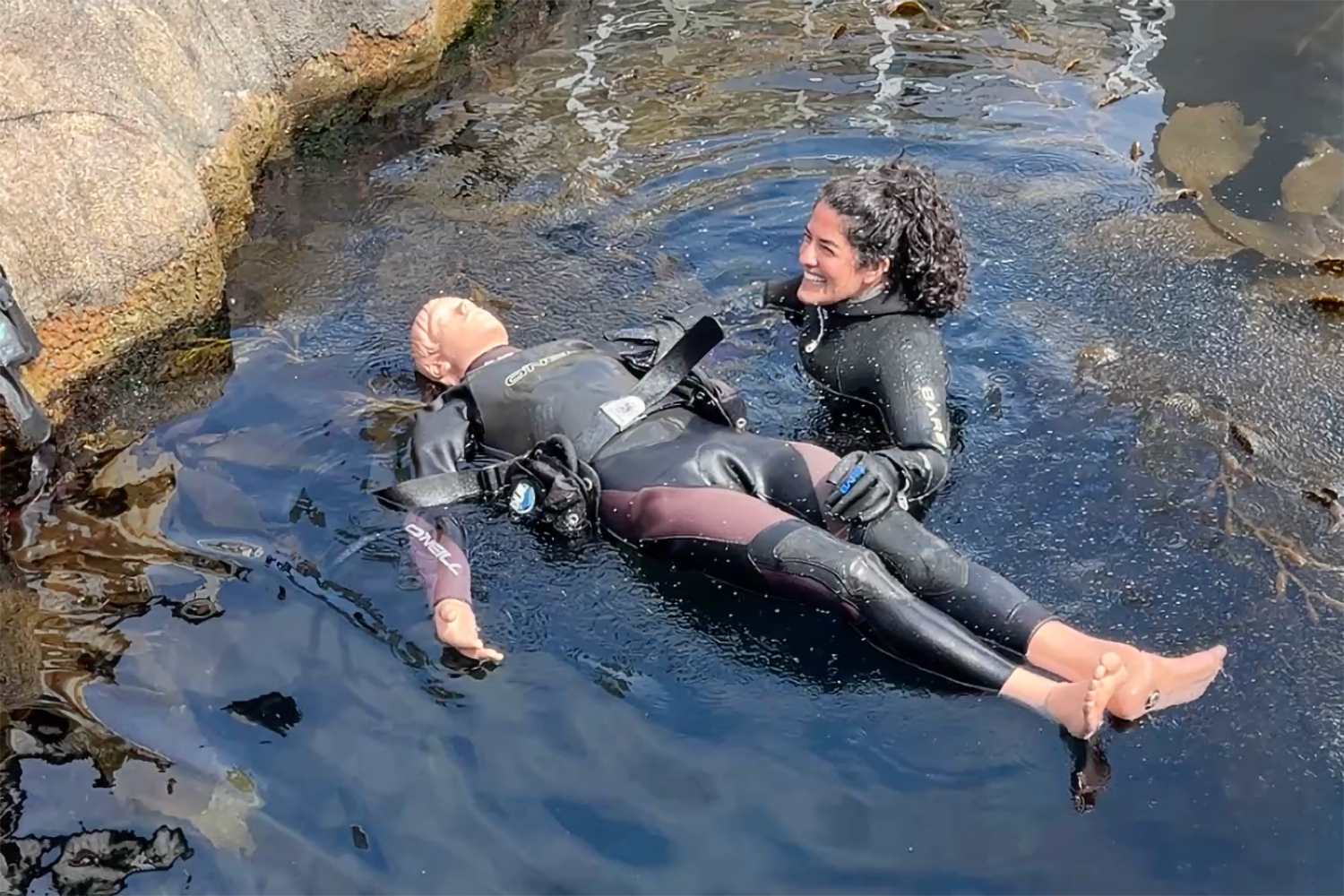
Diver training in the Kelp Forest exhibit using a mannequin.
My fins caught the kelp blades, but I stayed calm, remembered my training, and slowly untangled myself, detangling one kelp frond at a time.
Once I reached the bottom of the 28-foot exhibit, I looked up and admired the golden sunlight piercing through the kelp. The thick canopy surrounding me reminded me of a colorful mosaic of an underwater kelp cathedral. The moment was completely peaceful yet dramatic, magical, and emotional all at once.
Submerging into the Kelp Forest exhibit felt surreal. I wasn’t creating content from the outside anymore; I was now on the inside of the glass, one with the animals and kelp.
The goal of earning my staff diver qualification is to capture fun and unique content from behind the glass, giving our digital audiences an inside peek into our exhibits!
Check out this video I captured of my first Kelp Forest feeding dive, featuring our volunteers and how they feed our Kelp Forest friends twice a day!
Keep Exploring
Watch these YouTube videos for more on scuba diving at the Aquarium!

