

On a beautiful sunny day at Elkhorn Slough, Lilianna walks into MBARI (Monterey Bay Aquarium Research Institute) conference room wearing a blue and white skirt that mimics the patterns of ocean waves. At the back of the room a wall of windows offer a panoramic view overlooking the ocean and the Monterey submarine canyon.
The canyon is a mile deep within Monterey Bay but more than two miles deep farther offshore, making it the deepest submarine canyon on the West Coast. Here lives a diverse and fascinating array of deep-sea animals, including the bloody-belly comb jelly and the crystal amphipod.
Beyond the conference room windows, the rhythmic thumping of the crashing waves creates an audible connection between the room and the ocean outside. Lilianna walks to the podium and begins to tell a story that reveals surprising connections between the residents of the deep sea and us humans.
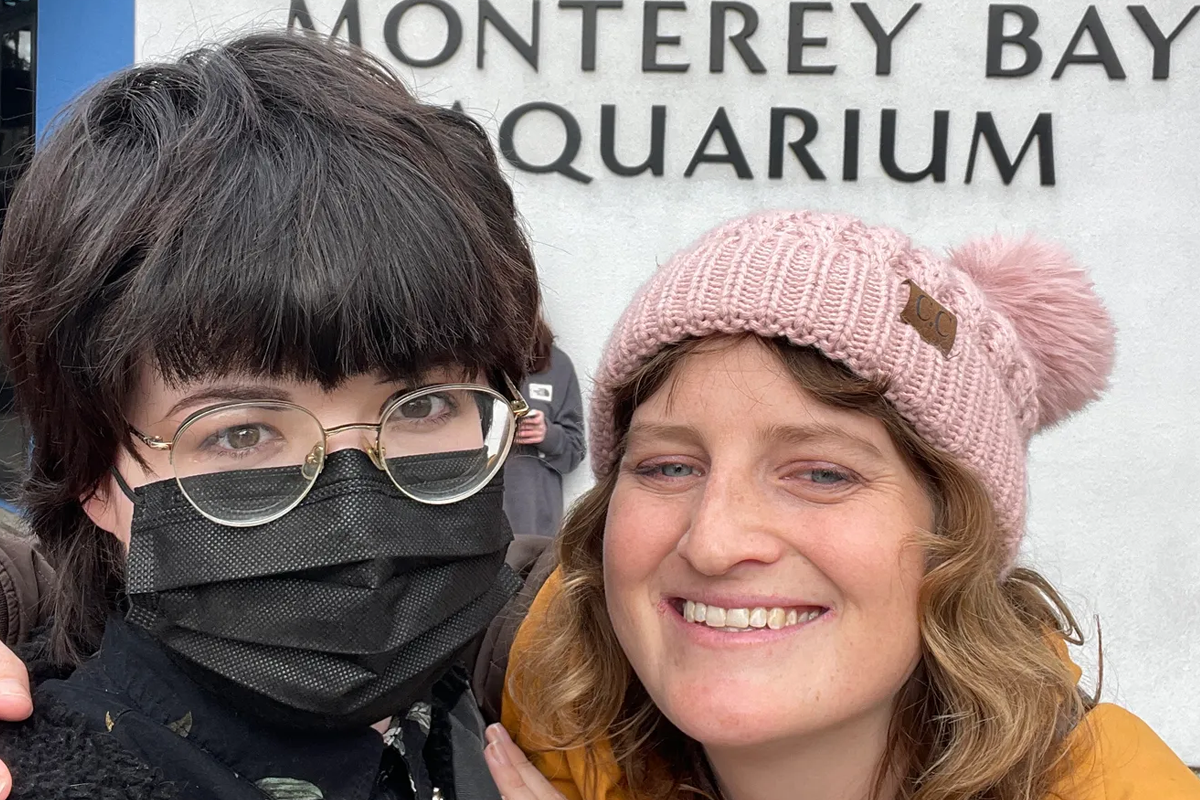
Lilianna (right) and her girlfriend, Allison (left), on a date at Monterey Bay Aquarium.
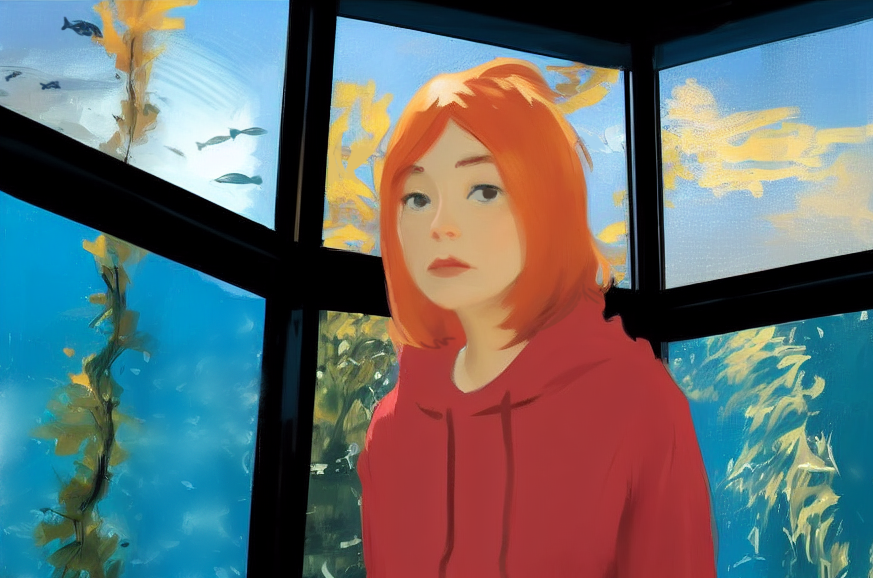
A panel from Swim Down, a digital graphic novel where a neurodivergent teenager named Mari visits Monterey Bay Aquarium during a school field trip.
© Liliana Watson
Lilianna is a graduate of a novel program at Scripps Institution of Oceanography: the Masters of Advanced Studies in Marine Biodiversity and Conservation. She's passionate about using storytelling to engage people with ocean conservation. As an individual on the autism spectrum, Lilianna doesn't shy away from sharing how this unique perspective influences the way she interacts with the world. For her capstone project at Scripps, Lilianna explored the parallels between neurodivergent experiences and deep-sea animals through a digital graphic novel called Swim Down.
The story follows the journey of a neurodivergent teenager named Mari on a school field trip to the Aquarium. While exploring the Aquarium, Mari is separated from the rest of her classmates. When Mari's teacher finds her, she approaches in distress and grabs Mari's hand. The unwanted physical touch is a triggering experience for Mari and she screams out in pain. However, soon Mari is immersed in the blurry line between humans and the deep-sea world.
First, she meets the Dall's porpoise, whose sensitive hearing and echolocation parallels Mari’s sensitivity to noise on land. Farther down, Mari meets the crystal amphipod. These creatures have specialized eyes that take in many visual stimuli at once—corresponding with Mari’s overwhelm in bright light and busy spaces. As she swims down farther into the Monterey submarine canyon, Mari meets more animals of the deep sea and connects with their unique abilities and adaptations to their environment.
We asked Lilianna to join us and share her own story, her process for creating Swim Down, and how she advocates for the denizens of the deep sea.
Related videos
Watch Swim Down
Question: Tell us about yourself through a favorite memory of visiting the Aquarium.
Answer: My first visit to the Aquarium was in the ‘90s. As a little child, I remember looking up at the Kelp Forest and everything seemed so tall. I felt like I was at the bottom of the ocean. The swaying kelp was mesmerizing and my friend and I would lie on the ground and look up at the kelp forest. I remember the soft lighting and ambient music helped me find a state of relaxation. I have a busy mind so it helps to go back to the relaxation techniques I learned at the Aquarium.
I enjoy getting to explain complicated topics like climate change and deep-sea animals in a way that is more digestible. I want my work to help policymakers with key decisions and be a point of connection for people everywhere.
Lilianna Watson
Q: From an undergraduate degree in English to a masters in oceanography, your journey has been one of connecting passions and skills. How did it all come together?
A: I enjoy talking about this. It all goes back to when my grandfather did contract work with Scripps through the U.S. Navy. He would bring back various things with him and make mosaics out of them. So I grew up with examples of how science and art intersect. I often passed by Scripps, too, and knew I wanted to go there someday.
As I grew older, it became evident that my English was very good but I was struggling in science and math. Looking back though, it wasn’t that I was particularly bad at science. The failure was in the people who didn’t explain the concepts to me in a way that I would understand and expected me to “do it”. So, with the encouragement of my family, I put my focus on English and got accepted at NYU. I did really well in my degree, all the while losing my connection to science.
To everyone’s surprise, I landed a communications job at a financial services company. I would take scientific writings and translate them into something more tangible to our targeted audience. When the pandemic hit, I moved back to San Diego and worked remotely for a few years. That was a catalyst for me to apply to grad school. I knew deep in my heart that I wanted to go into the path of science communication. The connections and experiences I had at Scripps helped me see that future for myself.
Q: How did you land on Swim Down as your capstone project?
A: While I was at Scripps, I was connected with Susan von Thun, the science communication and content manager at MBARI. She told me that in today's videocentric society, you need to differentiate yourself to get peoples' attention. I knew that I had to expand my writing skills to something more palatable for today's audience.
I knew I wanted to write about the connection between autism and the deep sea. I personally find comfort in the physical feeling of being pushed down in a sensory sense—it’s actually one of the things I like about scuba diving. Autistic people often have a special interest in something and mine is jellyfish. So I combined these and Susan’s guidance and began taking various electives while at grad school, including one on video production. From there, the story was developed. Soon I was connected with scientific illustrator Freya Hammar who illustrated each panel of Swim Down based on my storyboard sketches.
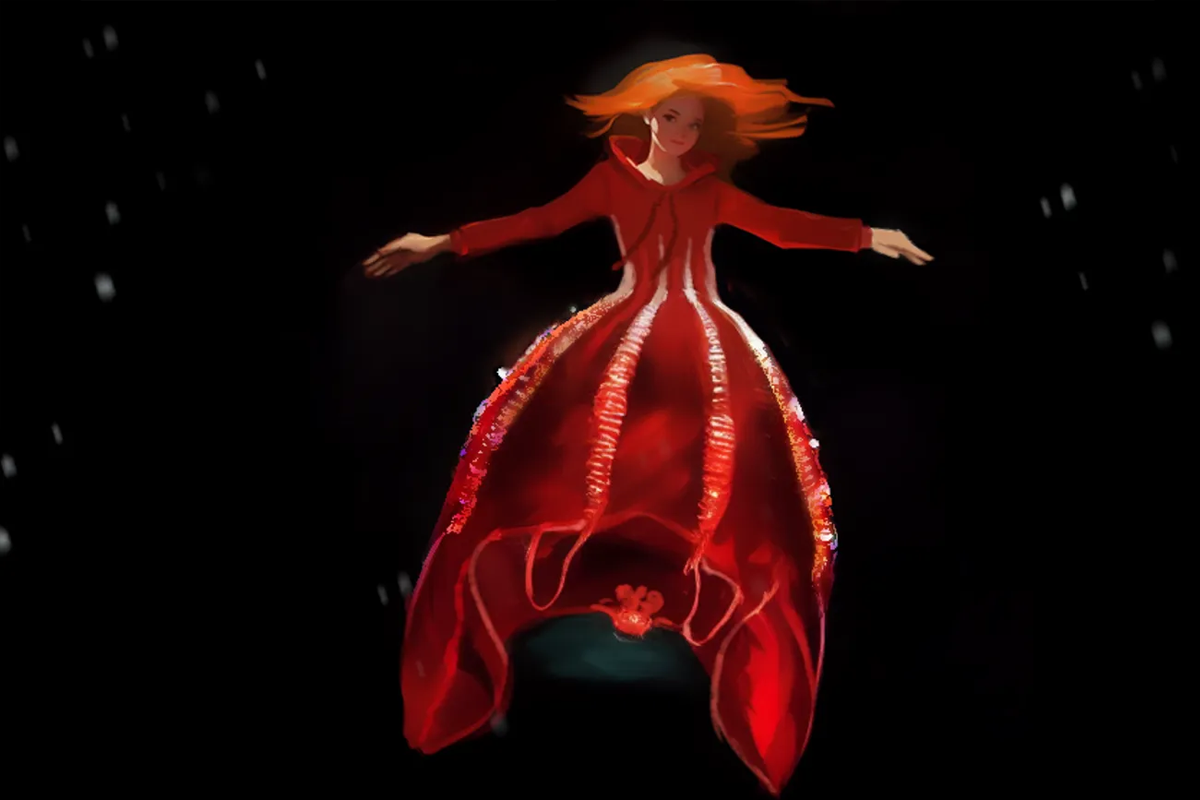
A panel from Swim Down where Mari feels connected with the gelatinous body of the bloody-belly comb jelly. Illustrated by Freya Hammer.
© Liliana Watson
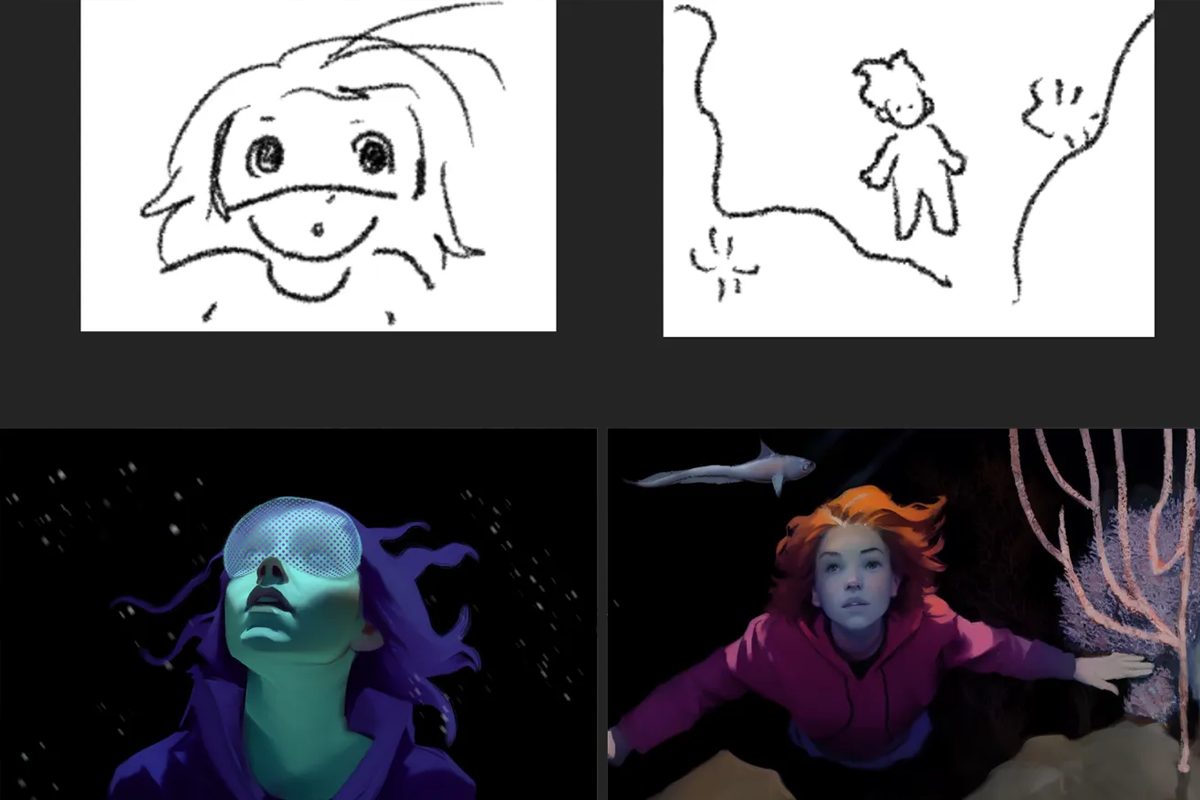
Lilianna collaborated with scientific illustrator Freya Hammar to bring Lilianna's storyboards to life through full-color illustrations.
Q: How did you go about choosing the highlighted animals in the graphic novel?
A: One of my favorite parts of this project was figuring out how to take the scientific research that I was doing on deep-sea animals and incorporate it into the story. My committee suggested I choose one creature for each sensory experience that I wanted to explore. After touring MBARI and visiting the Aquarium, I decided to keep the range to the inhabitants of the Monterey submarine canyon.
I wanted the story to start closer to shore with a charismatic animal that everyone could relate to. From there, Mari would dive into the depths of the Monterey Canyon and see animals that can often be misunderstood. That’s how I landed on the Dall’s porpoise as the first animal, and then gradually introduced other animals such as the crystal amphipod. During my trip to the Aquarium, it was so amazing getting to see the bloody-belly comb jelly. I knew that I had to incorporate the jelly and MBARI's remotely operated vehicle in the story. It made sense to me to connect the bloody-belly comb jelly's fragile gelatinous body to Mari's sensitive skin.
Q: What kind of challenges and opportunities were you expecting to come across?
A: I was concerned about how this project would be perceived by the scientific community as well as the neurodivergent community. It ended up not being a problem at all. Every deep-sea scientist I’ve talked to has been very supportive. It was so valuable for me to get to know George Matsumoto, the scientist at MBARI who identified and named my favorite deep-sea jelly—the bloody-belly comb jelly. He worked with me to organize the seminar at MBARI, and he was also sitting there right by the podium as I presented my work. It was an amazing experience.
I also received positive feedback from neurodivergent and neurotypical people alike. I’ve had parents of neurodivergent kids come to me and say they would like to share this story with their children. I got to present an early stage of my project on Ocean Day at the State Capitol, during a competition event called Shark Tank of Science Communication. My project won first prize and someone approached me after a presentation and said, “I never told anyone at work that I have ADHD because I was worried that I would be treated differently. This story makes me want to be open about that now.”
Overall, I wanted to center deep-sea animals' increased sensitivity as a positive form of adaptation in water. In the same way, increased sensitivities of neurodivergent people should be seen as an alternative way to adapt to various environments—as opposed to a hindrance.
Lilianna Watson
Q: What would you say to folks who are passionate about ocean conservation but worry that not having a background in ocean sciences would keep them from entering the field?
A: There was a period after college where I didn’t know what I wanted to do. I felt like I didn’t have the skills I needed to engage in the issues that mattered to me. Yet I kept the dream of being in the field of ocean conservation close to my heart. When deciding between an opportunity that is safe versus one that means a lot to you but feels risky—because you don’t have the background or don’t feel like you’re good enough—I’d say take the risk every time. Put yourself out there and know that it will make you stronger. I say this especially to people who are neurodivergent, because your story and presence is important in every space.
Q: What’s the next step for you?
A: I’m planning to get Swim Down published so that we can share the story with a larger audience. Meanwhile, I am excited to join the Aquarium's Marketing department as a Senior Content Creator.
Keep exploring
Story
Nature is queer
We’re excited to sea-lebrate the queerness of nature!
Read story – Nature is queer
Story
Q&A: Julie Packard and Dr. Jenny Gray
Get to know incoming Chief Executive Officer Jenny Gray in this Q&A with Julie Packard.
Read the Q&A – Q&A: Julie Packard and Dr. Jenny Gray
Story
Elevating Black voices in ocean science and conservation
Why representation in ocean science matters.
Read story – Elevating Black voices in ocean science and conservation