

Swimming. Darting. Dashing. Hunting. Penguins feeding in the water are an exhilarating sight! More importantly, swim time is critical to the health of these seabirds.
A few years ago, we transitioned from only hand feeding our African penguins on land to broadcast feeding, or throwing their food out into the water during our daily public penguin programs. Not only does encouraging more water time improve the welfare of our colony, it’s more fun for our guests and Penguin Cam viewers to watch. Most of the birds made a smooth transition to the new broadcast feeding strategy. However, one penguin helped remind us of the resilience of animals, the importance of keeping an open mind and the power of positive reinforcement.
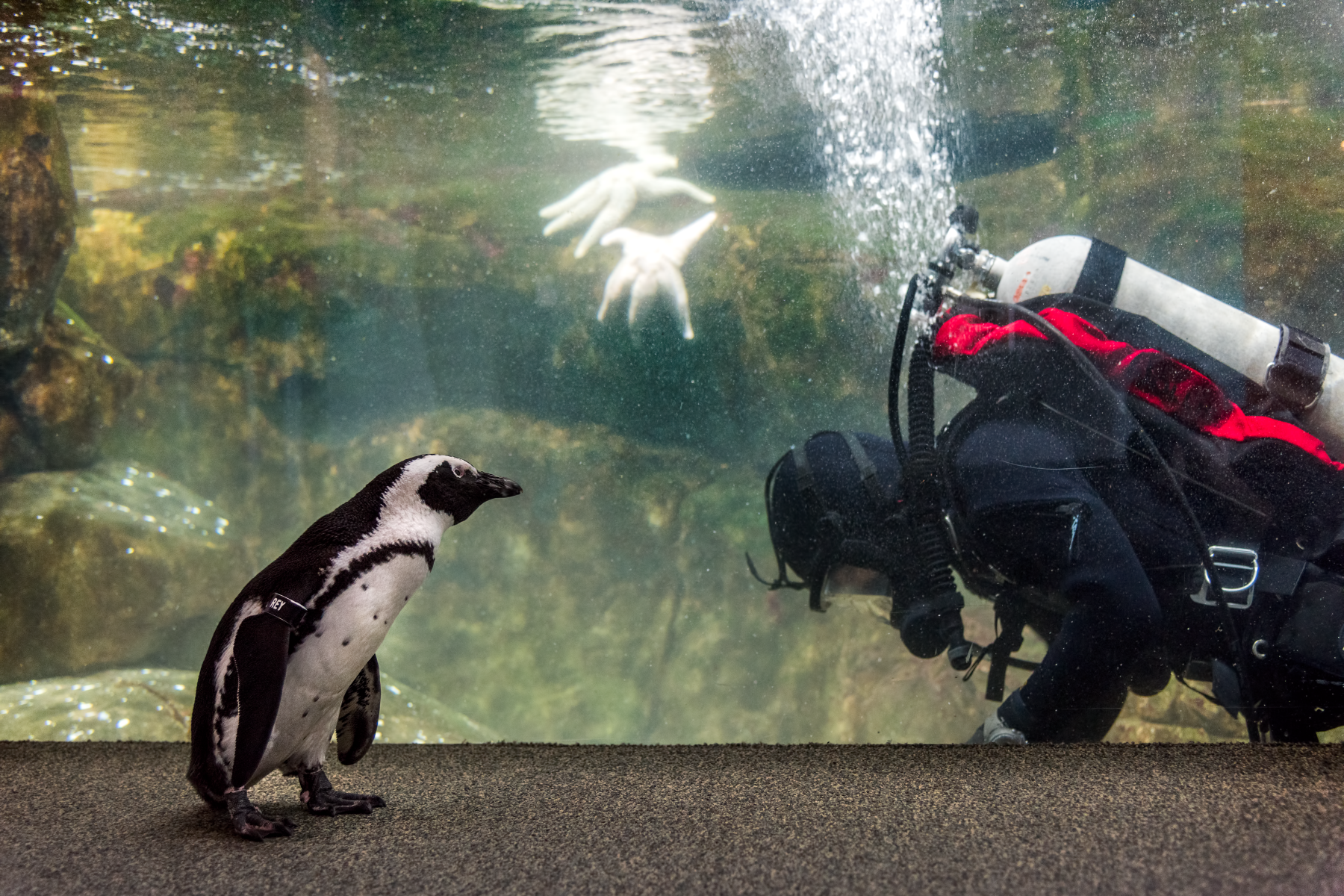
Meet Rey
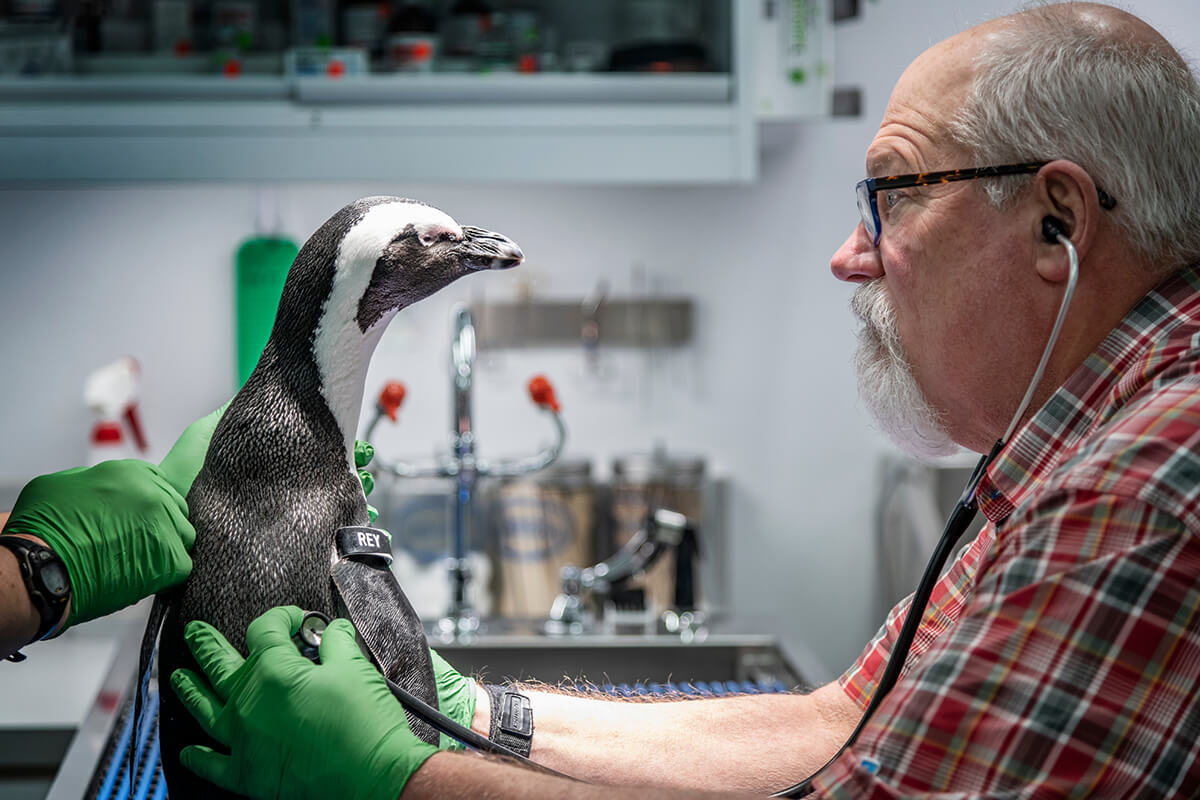
Rey hatched at the Monterey Bay Aquarium on June 4, 2014. Shortly after hatching, she was diagnosed with congenital cataracts. Rey had some function in her left eye but was blind in her right eye. In June 2016, Rey was taken to the University of California Davis for cataract removal surgery. While sight in her left eye was improved by the procedure, she still had some vision impairment.
Rey’s vision affected how she lived on exhibit. Throughout the diagnosis and treatment process, Rey came to associate with people more than penguins because of all the extra hands-on care she needed. (She is a special friend to our veterinarian, Dr. Mike). She seemed timid around the other birds and reticent to explore parts of the exhibit, including the water.
We treated Rey differently from the other penguins when we assumed she needed more from us than they did. For example, since Rey seemed uneasy swimming, we only fed her on land, even as we began transitioning the rest of the colony to in-water feeds during our penguin programs.
A new perception
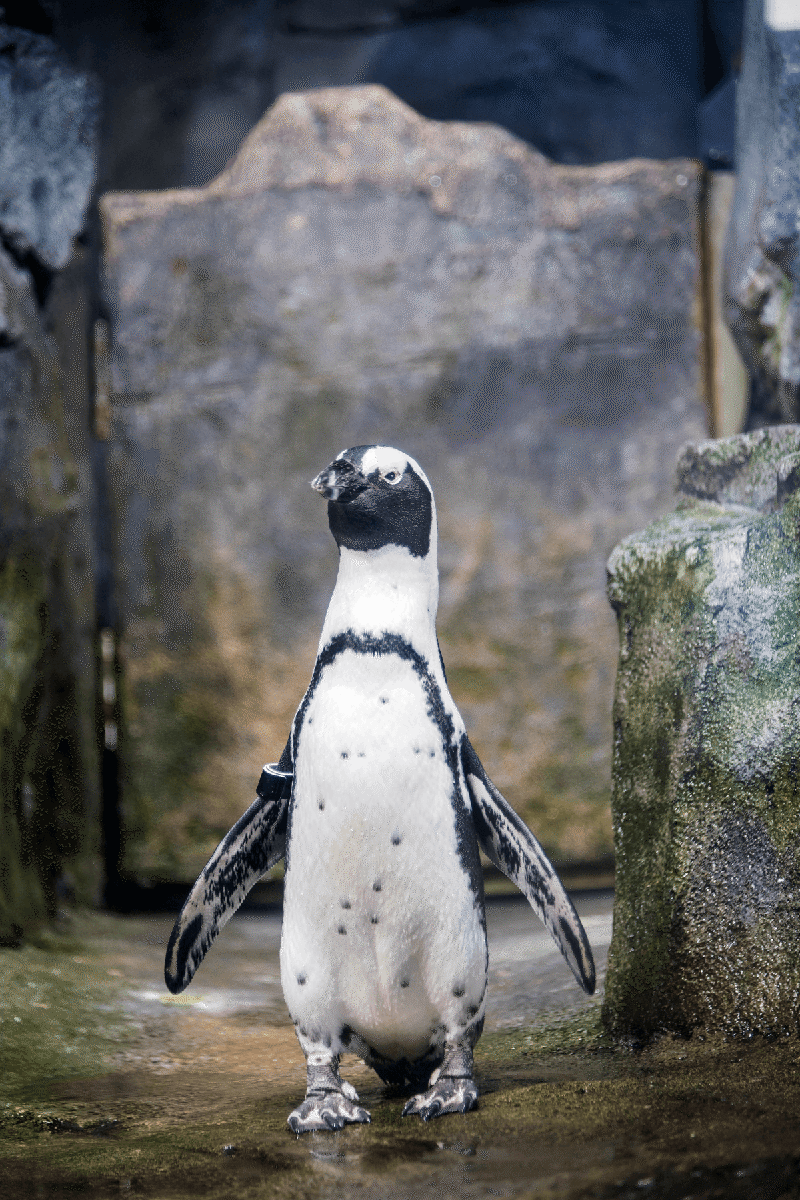
After her surgery, Rey still associated strongly with people, but her demeanor around the rest of the penguins changed. She seemed more confident on exhibit, exploring places she wouldn’t go before. Her vocalizations had more oomph behind them, and she began defending herself against other birds if they got too close.
This led us to reevaluate our approach. Did Rey really need to be cared for differently? We challenged ourselves to adjust our perception of Rey’s abilities and to use a technique called operant conditioning to teach her skills she would need to better integrate into the colony.
We made a conscious effort to make being on exhibit extra fun for her. We began bringing her out for training sessions with other penguins rather than working with her by herself to grow her confidence around the other birds.
Rey proved to be a ready participant in training sessions and a quick learner.
Our biggest goal, though, was to teach Rey to eat comfortably in the water with the rest of the colony during penguin programs. We had to change our mindset from “Rey doesn’t eat in the water” to “Rey doesn’t eat in the water yet!”
It was still important to recognize Rey’s individual needs. Since she can’t see the fish well enough to dive and compete with the other penguins for food, we came up with a modified feeding plan that we thought would work for her. We would teach Rey to go to a spot in the water near the rest of the swimming birds and hand feed.
Diving in
We started by making the pool a fun and positive place for her. While in the pool for daily cleaning, staff and volunteers began purposely playing with Rey and offering food anytime she got in the water. Over the next two weeks, Rey’s comfort level increased dramatically, and she came into the water more and more to interact with us.
We then started pairing a cue to enter the pool every time Rey got in the water during cleaning. Within a week, Rey entered the pool on cue readily, so we moved to asking her in during scheduled feeds.
During the feedings, one staff member fed the rest of the colony while another got in the pool on the other side of the exhibit and focused on Rey. Rey responded to her water cue well, so at each subsequent feeding we asked her to get in the water a little closer to the other feeding birds. Within a few feeds, Rey was already a third of the way toward the group! She had quickly progressed to the next phase of the training — being asked to get in the pool by a staff member on land. On the very first cue from land, Rey jumped in the water!
Soon Rey was getting in the water on her own with the entire colony feeding around her. Thank goodness there was a pane of glass between Rey’s trainers and the public because the joyous shrieks would have been heard across the Aquarium!
Rey for the peng-win
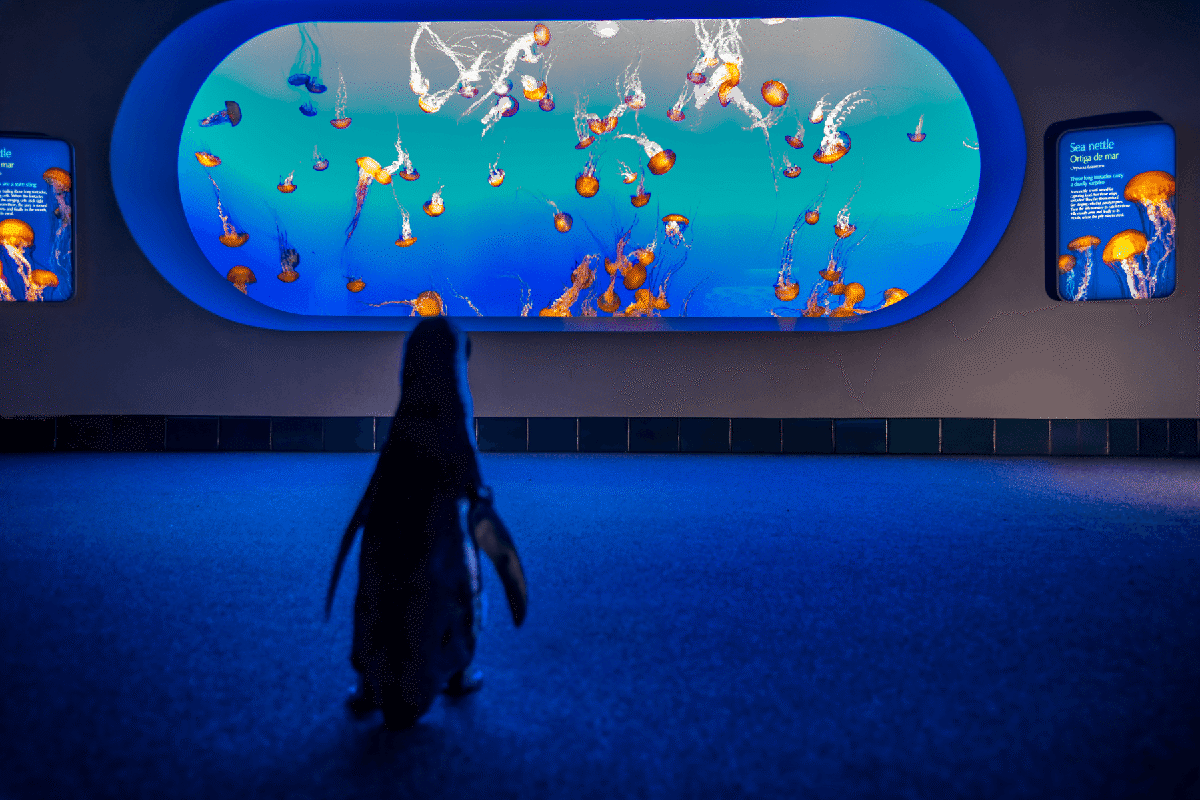
Rey now readily participates in water feeds with the other birds, going in the water for hand feeding both on her own and on cue. She is also an active participant in crate training and “penguin parade” training, even with other penguins around.
Looking back, we realize we should never have underestimated this penguin because she can do what other penguins do, just in a slightly modified way.
Focusing on her potential allowed us to use the foundations of behavioral science to improve Rey’s overall welfare. Her success has been an inspiration for us to look at our entire avian collection and ask ourselves if there are other ways we can use operant conditioning to continue to improve the welfare of our birds. All it takes is a mindset shift and the power of positive reinforcement to provide our animals more opportunities to live the most natural, well-adjusted lives possible.
Keep exploring
Story
Nature is queer
We’re excited to sea-lebrate the queerness of nature!
Read story – Nature is queer
Story
2026 Lucile S. Packard Memorial Award and Youth Award recipients
We’re proud to announce the 2026 Lucile S. Packard Memorial and Youth Awards for outstanding volunteers!
Read story – 2026 Lucile S. Packard Memorial Award and Youth Award recipients
Story
Elevating Black voices in ocean science and conservation
Why representation in ocean science matters.
Read story – Elevating Black voices in ocean science and conservation