

Our deep sea exhibit, Into the Deep/En lo Profundo, brings guests face-to-face with inhabitants of the ocean’s deep. Today, thanks to advances in collection methods, culturing, and animal care, we’re making what was once a dream a reality. Many of the gelatinous animals we’ve featured in our midwater gallery—including bloody-belly comb jellies, barrel amphipods, and common siphonophores—are among the first ever to be displayed for the public.
The journey to achieving these milestones wasn’t always clear or easy. In fact, had it not been for the groundbreaking, innovative work of our Jellies Team, we wouldn’t have the deep sea exhibit we have today. The success of the wondrous exhibits of midwater inhabitants comes from the years-long journey of raising comb jellies, or ctenophores, at the Monterey Bay Aquarium.
Our story begins with the sea walnut (Mnemiopsis leidyi), also known as the warty comb jelly. As these common names suggest, it resembles a bumpy walnut with its two large, transparent lobes fanning outward. We started working with this animal in 2010 in preparation for the Jellies Experience exhibition.
Mnemiopis was the start, the origin, that framed all our work. That work, even though it wasn't 100 percent new, we took it to another level.
Tommy KnowlesSenior Biologist
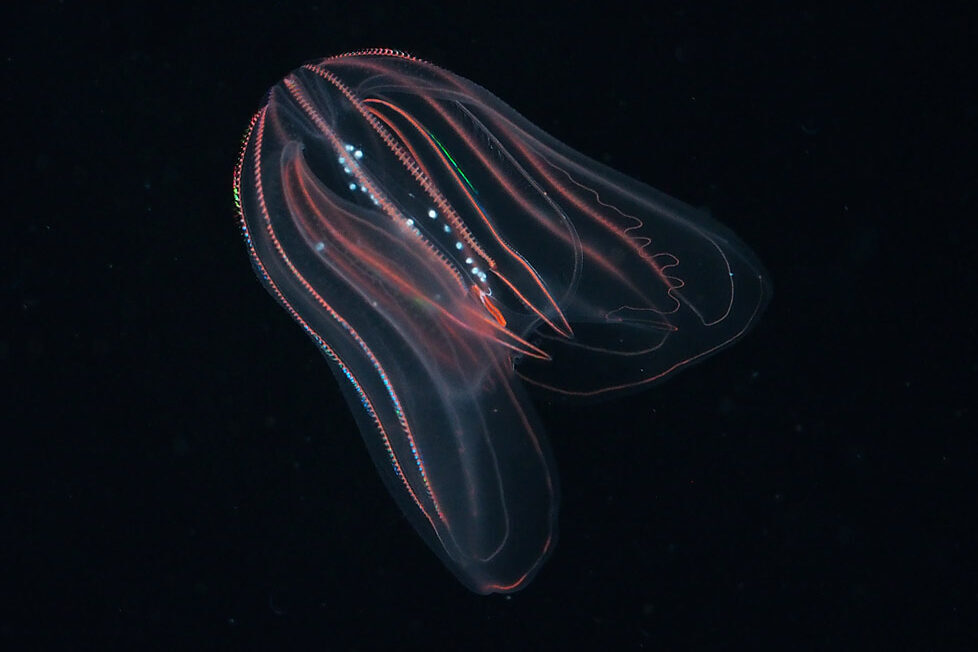
The sea walnut or warty comb jelly (Mnemiopsis leidyi) was the first species of ctenophore the Jellies Team attempted to culture. Photo © Charlene Boarts.
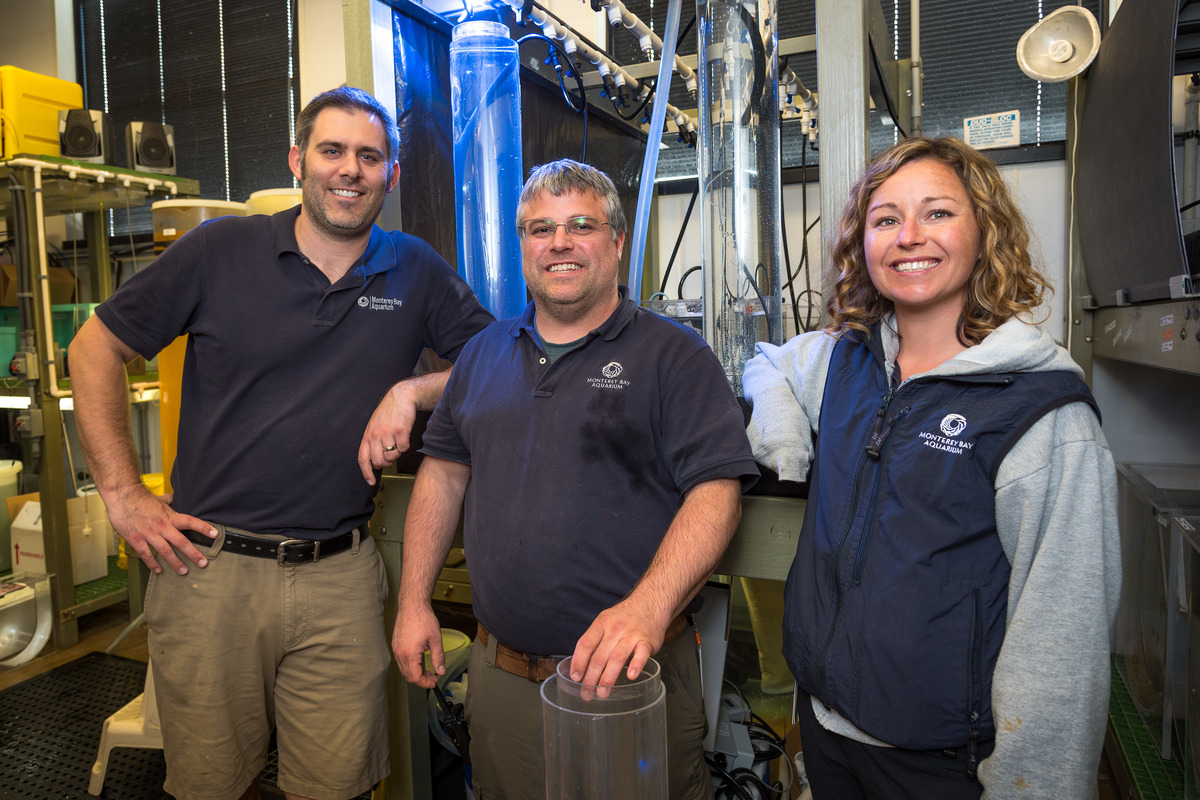
Members of the Jellies Team, from left to right: Senior Biologists Wyatt Patry and Tommy Knowles and Senior Aquarist MacKenzie Bubel
The challenges of raising comb jellies
Tucked away behind the scenes of the Open Sea galleries, the Jellies Team meticulously sorts out tiny larvae among several shallow dishes of seawater. Housed in the Jelly Lab, the team is surrounded by dozens of bubbling tanks, tubes, and containers filled with all sorts of gelatinous life. Represented here by Senior Biologists Wyatt Patry and Tommy Knowles, and Senior Aquarist MacKenzie Bubel, the team is responsible for raising over 50 different jelly (scyphozoan and hydrozoan) species over the years. These are the typical jellies we think of when we hear the term “jellyfish”—with the large, round bells and long, frilly tentacles that can sting, belonging to the phylum Cnidaria.
Comb jellies, on the other hand, are completely different animals from the phylum Ctenophora. They just happen to be mostly gelatinous as well. Long considered in the aquarium world to be too delicate and difficult to culture, raising comb jellies was always the team’s dream. We’ve had mixed success over the years in displaying animals like the sea walnut. At first, we relied solely on collecting comb jellies from the wild, which can be a time-consuming and labor-intensive process. While displaying them was a true feat in itself (due to their delicate nature), we wanted to take the culturing process in-house to have a continuous and sustainable comb jelly collection.
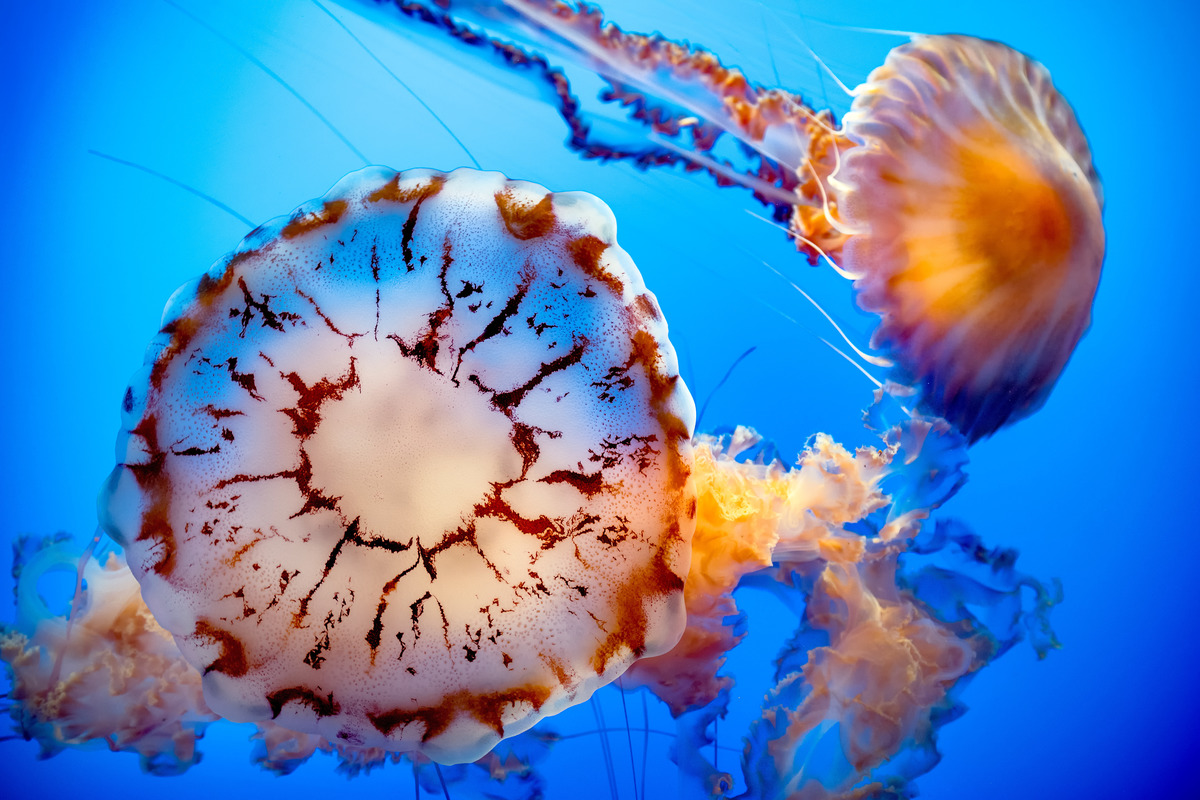
The Jellies Team has successfully cultured over 50 species of jellies—or "jellyfish" as they're commonly known as—like this purple-striped jelly (Chrysaora colorata) and black sea nettle (Chrysaora achlyos).
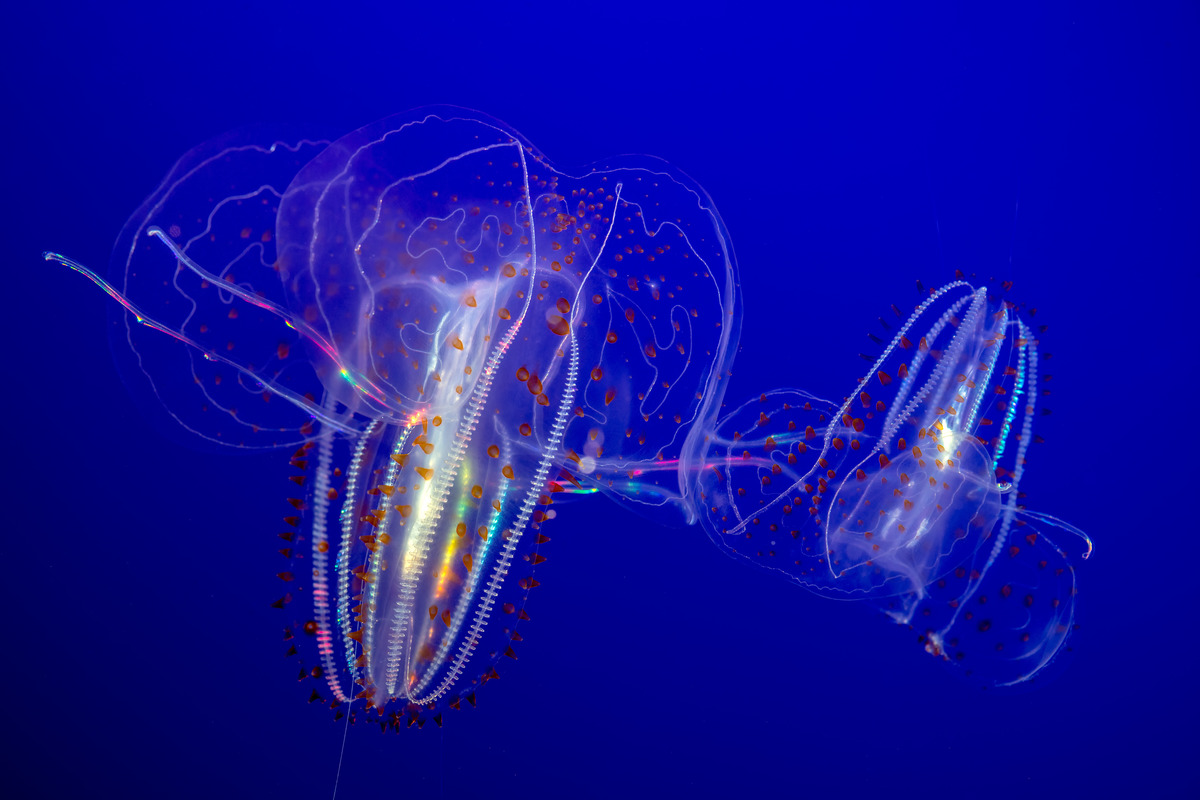
In the past, comb jellies, like these spotted comb jellies (Leucothea pulchra), were considered too delicate and difficult to raise for an aquarium.
What is culturing?
Culturing in an aquarium setting is being able to raise an animal through its entire life cycle—over and over again. If you start with the adult animal, can you get them to spawn? If so, can you then raise the larvae (or hatchlings) successfully through the various stages of life to the point that they become sexually mature and reproductively successful adults? Can you then repeat the process with successive generations? The Aquarium has been successful in culturing many different species of cnidarian jellies in the Jellies Exhibit and various squid and cuttlefish species when we had the Tentacles exhibition.
Culturing can have other benefits. We feed many exhibit species live food as the best and healthiest option. For example, many jellies in our care thrive on live plankton, the typically microscopic organisms drifting about in the ocean. By culturing the food that jellies eat, we’re able to create a continuous, sustainable food source. The same goes for raising the animals themselves for exhibit. We can reduce the cost and effort associated with collecting the animals by growing and raising them here.
Related videos
Comb jelly life cycle

A look at the different life stages of comb jellies raised behind the scenes at the Monterey Bay Aquarium.
What makes culturing comb jellies so difficult?
Ctenophores like sea walnuts have a different life history than cnidarian jellies. While most jellyfish larvae—like those of our moon jellies or sea nettles—settle and attach to the bottom, comb jelly larvae live entirely within the water column. Considering that they’re incredibly tiny and mostly transparent, you have a recipe for a needle-in-the-haystack-type situation just trying to locate their young.
Comb jelly larvae are extremely delicate as well. In a laboratory setting, they need a gentle environment that still allows water to flow through their holding tank and remove waste. With sea walnuts, MacKenzie experimented with several different setups—from glass dishes set in water baths to huge cylinders with artificial lighting, and even small standalone structures. However, none of these setups was the key to housing these delicate drifters.
Food was another important consideration, especially for growing larval comb jellies. Our team knew they needed live food that was smaller in size than the larvae themselves. They tried feeding them a typical cnidarian jelly diet of algae-enriched plankton like baby brine shrimp and microscopic organisms called rotifers. Unfortunately, the comb jellies weren’t thriving with this diet and our team needed to figure out what the nearly invisible comb jelly babies would eat.
To complicate matters further, they had to consider all of the different life stages when thinking about the overall culturing process. As an animal grows its needs may change. Success in exhibiting wild adult comb jellies represented only a snapshot in the animal’s life history. To truly be successful, we needed to provide the ideal conditions (water flow, food choice and size, temperature, etc.) for each of the different life stages. With sea walnuts, we were successful in getting the adults to spawn but had little luck with raising their larvae.
It wasn’t until a chance meeting at sea with another comb jelly scientist that we were able to “close the loop” on their life cycle.
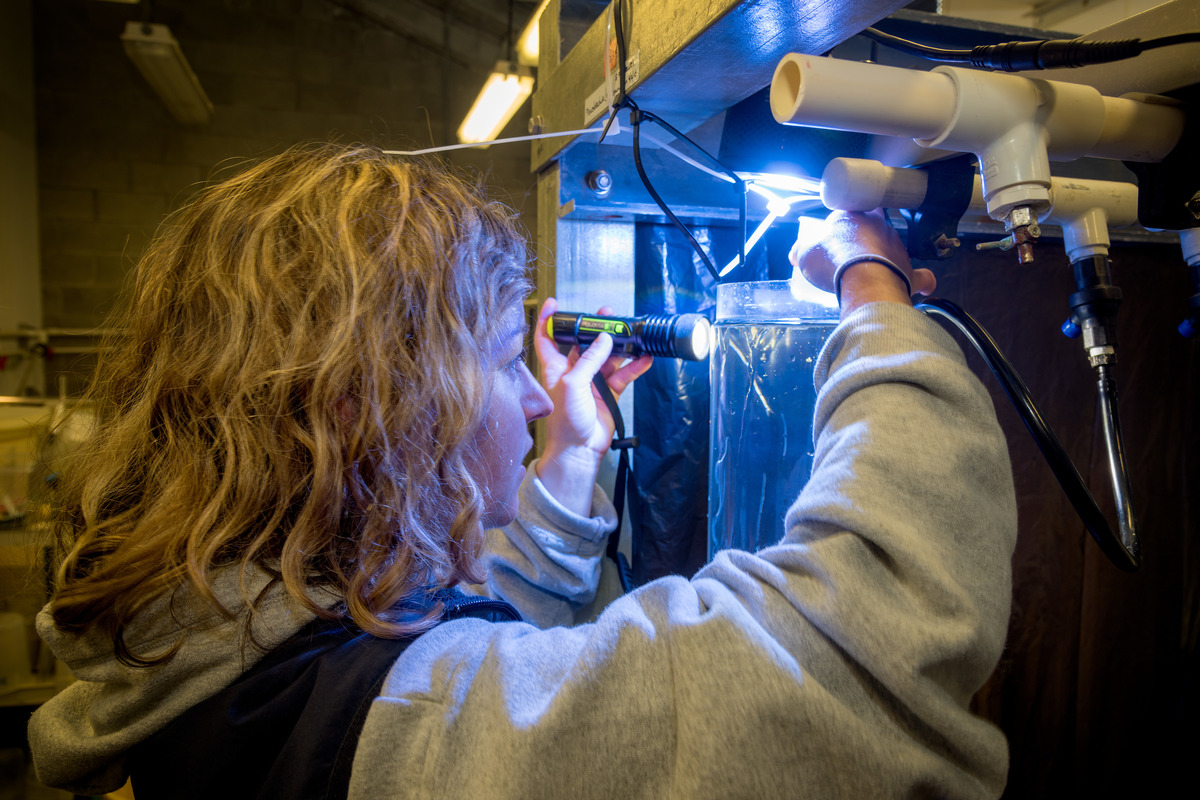
Senior Aquarist MacKenzie Bubel tried several different setups to raise comb jellies behind the scenes, but none seemed to be successful.
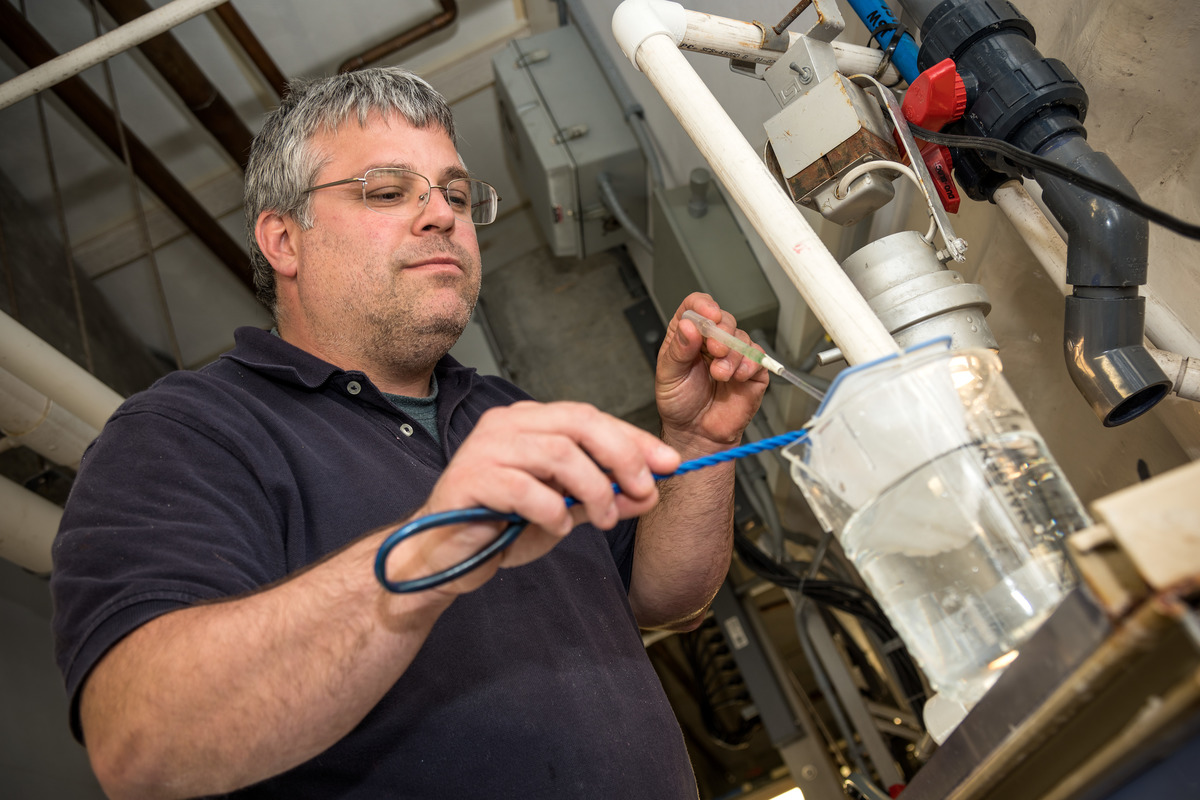
Senior Biologist Tommy Knowles carefully feeds comb jelly larvae with a pipette, using a mesh net as a sieve to filter out larger food items.
Cracking the code of comb jelly culturing
In March 2015, Wyatt joined a Monterey Bay Aquarium Research Institute (MBARI) expedition led by marine biologist Dr. Steve Haddock in the Gulf of California. Dr. William Browne, a professor at the University of Miami studying comb jellies from an evolutionary biology angle, was also onboard. He and Wyatt quickly hit it off and launched right into discussions of sea walnut culturing.
Dr. Browne told Wyatt the key to keeping baby comb jellies alive was to feed their parents larval fishes. In theory, the increased nutrition for the adults would in turn produce more robust offspring. Wyatt quickly got in touch with MacKenzie back at the Aquarium and advised her to switch the comb jelly food to hatchling zebrafish. Suddenly, the Jellies Team’s innovative spawning methods worked.
“As soon as we started feeding the adults larval fish, we had super-healthy adults, and the quality and quantity of embryos exploded,” MacKenzie says. Where previous efforts had produced approximately ten baby comb jellies, the team was now spawning hundreds—even topping 1,000 individuals at one point.
We grew so many that we had to find homes for them all. Then we started applying the methods to other (comb jelly) species.
Wyatt PatrySenior Biologist
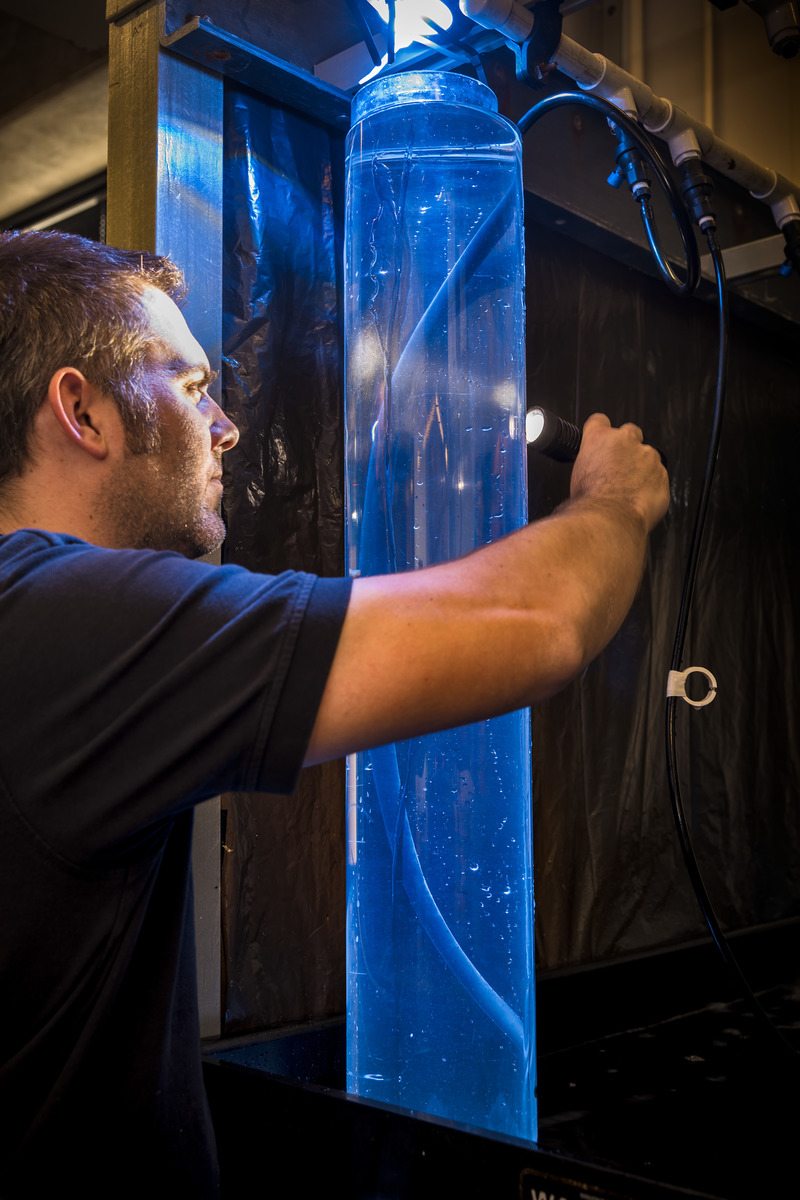
Senior Biologist Wyatt Patry uses a flashlight to locate tiny lobed comb jelly (Bolinopsis microptera) larvae in a large tube-shaped tank behind the scenes.
Using the comb jelly blueprint
After spawning three generations of sea walnuts behind the scenes, the Jellies Team moved on to other species. While the Jellies Experience exhibition afforded us the opportunity to work with tropical and warm-water jellies like sea walnuts, we wanted to apply the culturing process to local, cold-water species for our permanent exhibits. However, it was more than simply repeating the steps that worked before. Some of our local comb jellies are smaller than sea walnuts, while others are even more delicate, so the team made adjustments to the process.
For species like the sea gooseberries (Pleurobrachia spp. and Homiphora spp.), a smaller food item is crucial for the survival of their larvae. Luckily around this point in our jelly journey, we started culturing copepods—planktonic crustaceans—whose larvae proved to be small enough to be eaten by the minuscule comb jelly larvae (100 microns across—about as thick as a sheet of paper).
For even more delicate comb jelly species, the larvae required a gentler environment. With sea walnuts, we had the adults spawning successfully in a ten-liter tank. Over time, the setup transformed into a tube-within-a-tube design that creates an extremely gentle environment with little water flow, but still enough for waste removal.
By making adjustments to meet each species’ needs, this new culturing method worked beautifully for closing the loop on the life cycles of lobed comb jellies (Bolinopsis microptera) and sea gooseberries (Pleurobrachia bachei and Hormiphora californensis), three species we’ve featured in our Jellies gallery. It’s also given us the opportunity to raise the beautiful sea goddess known as the spotted comb jelly (Leucothea pulchra) an exceptionally delicate animal.
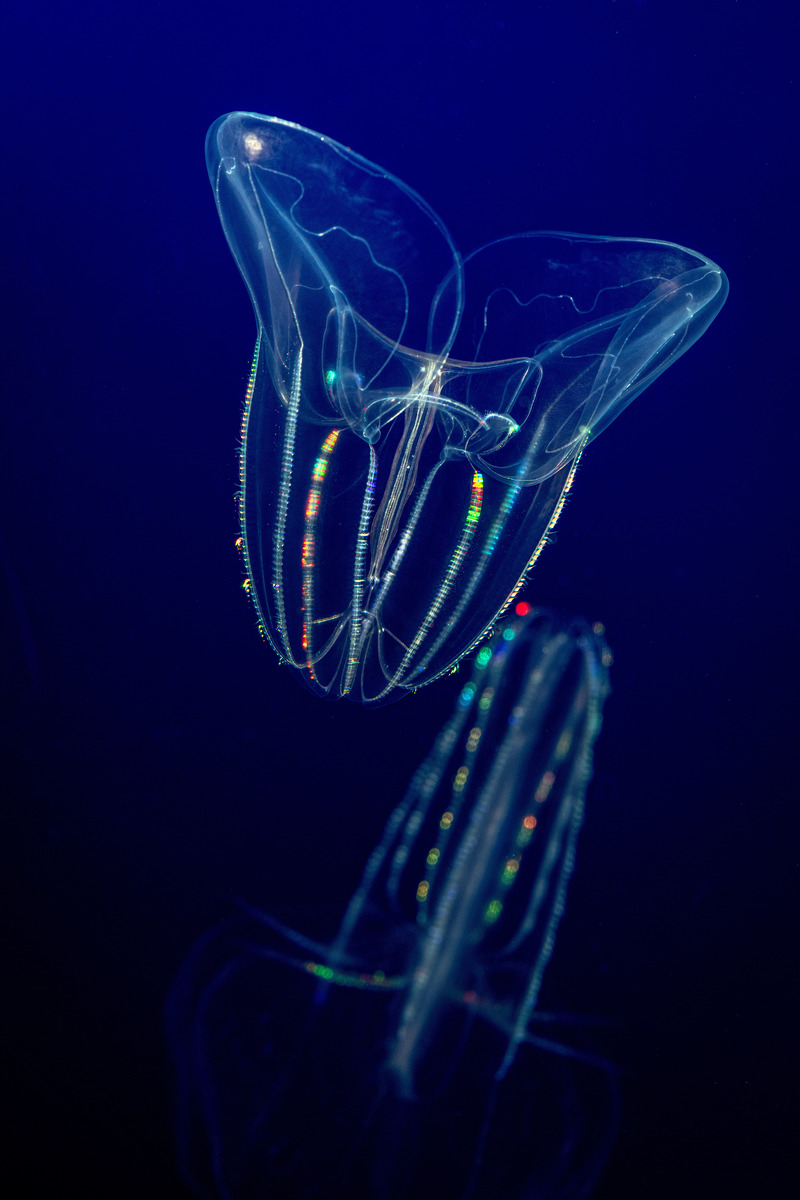
Other comb jellies we have cultured: Lobed comb jelly (Bolinopsis microptera)
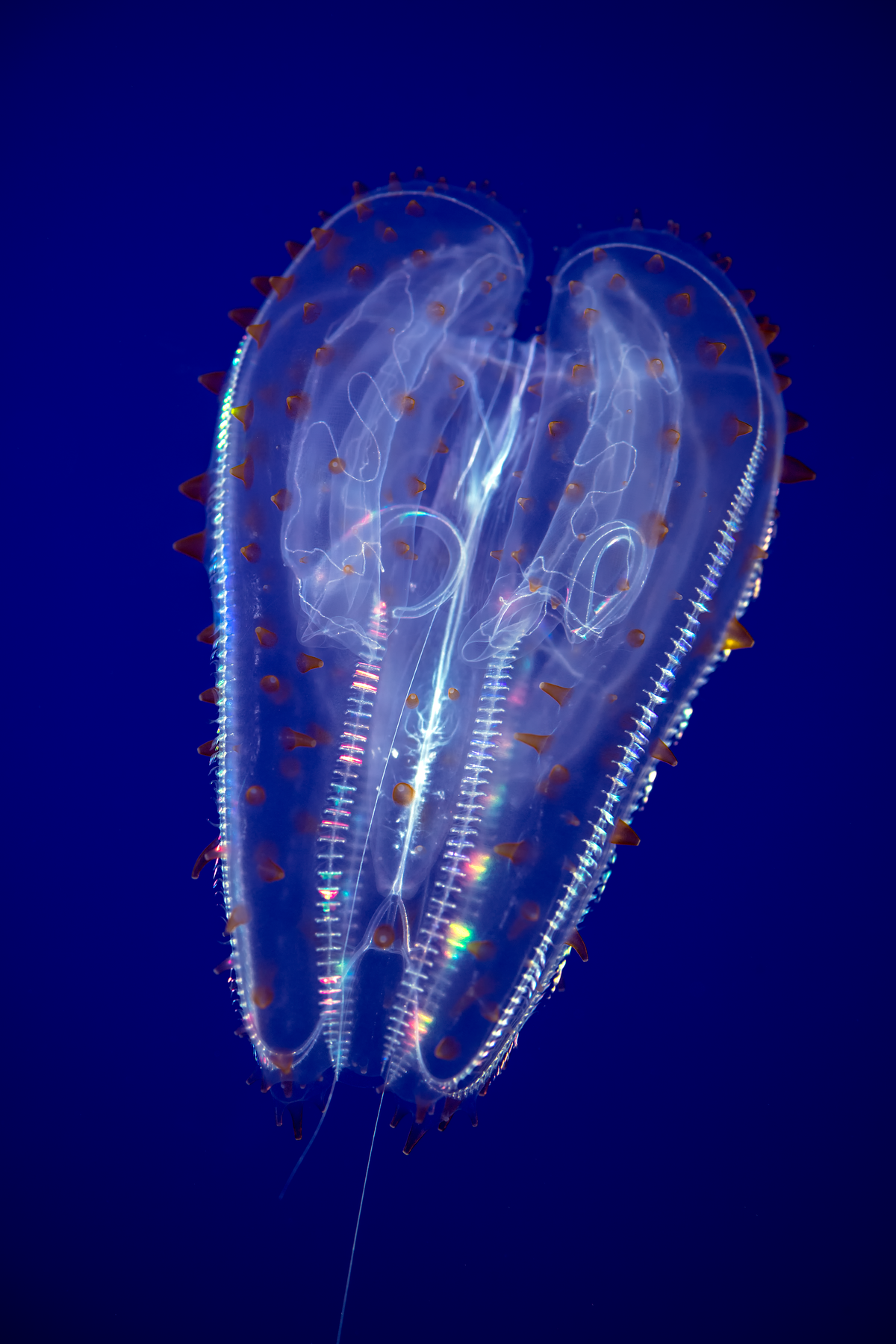
Spotted comb jelly (Leucothea pulchra)
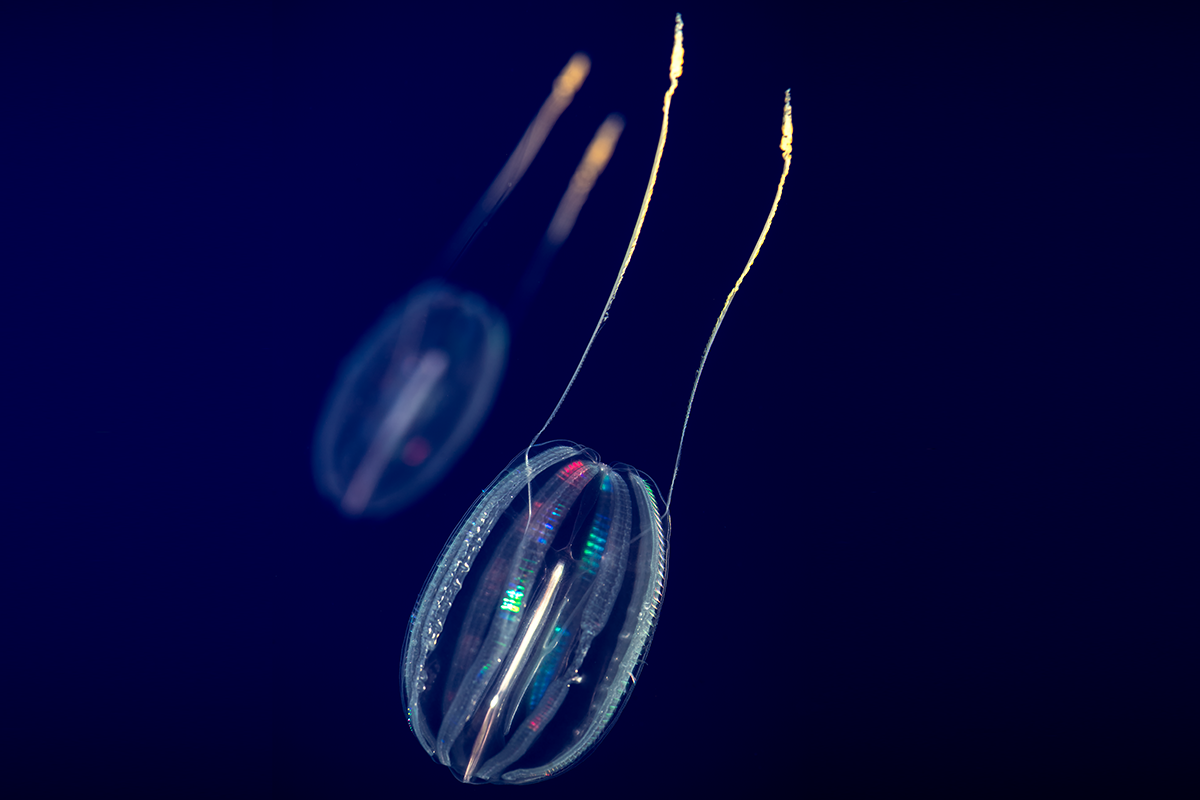
Sea gooseberry (Hormiphora californensis)
Taking the techniques Into the Deep
In preparation for the opening of Into the Deep/En lo Profundo, we paired some of the processes used in raising comb jellies with the systems needed to recreate the deep-sea environment so we could share an ever-growing number of midwater animals with our guests. While we're still working to culture the first deep-sea comb jelly, we've taken what we've learned to be the first to be able to exhibit bloody-belly comb jellies anywhere. We have also been successful in exhibiting other gelatinous midwater organisms like barrel amphipods and sea angels.
That said, we have had success in culturing other deep-sea animals. Senior Aquarist Michael Howard, another dedicated member of the Jellies Team, has been responsible for culturing purple-lipped jellies (Earleria purpurea) and tower jellies (Neoturris sp.), two species of deep-sea cnidarian jelly featured in Into the Deep/En lo Profundo.
In a recent breakthrough, the team achieved another industry first—successfully raising the extremely delicate common siphonophore(Nanomia septata). Our culturing efforts have enabled us to keep this animal on display consistently since the opening of Into the Deep/En lo Profundo. We hope this success carries over into our work with deep-sea ctenophores.
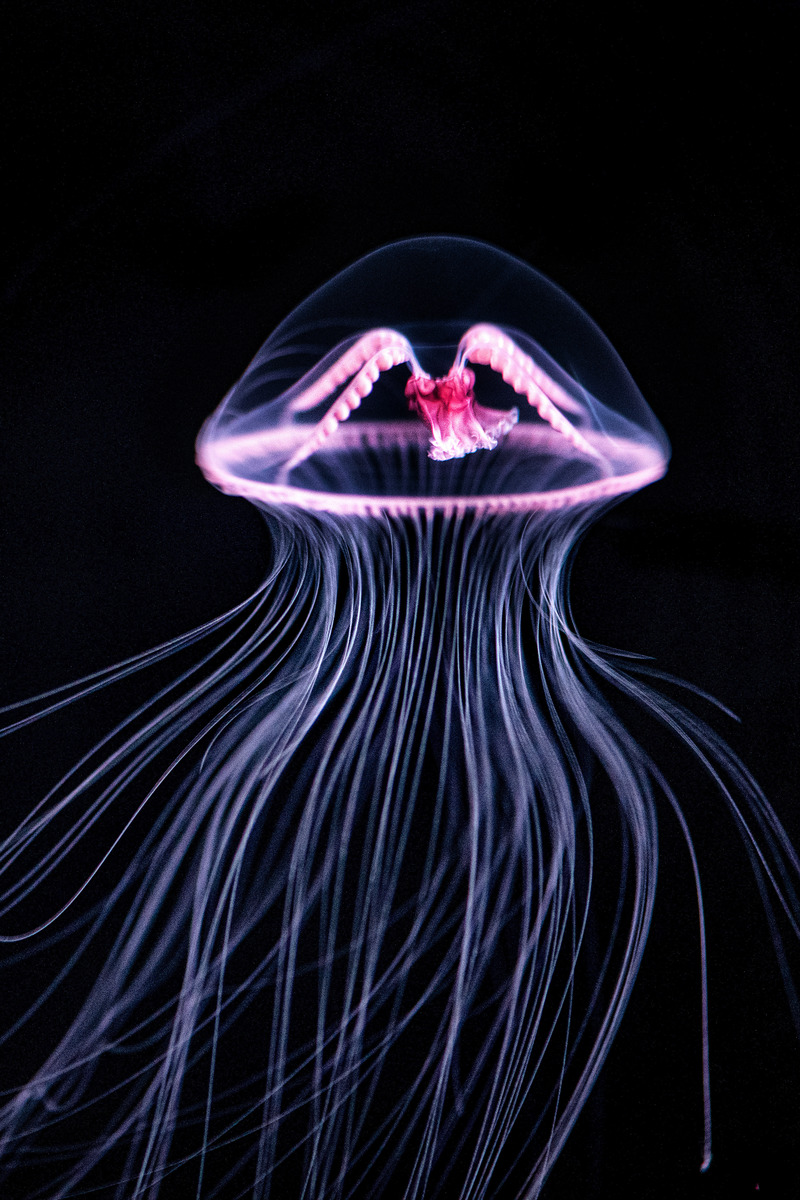
Senior Aquarist Michael Howard, as part of the Jellies Team, is responsible for culturing deep-sea cnidarian jellies like this purple-lipped jelly (Earleria purpurea) and the tower jelly (Neoturris sp.).
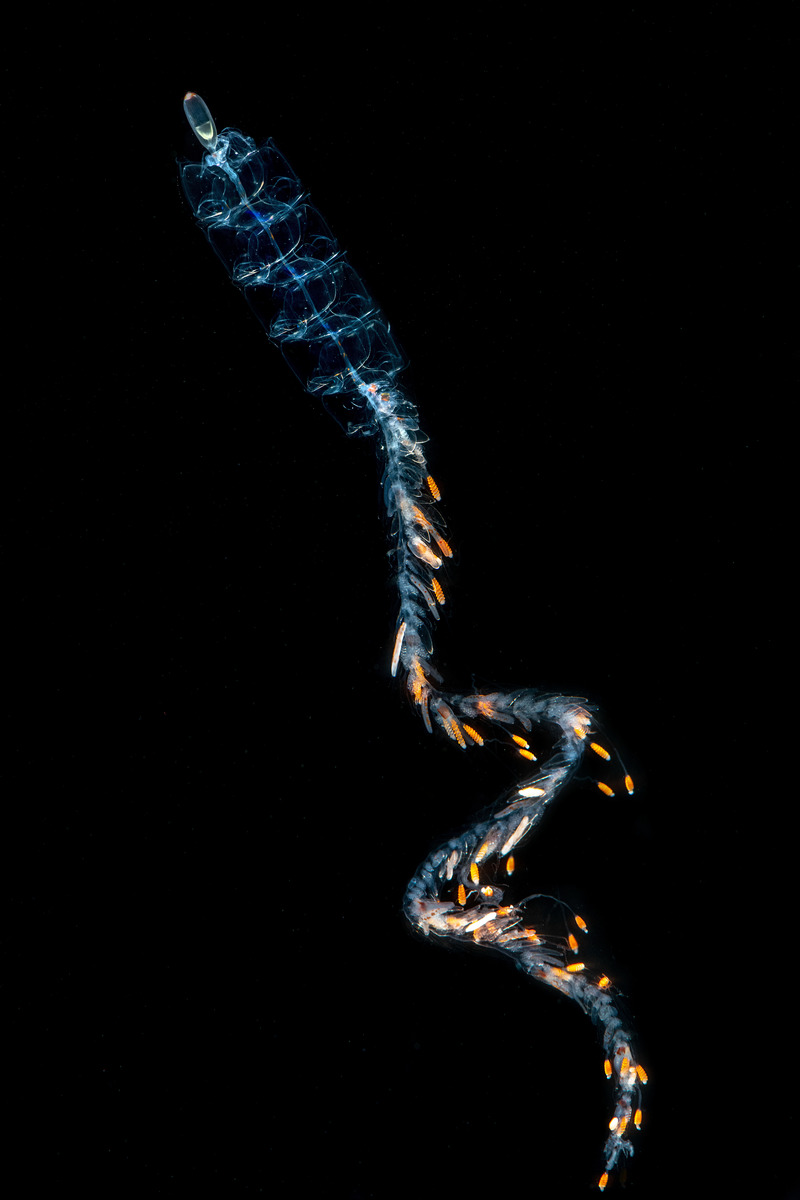
In an industry first, the Jellies Team successfully cultured the common siphonophore (Nanomia septata) by adapting the techniques developed for raising comb jellies.
Sharing our success with colleagues
The Jellies Team collaborated with Dr. Browne to publish a paper sharing the ctenophore culturing protocols so that other researchers and institutions can learn from our efforts. Our comb jelly culturing helped our colleagues at MBARI determine—in a laboratory setting—that sea walnuts were bioluminescent and could create the light on their own. The ability to culture these animals and monitor their feeding was crucial to the success of this study. The results challenged a long-held thought that animals needed to consume other bioluminescent animals in order to bioluminesce.
In another example, a team of scientists led by MBARI researcher Darrin Schultz generated the first complete set of chromosomes for a comb jelly. This work has confirmed, in a study recently published in Nature, that comb jellies represent the earliest lineage to break off from the animal tree of life. With this knowledge, scientists now have a better understanding of the genetics of all animal life and how key features of animal biology have evolved over time, like the digestive tract or nervous system.
It is because of findings like this that we are happy to share our work outside of our institution. After all, had it not been for the collaboration with Dr. Browne, we wouldn’t have enjoyed the success we’ve had raising comb jellies. MacKenzie for one is thrilled:
Comb jellies are awesome for so many reasons. I really hope there’s a comb jelly craze!
MacKenzie BubelSenior Aquarist
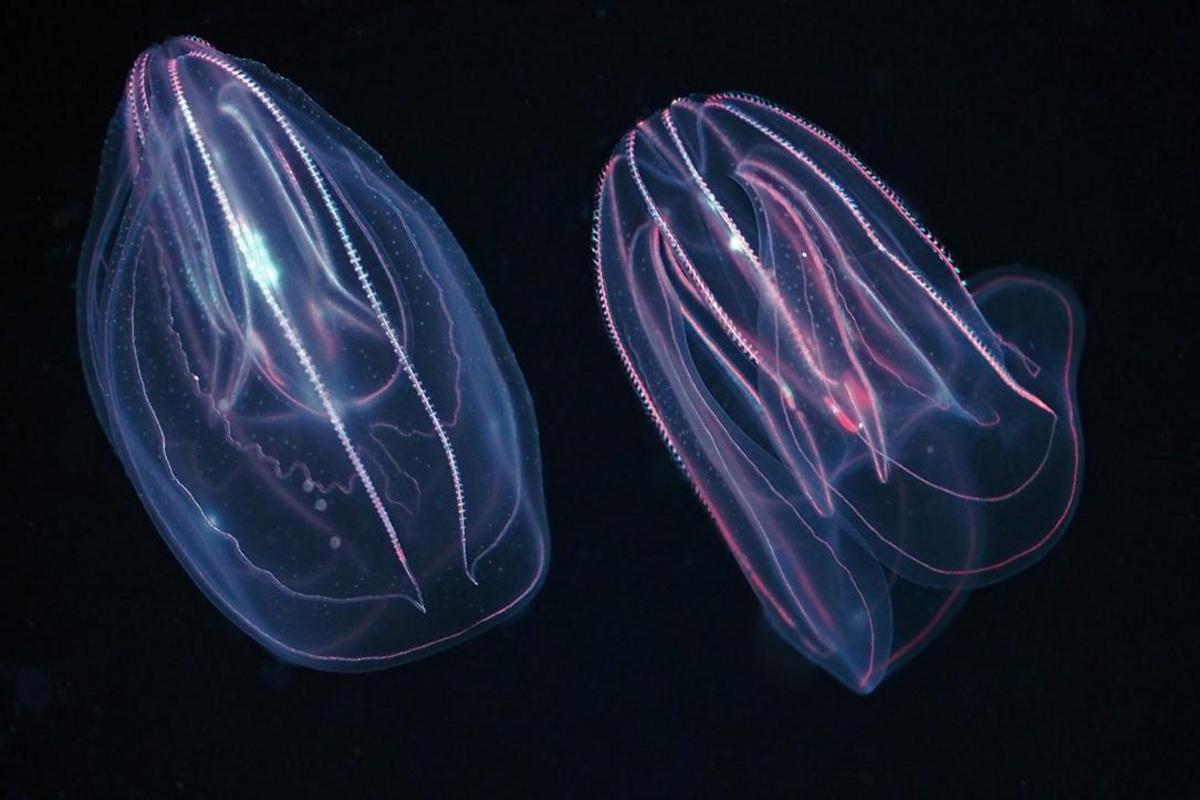
Researchers from MBARI utilized comb jelly culturing methods developed at the Aquarium to determine that sea walnuts and lobed comb jellies could create their own light in a laboratory setting. Photo © Charlene Boarts
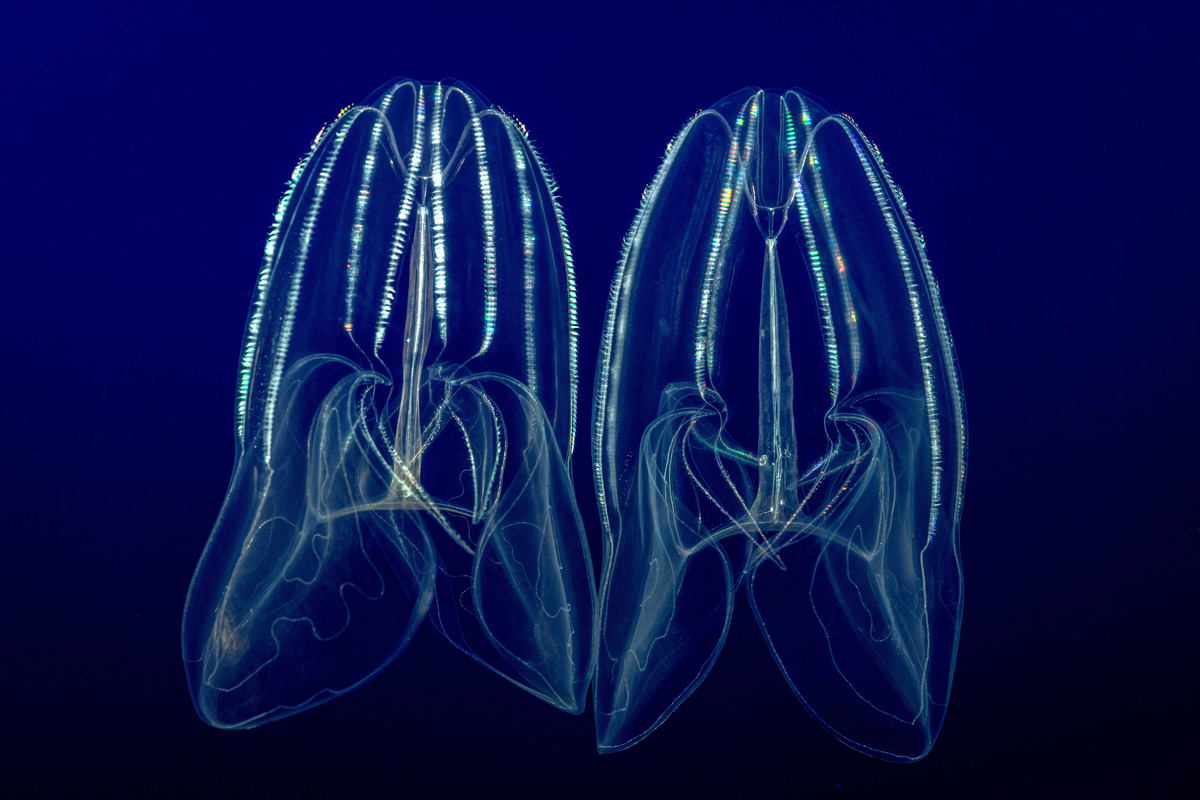
MBARI researchers also generated the first complete set of chromosomes for a comb jelly using lobed comb jellies, confirming that ctenophores represent the earliest lineage to break off from the animal tree of life.
The future of jelly culturing
Over the past 40 years, we’ve achieved many breakthroughs in showcasing animals that have never been displayed to the public before. But our journey continues as we strive to raise many more of our animals, including ones found in Into the Deep/En lo Profundo. While bloody-belly comb jellies have been a highlight of our deep-sea exhibit, we’re still working to close the loop on their life cycle.
Getting the deep-sea comb jellies to spawn and in general culturing deep sea comb jellies is within the realm of what we can do—but we just don't quite know how yet. If we were able to grow baby bloody-belly comb jellies, it would be amazing.
Tommy KnowlesSenior Biologist
As we continue to make discoveries, both in the deep sea and in the process of raising these gelatinous wonders, we look forward to sharing our journey with you!
Related videos
Cracking the code of comb jelly culturing

Our Jellies Team discovered the key to comb jelly culturing was feeding the adults larval fish.
Keep exploring
Story
Nature is queer
We’re excited to sea-lebrate the queerness of nature!
Read story – Nature is queer
Story
2026 Lucile S. Packard Memorial Award and Youth Award recipients
We’re proud to announce the 2026 Lucile S. Packard Memorial and Youth Awards for outstanding volunteers!
Read story – 2026 Lucile S. Packard Memorial Award and Youth Award recipients
Story
Birdwatching tips: A guide to enjoying and identifying local birds
Here are our best tips to help keep you and the birds safe and healthy during a birdwatching adventure.
Read story – Birdwatching tips: A guide to enjoying and identifying local birds