

Monterey Bay and surrounding waters are prime habitat for white sharks. The same adult white sharks visit this part of California annually, mostly during fall and early winter. Farther south, from Santa Barbara to Central Baja, white shark babies, or pups, typically spend their first years in warmer “nursery” waters. In recent years, a seasonal group of younger white sharks has established itself within sight of the beaches at the north end of Monterey Bay, leading scientists from the Aquarium, Stanford University, Cal State Long Beach and other collaborators, to new research questions: Is this new cohort taking up residence as a result of warming ocean conditions? And why are the sharks aggregating in one portion of the bay?
A warmer Monterey Bay
In August 2020, the water temperature at the northern end of Monterey Bay (just off the coast of Aptos, California) reached an alarming 69 degrees Fahrenheit (21 degrees Celsius)—far above what we’ve considered normal for the area. While the temperature in this spot averages about 55 degrees F (13 degrees C), temperature extremes have become more common since a North Pacific heat wave hit the California coast from 2014 to 2016.
With that heat wave came unprecedented sightings of juvenile white sharks.
“We began using electronic tags to learn about juvenile white sharks in southern California two decades ago, when we were preparing to exhibit them to the public. We had no idea that those animals would help us learn so much about our changing ocean,” explains John O’Sullivan (he/him/his), former director of collections at the Aquarium.
Aquarium scientists turned to these data to see where the animals were spending most of their time. The team analyzed 22 million electronic data records from 14 sharks tagged in Ssouthern California and Mexico and compared them to 38 years of ocean temperatures to map the cold edge of their thermal preferences, or niche.
Turns out, adolescent white sharks prefer their water balmy.
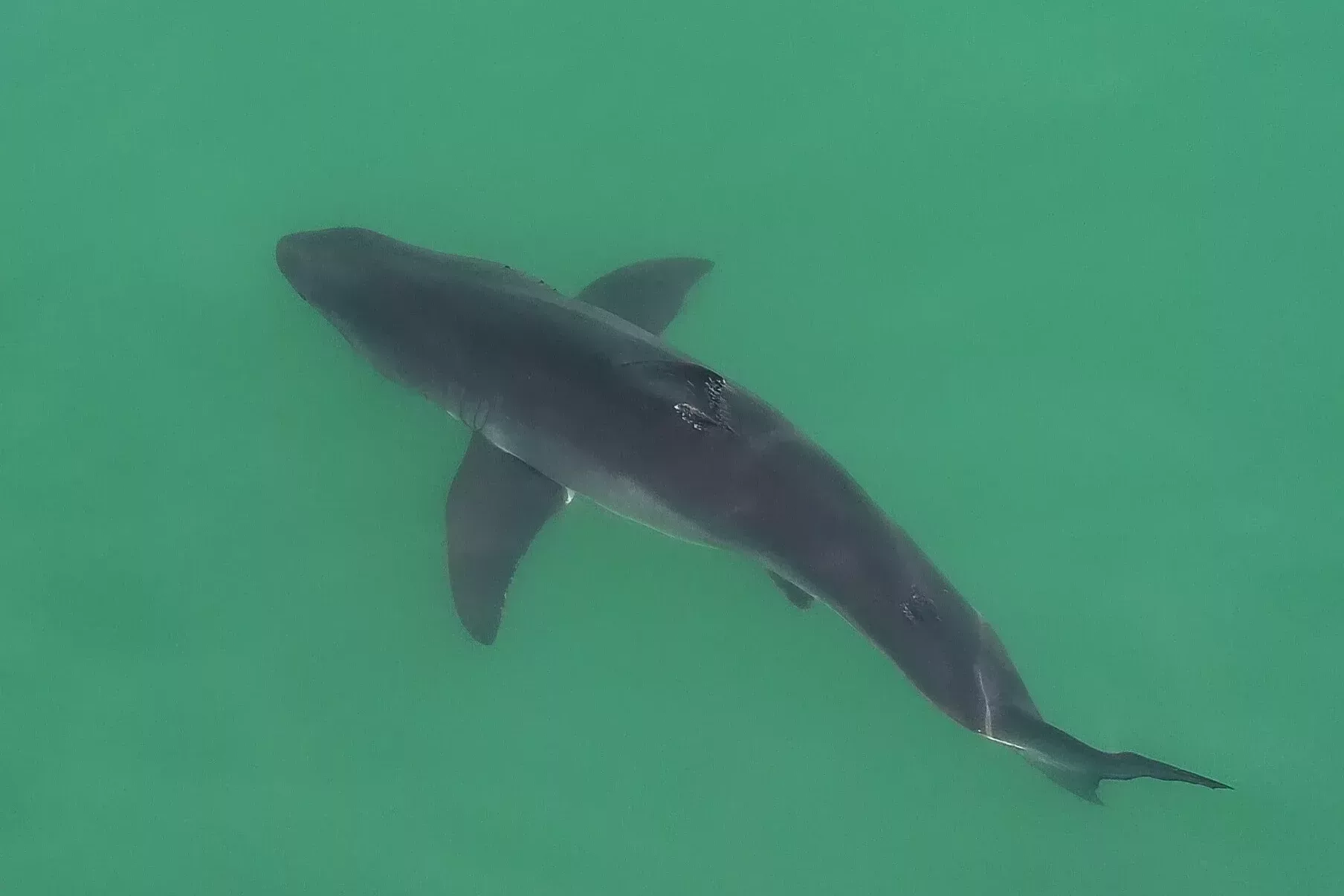
While baby white sharks are born with warm bodies, they don't have enough body mass to keep themselves warm in cold water. Young white sharks therefore require warmer waters until they grow big enough to maintain their body temperature.
Eric Mailander
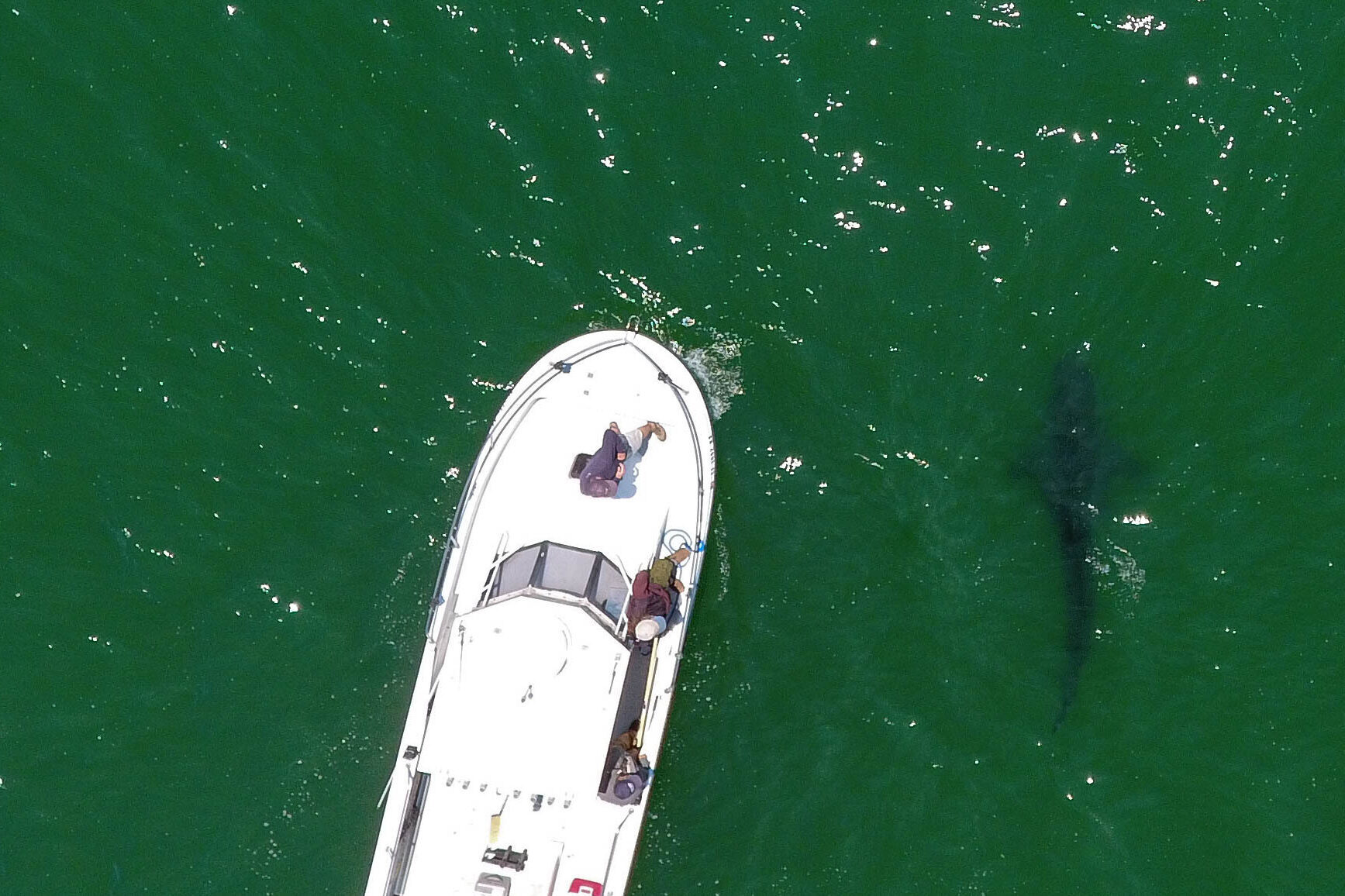
Local residents observe a juvenile white shark from the deck of their boat near Aptos, CA. Unprecedented sightings of these young animals helped scientists understand how Monterey Bay is warming due to climate change.
Eric Mailander
Preferred water temperature for white sharks
Unlike far-ranging adult white sharks, juvenile white sharks are temperature dependent—meaning they can’t easily adapt and survive in cold ocean water because they lack the body mass needed to stay warm. White sharks develop thermal inertia as they get girthier, or as their surface area to volume ratio drops.
"So, until they are massive enough to keep warm even in cold water, they stay in places within their favorite temperature range," explains Dr. Salvador Jorgensen (he/him/his), a marine ecologist at the California State University, Monterey Bay.
“In the northeast Pacific, newborn and small juvenile white sharks were historically confined to Southern California and Baja, a ‘Goldilocks’ zone that was neither too hot nor too cold,” he says. “Our study shows recent ocean warming has drastically shifted this zone north.”
In other words, Goldilocks has come to Monterey.
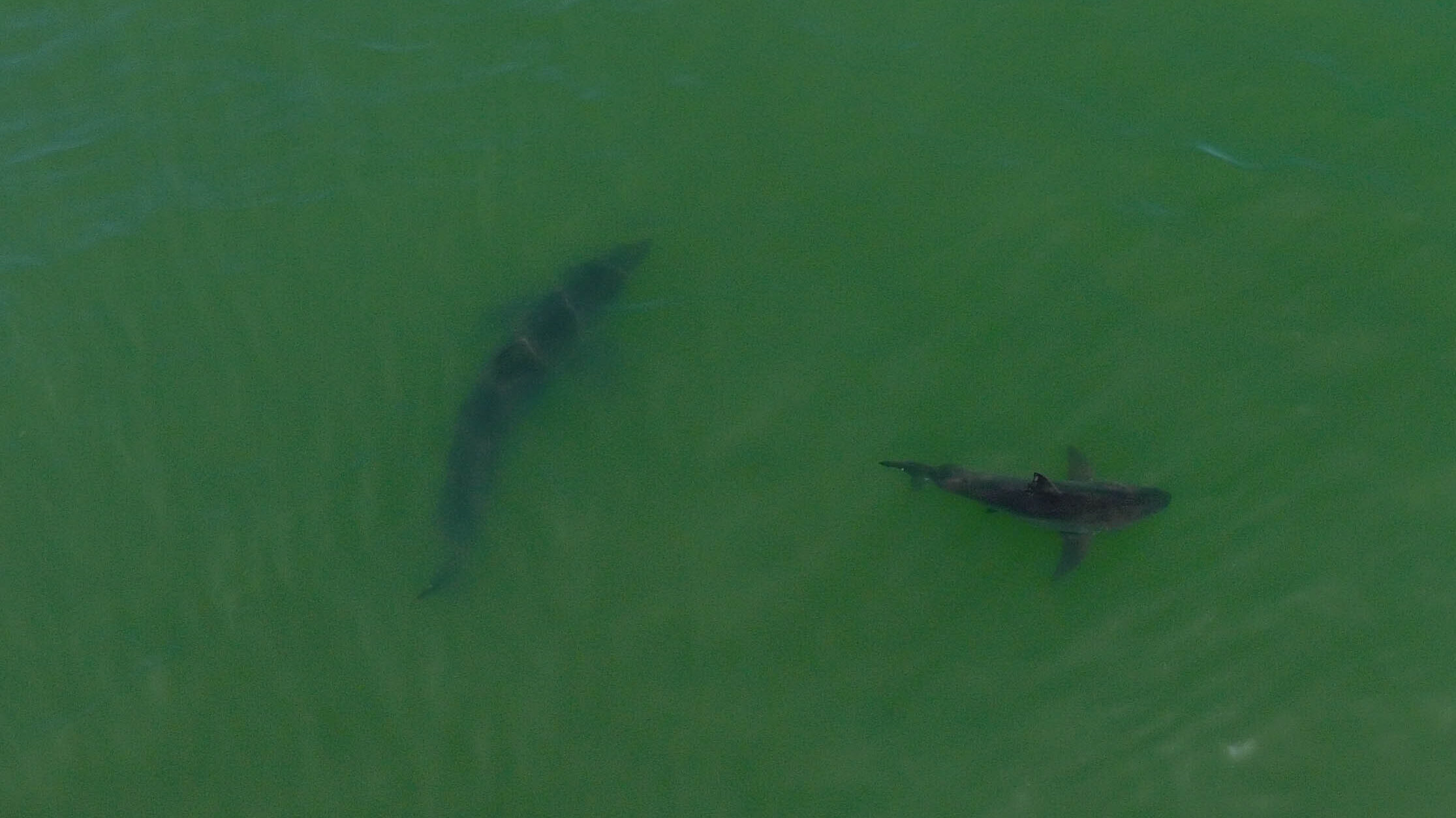
Juvenile white sharks are part of a chorus from nature telling us how our planet is changing. By working together, we can reduce our reliance on fossils fuels and help restore our global ocean, the heart of our climate system.
Eric Mailander
Climate change has shifted the range of white sharks
In 2021, Aquarium scientists published these findings in Scientific Reports, charting a significant northward shift in the young white sharks’ range.
Between 1982 and 2013, the northernmost edge of the juveniles’ range was located near Santa Barbara (with a latitude of 34 degrees north of the equator). But after the destructive marine heat wave, their range shifted nearly 400 miles (~600 km) north to Bodega Bay (38.5 degrees north). Ever since, the young sharks’ range limit has hovered near Monterey (36 degrees north).
Because this shift took scientists by surprise, the team turned to novel sources of data such as community science and recreational fishing records to document this northward movement of the population.
Eric Mailander, a local firefighter, provided a decade of detailed logbook records of shark sightings, and volunteer Carol Galginaitis transcribed those hand-written data into an electronic database.
“This study would not have been possible without contributions from our community scientists and Aquarium volunteers,” says Dr. Kyle Van Houtan (he/him/él), a co-author of the study.
"But let’s be clear: The sharks are not the problem. Our emissions are the problem. We need to act on climate change and reduce our reliance on fossil fuels."
Dr. Kyle Van Houtan
Shark researcher
The search for suitable habitat
In addition to this shift of their range, juvenile white sharks are also facing a loss of suitable thermal habitat, meaning water temperatures within their preferred thermal range are becoming harder to find.
“The movement of these young sharks into more northern latitudes is just another example of how marine animals are being displaced by climate change,” says Dr. Kisei Tanaka (he/him/his), lead author of the study.
Aquarium researchers and partners hope this study will reinforce what scientists have been saying for years: that it’s not only scientists and activists documenting the realities of climate change—it’s animals and the living world, too.
“White sharks, sea otters, kelp, lobsters, corals, redwoods, monarch butterflies—these are all showing us that climate change is happening right here in our backyard,” Kyle says. “It’s time for us to take notice and listen to this chorus from nature.”
Scientists know that greenhouse gas emissions are rapidly disrupting our climate, and this is taking hold in many ways.
Previous studies from the Aquarium have illustrated the complex, interconnected nature of coastal ecosystems. The relationship between sea otter population recovery, increased sea otter deaths from white shark bites, and the loss of kelp canopy cover along the California coast exemplifies the cascade of impacts set in motion by climate change.
For more information, see: K. R. Tanaka et al. 2021. "North Pacific warming shifts the juvenile range of a marine apex predator." Scientific Reports: 82424. Read report on DOI.org.
Keep exploring
Story
How to go tidepooling on California’s rocky shores
Explore California tide pools, see sea stars and anemones, and get tips to stay safe and protect wildlife.
Read story – How to go tidepooling on California’s rocky shores
Story
Chumash Heritage National Marine Sanctuary is almost here
Chumash Heritage National Marine Sanctuary protects marine life and cultural resources on California’s coast.
Read story – Chumash Heritage National Marine Sanctuary is almost here
Story
Pacific bluefin tuna are on a path to recovery
For 30+ years, the Aquarium helped drive this success—bluefin tuna, ocean athletes and highly valuable fish.
Read story – Pacific bluefin tuna are on a path to recovery