

Blubber jelly
Catostylus spp.
- Not on exhibit
- Animal type
- Invertebrates
- Ecosystem
- Coastal waters
- Relatives
- Spotted jelly; Family: Catostylidae
- Diet
- Microplankton, small fish and some crustaceans
- Range
- Indian and Atlantic Oceans, Philippines
- Size
- Up to 13 inches (35 cm)
Meet the blubber jelly
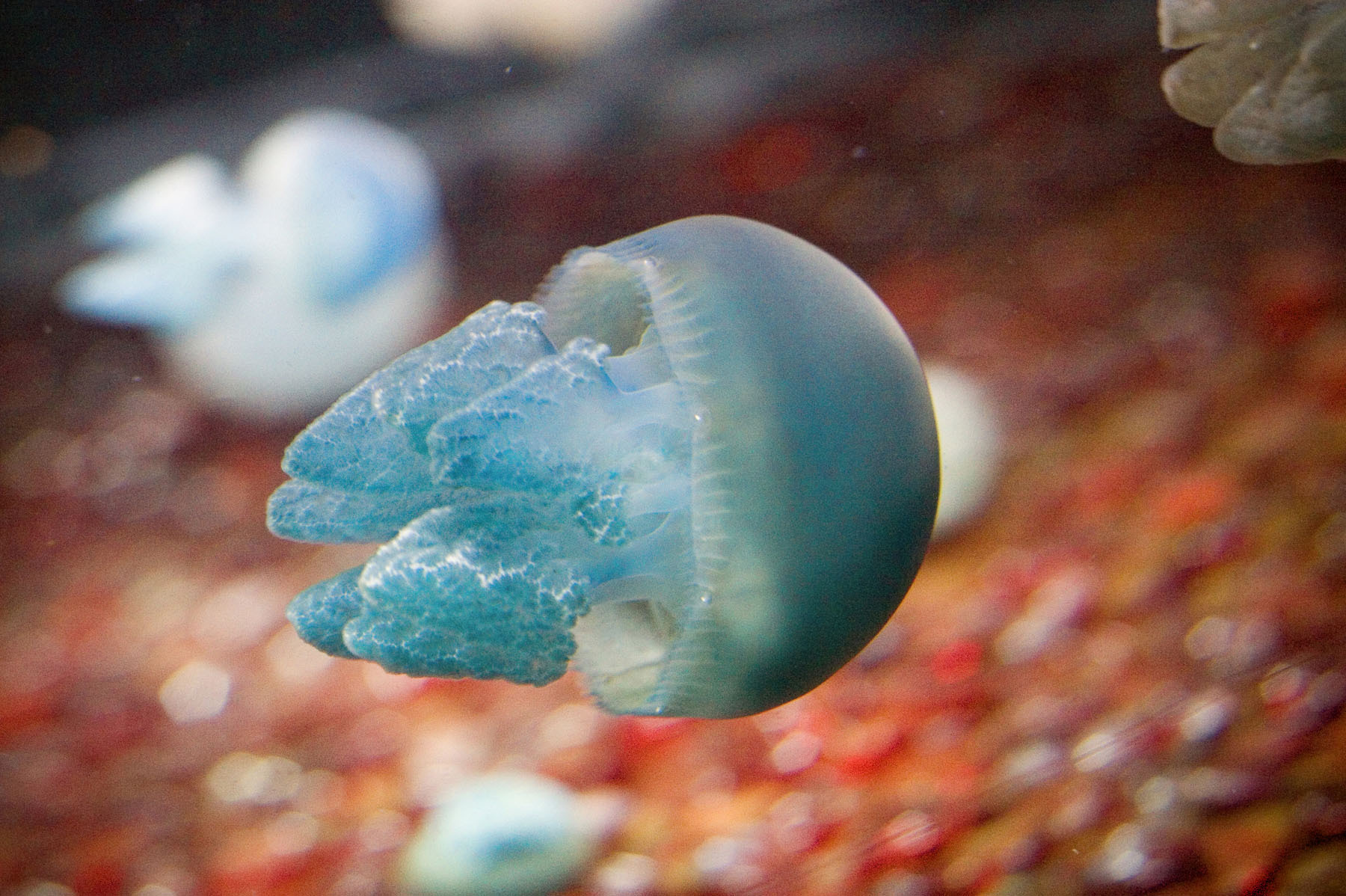
The blubber jelly refers to several species and comes in colors ranging from very light blue to dark purple and burgundy. Its bell pulses in a distinctive, staccato like rhythm. Some species of this jelly are found in coastal lagoons off eastern Australia, often in large blooms. Others are found throughout the Indo-Pacific and Philippines islands.
Natural history
Eight clublike mouth-arms act like filters and funnel food to the jelly’s stomach through canals. As with all true jellies, blubber jellies alternate between a sexual medusa stage and an asexual polyp stage. The adult medusa broods its free swimming larvae, called planula.
Conservation
The blubber jelly is commercially harvested throughout the Indo-Pacific. Scientists know little about blubber jelly populations and how fisheries might impact them. This makes it difficult to manage blubber jelly populations to ensure their healthy survival.
Cool facts
- People can eat this venomous jelly once it’s been properly dried and stored.
- The Chinese believe eating jellies will reduce high blood pressure. Dried jellies are popular in many Asian countries, especially Japan, where they’re considered a culinary delicacy. The texture is reportedly crispy, yet elastic—hence the name “rubber band salad” for a dish sold in China.
Up next in coastal waters
Animal
Mangrove box jelly
The square-shaped box jelly is one of the smallest jellies in the world—it grows to about the size of a grape.
Keep exploring
Animal
Sea otter
Beyond their cute faces and fluffy fur, sea otters play an irreplaceable role in their coastal habitats.