

Broadnose sevengill shark
Notorynchus cepedianus
- On view
- Monterey Bay Habitats
- Animal type
- Sharks & rays
- Ecosystem
- Open ocean
- Relatives
- Sixgill shark, sharpnose sevengill and frilled sharks; Family: Hexanchidae
- Diet
- Other sharks, bat rays, harbor seals, crabs and carrion
- Range
- Temperate waters of the Pacific and South Atlantic oceans
- Size
- Up to 10 feet (3 m)
Meet the broadnose sevengill shark
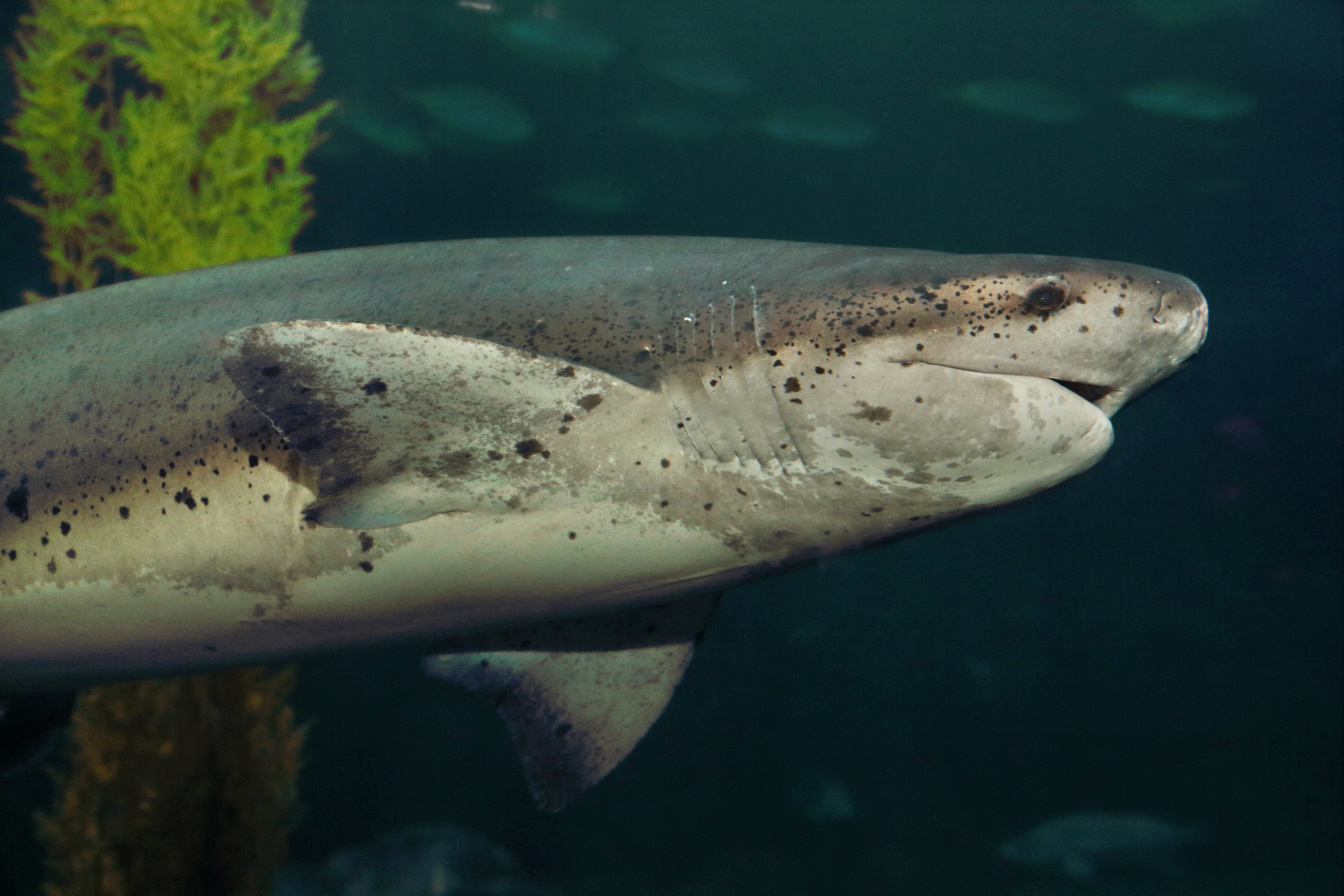
As its name suggests, a sevengill shark has seven pairs of gill slits (most sharks have only five). Its back and sides are reddish brown to silvery gray, or olive-brown and speckled with many small black spots. The shark’s underbelly is cream colored. Other features include a wide head with a blunt nose and only one dorsal (top) fin—most sharks have two.
Watch in real time
Shark Cam
Check out this live cam – Shark CamAbout the broadnose sevengill shark
A broadnose sevengill shark on the hunt for food prefers prowling in shallow inshore waters, although it can appear in deeper waters along the continental shelf. A sevengill shark isn’t a fussy eater. This important coastal predator preys on octopuses, rays, other sharks, bony fishes and carrion. Observers have seen sevengill sharks in packs hunting for seals.
This coastal shark uses bays and estuaries as important nursery grounds for its pups. Adults appear to return to the same coastal bays, but also swim in coastal waters.
Conservation
The broadnose sevengill shark lives in heavily fished, temperate waters and is an easy catch for inshore fisheries. During the 1930s and 1940s, sevengills, valued for their liver oil, were overfished in San Francisco Bay. After the fishery collapsed, fishing competitions and commercial sport fishing (encouraged by a popular movie) depleted sevengills in San Francisco Bay. The lack of fishery data elsewhere makes it impossible to determine if sevengills are depleted in other areas.
Sport fishermen in Australia and the United States target sevengill sharks. Some commercial fisheries retain sevengill sharks as bycatch, selling their flesh for human consumption. Chinese fisheries, which target sevengills, supply the market for shark leather and liver oil.
Cool facts
- The teeth on this shark’s lower jaw are comb shaped, while the teeth in its upper jaw are jagged. When biting large prey, the shark anchors its jaw with the lower teeth, then thrashes its head back and forth to saw off pieces of flesh with its upper teeth.
- Although the broadnose sevengill is a powerful swimmer that can be aggressive if provoked, there’s no record of humans being attacked in open water.
- Sevengill sharks tagged in San Francisco Bay have been recaptured as far south as Baja California, Mexico and as far north as Willapa Bay, Washington. This shark may undertake significant migrations along coastal waters when not occupying coastal bays.
- After a meal, a shark slowly digests its food for many hours or days, allowing it to cruise for weeks without eating again. Research on sevengill shark feeding and growth done at the Aquarium showed that an adult sevengill may eat as little as six percent of its body weight in food each month (or 0.2 percent of its body weight per day).
Up next in open ocean
Animal
Comb jelly
A comb jelly's rows of tiny beating cilia break up light, producing a shimmering rainbow effect as they swim.
Keep exploring
Animal
Moon jelly
This dreamy jelly is named for their translucent, moon-like bell.