

Ocean sunfish
Mola mola
- Not on exhibit
- Animal type
- Fishes
- Ecosystem
- Open ocean
- Relatives
- Family: Molidae
- Diet
- Mainly jellies and other gelatinous zooplankton like salps, squid, fish, crustaceans, algae
- Range
- Distributed across the globe in tropical and temperate oceans
- Size
- Up to 1,000 pounds (454 kg) or more
Meet the ocean sunfish
The ocean sunfish (Mola mola) looks like the invention of a mad scientist. This peculiar silvery-gray fish is laterally compressed, meaning they look like they’ve been squished flat from the side. Their tiny mouths and big eyes vanish into even bigger bodies with small, truncated tails. Though their appearance suggests ocean sunfish weren’t built for life in the fast lane, their impressive distribution throughout the world’s ocean proves that ocean sunfish can hold their own against faster and flashier fishes!
Status: Vulnerable
Least concern
Near threatened
Vulnerable(active)
Endangered
Critical
Extinct in wild
Extinct
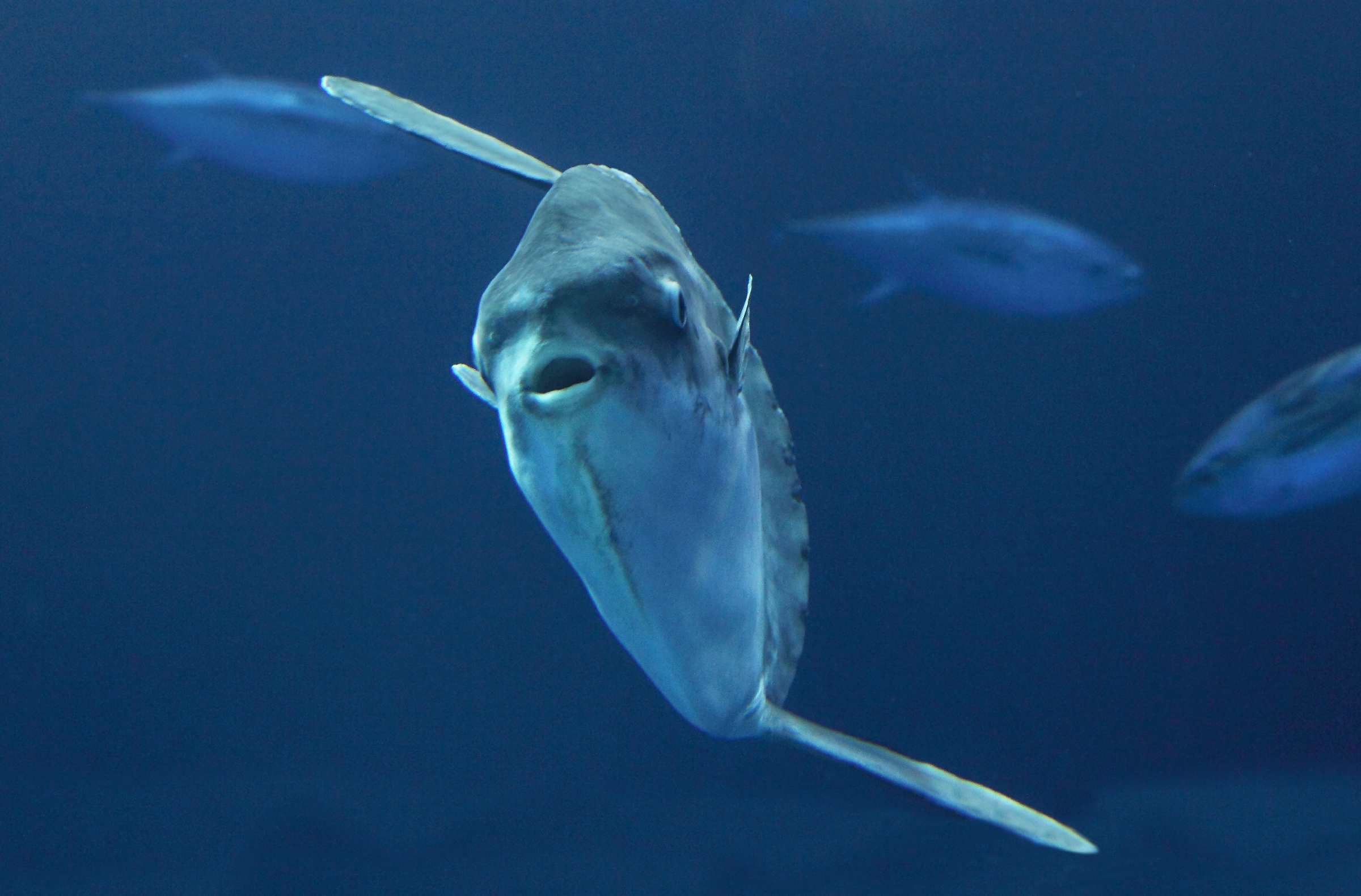
Topping out at around 5,000 pounds, the ocean sunfish is the world's heaviest bony fish.
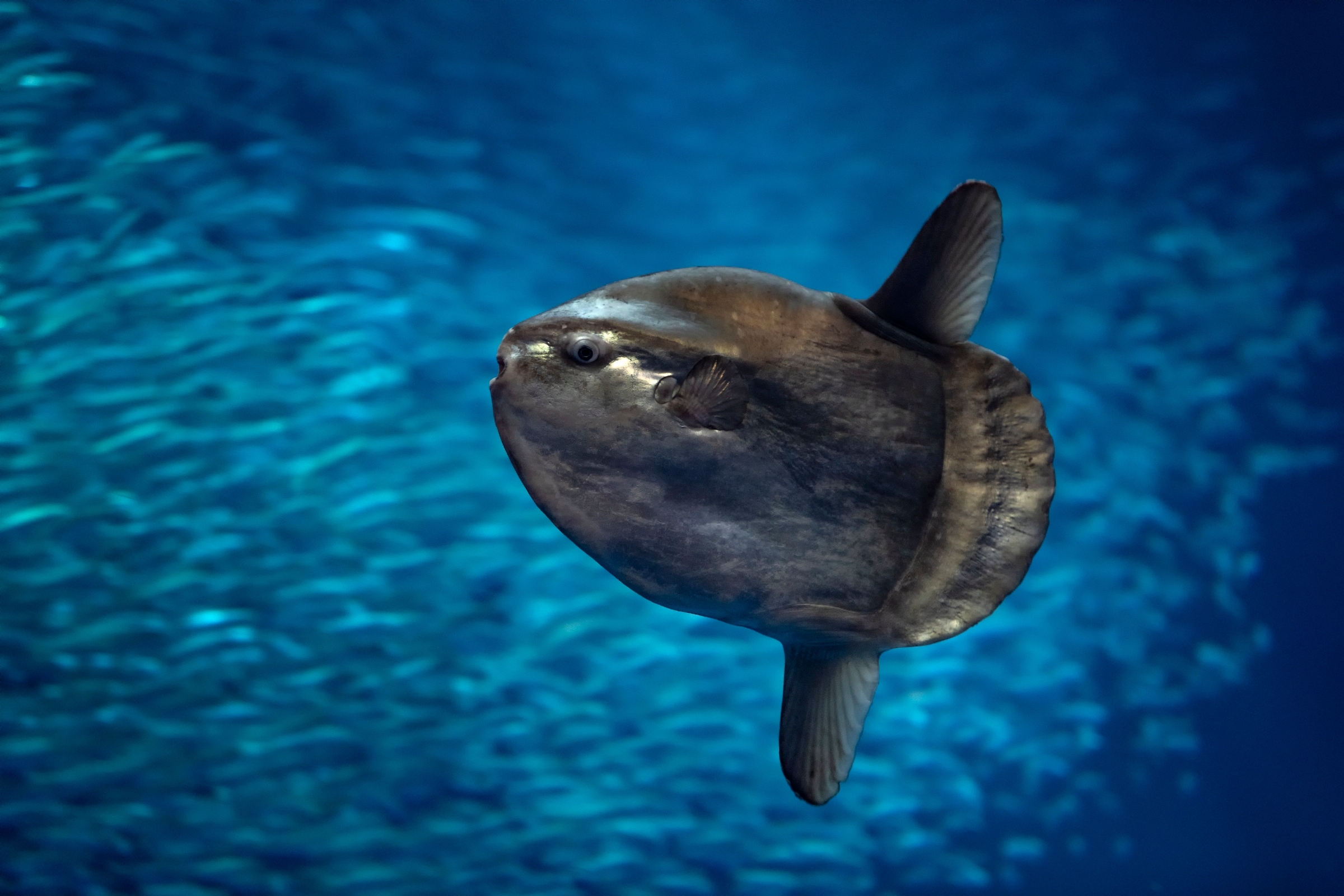
An ocean sunfish (Mola mola) and a school of Pacific sardines (Sardinops sagax) in the Open Sea exhibit.
Life in the slow lane
With their tank-like bodies, the ocean sunfish and other mola species were clearly not built for life in the fast lane. But they hold their own against faster and flashier fishes, and and they're able to live in almost all of the world's oceans. They're known to spend time near the surface but tagging shows thats molas can be prolific divers and migrate long distances at depth.
Natural history
Gentle giants
The mola mola, or ocean sunfish, here in Monterey Bay can grow up to 1,000 pounds (454 g). But another mola species, the giant sunfish Mola alexandrini, holds the title of the the world's heaviest bony fish, growing to a whopping 6,000 pounds (2,700 kg) or more.
This category doesn't count sharks and rays; a whale shark can be 10 times bigger than the giant sunfish! Still, the giant sunfish live up to their titanic name. They grow to a maximum of about 10 feet (3 m) long and are often taller than they are long—up to 14 feet (4.3 m) from dorsal fin tip to anal fin tip. These molas hatch from tiny eggs, and can grow to weigh more than a pickup truck–increasing its weight 60 million times along the way. That's the equivalent of a 1-gram tadpole turning into a 60-ton frog!
Breakfast of champions
Inside a mola's tiny mouth are two pairs of hard teeth plates shaped with a slightly curved ridge that look similar to a bird's beak. Instead of chewing, ocean sunfish suck food in and out of their mouths until their meal is broken into more manageable chunks.
Smaller ocean sunfish forage on benthic creatures like crustaceans as well as algae, squid, fish, and other invertebrates. An ocean sunfish can migrate vertically to find deeper-dwelling prey in the open ocean.
When they reach approximately 70 cm tall, ocean sunfish undergo a fascinating dietary shift. They switch to primarily eating gelatinous organisms at this larger size, including large moon jellies, tiny comb jellies, and even siphonophores! Scientists suspect ocean sunfish can enjoy this potentially-painful gelatinous diet because of a mucus-like lining in their digestive tract that keeps them from getting stung by jellies.
Nearly 40 different kinds of parasites have been observed inside or living on ocean sunfish, including a few gooseneck barnacles that were discovered living in a mola's throat. Some parasites that live on ocean sunfish even carry their own parasites!
Slow movers?
Molas have truncated tail fins referred to as the clavus—a scalloped fringe of muscle along the mola’s blunt rear end they can use as a rudder. Adult molas are slower swimmers than most other large pelagic fish because they lack a gas-filled swim bladder, the organ that gives most bony fish exquisite control over their buoyancy.
Stumped by their slow-motion swimming, scientists initially guessed that mola must drift wherever ocean currents take them. But ocean sunfish in Southern California have been tracked swimming 16 miles (26 km) in a day, at a top speed of two miles (3.2 km) per hour. That’s about the speed of a cruising yellowfin tuna!
Mola for dinner?
The mola is related to pufferfish, and a just-hatched mola is puffy, round and covered with spines like its relatives. The mola makes a popular meal in parts of Asia and is also used in medicine. Apart from humans, other predators include sea lions, sharks and killer whales.
Conservation
The mola mola is listed as “vulnerable” by the International Union for the Conservation of Nature and Natural Resources (IUCN).
Because molas spend so much time drifting near the ocean surface, they’re vulnerable to fishing boats that use drift gillnets. Gillnets usually don't kill molas immediately. They cut into their skin, scrape off their protective mucus, and flood their gills with air.
Another hazard to the mola are discarded plastic bags. When these wind up in the ocean, they float at the surface looking a lot like jellies—a large ocean sunfish's favorite meal. If a plastic bag doesn't immediately choke the ocean sunfish, it can slowly starve them by clogging the fish's stomach. You can help ocean sunfish by bringing your own reusable shopping bags to the store— and making sure any plastic bags you use are properly disposed of.
Related videos
A quick mola fact!

Learn an ocean sunfish fact in seven seconds!
Up next in open ocean
Animal
Blue whale
The blue whale is the largest known animal to have ever lived on Earth.
Keep exploring
Animal
Moon jelly
This dreamy jelly is named for their translucent, moon-like bell.