

Brown pelican
Pelecanus occidentalis
- Not on exhibit
- Animal type
- Birds
- Ecosystem
- Coastal waters
- Relatives
- Tropical birds, frigatebirds, gannets, cormorants; Order: Pelecaniformes; Family: Pelecanidae
- Diet
- Schooling fish close to the water’s surface, including anchovies, herring, Pacific mackerel, minnows and sardines; also, some marine invertebrates
- Range
- Tropical and temperate coastal waters of the Atlantic, Pacific and Gulf Coast of the Americas
- Size
- Wingspan up to 7 feet (2.1 m); weighs up to 10 pounds (4.5 kg)
Meet the brown pelican
This majestic bird has a distinctive large pouch that hangs from the lower half of its long, straight bill. It usually flies in flocks. Its flight pattern may be a straight line or a V-formation, with powerful wing strokes alternating with short glides.
Watch in real time
Monterey Bay Cam
Check out this live cam – Monterey Bay CamStatus: Least concern
Least concern(active)
Near threatened
Vulnerable
Endangered
Critical
Extinct in wild
Extinct
Natural history
With its keen eyesight, the brown pelican can spot fish from heights of up to 65 feet (19.8 m). It dives steeply, with its head pointed straight down and its wings folded back—ending by plunging into the water like a torpedo. Air sacs under their skin cushion the blow and bring the bird to the surface.
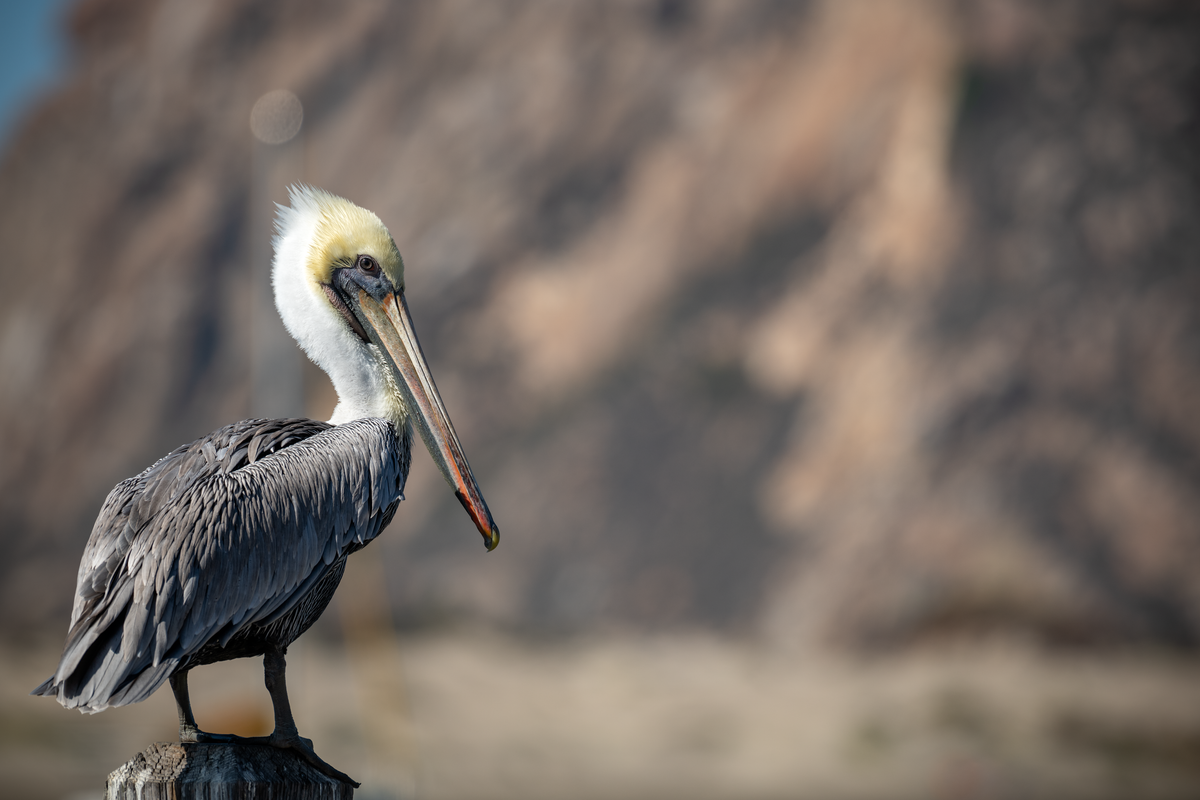
A brown pelican sitting on a rock in Morro Bay, CA
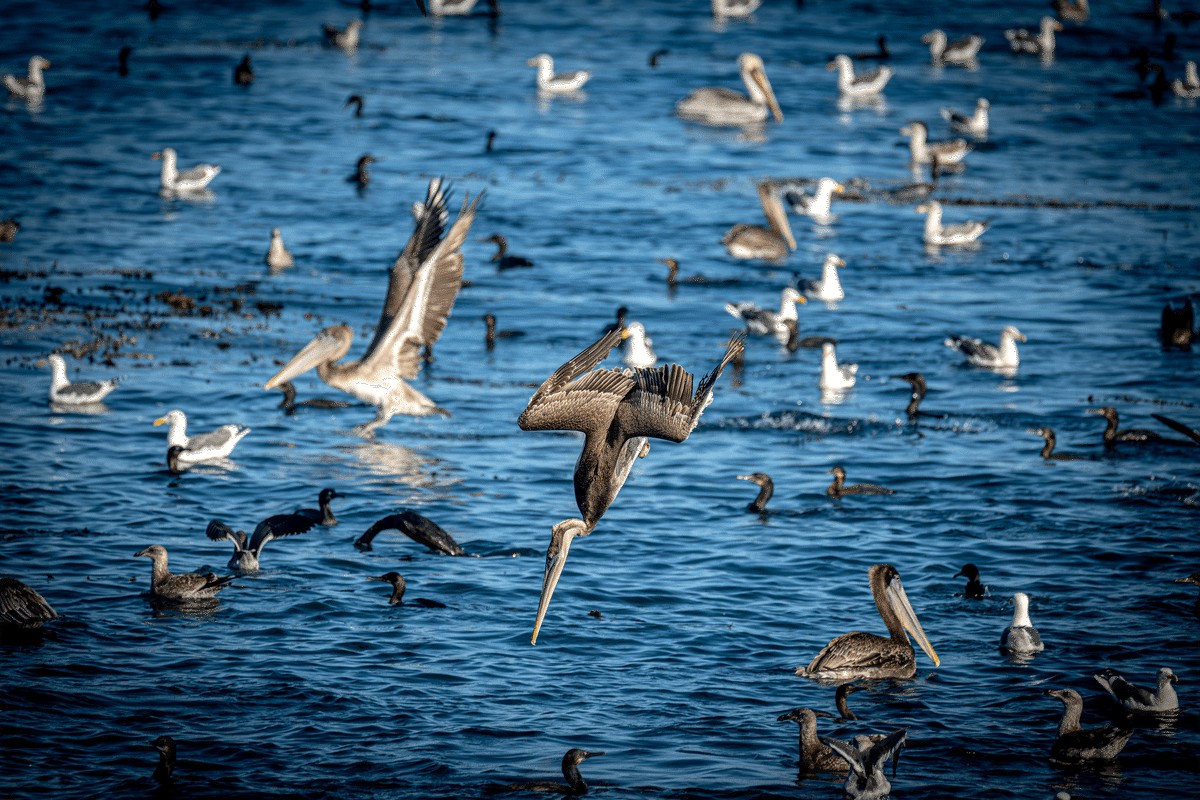
Brown pelicans dive for food in Monterey Bay as millions of anchovies arrive to provide a hardy breakfast.
In Monterey Bay
The brown pelican on the Pacific coast breeds in colonies from Baja to the Channel Islands off California in the winter and spring and then goes north. While you can see some birds here all year around, the majority arrive in Monterey Bay in the summer and remain through early fall.
You can often spot the brown pelican flying just offshore, or sitting on breakwaters, jetties and wharf pilings. You might be lucky enough to get a close-up view of its yellow eyes, black legs and black, webbed feet. In the late fall, when the male pelicans begin to display their breeding plumage, the brown pelican’s throat pouch turns a vibrant red color. This is true for both males and females.
Conservation
In the past, the use of DDT as a pesticide greatly affected the pelican’s calcium metabolism, causing its eggshells to become thinner and more fragile. Their population decreased so dramatically that in 1970, the U.S. Fish and Wildlife Service listed the brown pelican as endangered. In 1972, the Environmental Protection Agency banned the use of DDT in the United States.
These protections led to a dramatic recovery. Brown pelican populations have increased by an estimated 712 percent in some areas over the past 40 years, according to the International Union for the Conservation of Nature and Natural Resources (IUCN) Red List. The recovery on the Atlantic coast has been much more significant than on the Pacific coast. However, the species has officially been delisted from the Endangered Species Act throughout its range. The IUCN now considers it a species of “Least Concern.”
Human activities, such as destruction and disturbance of breeding and resting habitats, still threaten this bird. Abandoned fishing lines and hooks can entangle and injure the pelican, which often rests near shore. When you fish, please make sure you don’t leave fishing lines or hooks behind. If you find abandoned fishing line on the beach or wharf, be sure to throw it away.
Cool facts
- The brown pelican breeds in colonies on the Channel Islands off California. The male gathers materials while the female builds the nest, which typically begins with a scrape or mound on the ground. The bird lines its nest with soil, feathers or vegetation.
- Pelicans often fly in lines close to the water’s surface. This employs something pilots call the “ground effect” to make flying almost effortless, thanks to a cushion of compressed air.
- A marine bird drinks sea water and removes the salt from its system using special salt-extracting glands. These glands are located on the outside of the skull and above the eyes, but each species of bird has a different drip arrangement. In the case of a brown pelican, salty fluids flow down grooves on the outside of its bill and drip off the end.
- A pelican’s bill can hold three times more than its stomach can—nearly three gallons of fish and water. At the end of a successful dive, the pelican drains the water from its pouch and swallows the whole fish head first—after turning it if necessary. A large hook at the tip of a pelican’s bill helps hold the squirming fish.
- The brown pelican and its close cousin, the Peruvian pelican, are the only pelican species in the world that plunge dive. All other pelican species feed by sitting on the surface of the water and grabbing food. Brown pelicans and Peruvian pelicans will occasionally feed in this way, too.
Up next in coastal waters
Animal
Diatoms
Scientists estimate there could be as many as two million species of these unicellular organisms.
Keep exploring
Animal
Sea otter
Beyond their cute faces and fluffy fur, sea otters play an irreplaceable role in their coastal habitats.