

Johnson's sea cucumber
Parastichopus johnsoni
- Not on exhibit
- Animal type
- Invertebrates
- Ecosystem
- Deep sea
- Relatives
- Other sea cucumbers; sea stars; sea urchins; sand dollars
- Diet
- Plant and animal scraps, small organisms
- Range
- Seafloor (100–1,300 feet or 30–400 m)
- Size
- Up to 16 inches (40 cm) long
Meet Johnson's sea cucumber
Sea cucumbers are soft-bodied and live at all ocean depths, from the shallows to the abyss.
Did you know?
Most sea cucumbers move slowly by using their tiny tube feet, but some also have a faster escape response—they swim by flexing their bodies and inching along the seafloor.
As a deep sea cucumber crawls across the seafloor, mud and tiny pieces of fallen food cling to its sticky tentacles. The cucumber stuffs those coated tentacles into its mouth and cleans them off—devouring the muddy mixture and digesting the edible scraps.
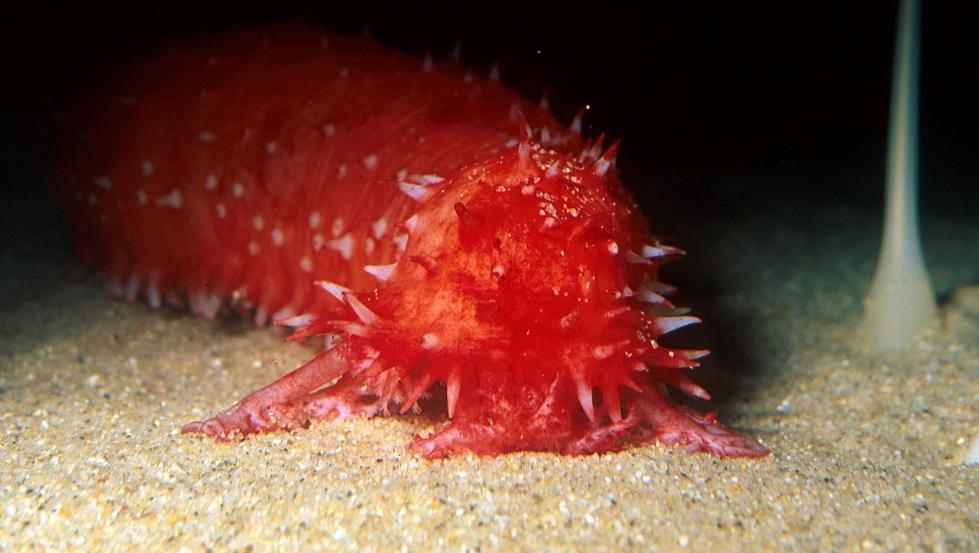
Johnson's sea cucumber feeding in sand
Conservation
Anything that finds its way into the ocean, whether it's tossed away as trash, washes off a beach or falls off a boat, may eventually make its way to the deep sea. It's important to realize that the deep sea is not so far away that it's beyond the reach of human activities. Living creatures in the deep are affected by what we do at the surface.
Cool facts
- Like other sea cucumbers, the Johnson's sea cucumber can shed its internal organs (eviscerate) when attacked by a predator. The sticky organs may entangle and distract the predator, and may provide a meal while the cucumber escapes. The shed organs soon grow back.
Up next in deep sea
Animal
Midwater eelpout
An eelpout's size and body provide clues to understanding life in the midwater.
Keep exploring
Animal
Giant siphonophore
When startled, the giant siphonophore glows with bright blue light.