

Lumpfish
Cyclopterus lumpus
- On view
- Into the Deep
- Animal type
- Fishes
- Ecosystem
- Deep sea
- Relatives
- Other species of marine lumpfishes and lumpsuckers
- Diet
- Invertebrates and fish including jellies, small fish, crustaceans, polychaetes
- Range
- Surface to 2,850 feet (870 meters)
- Size
- Maximum size in males is 20 inches (50 cm); in females 24 inches (61 cm); can weigh up to 21 lb (9.5 kg), but are typically much smaller
Meet the lumpfish
Are lumpfish the most adorable animals in the aquatic realm? These stumpy, lumpy swimmers flap their fins to scoot through the sea and cling to rocks with modified fins that act like suction discs.
About the lumpfish
Appearance
These chubby-looking fish have round, stout bodies and large eyes. They're not the fastest swimmers, propelling themselves through the water with their fanlike pectoral fins and broom-shaped caudal fin.
Lumpfish live up to their name with the assortment of lumps, bumps, and ridges on their rough skin. One of our aquarists describes lumpfish skin as "feeling like old, mold-crusted Jell-O".
Instead of scales, a lumpfish’s body is covered with spots and fleshy knobs called tubercles. A row of larger bumps line the side of their body. The thick layer of skin covering the first dorsal fin creates an enormous ridge along their backs, making lumpfish look like they’re sporting massive, meaty mohawk!
Suction discs
Have you ever stuck a loofah to your shower wall with a suction cup? The lumpfish sports a modified pelvic fin that allows them to attach themselves to objects. Just like your loofah’s suction cup keeps it in place, the lumpfish’s suction disc helps them hold tight to a frond of kelp or a rock when a strong current passes.
The lumpfish belongs to a whole group of fishes that share this fascinating feature. They’re part of the family Cyclopteridae, from the Greek words for "circle" and "fin.”
Color
A young lumpfish might match the color of their surroundings, then develop pale grey to light blue skin as an adult. A breeding male turns orange-red in color, whereas a female shifts to blue-green.
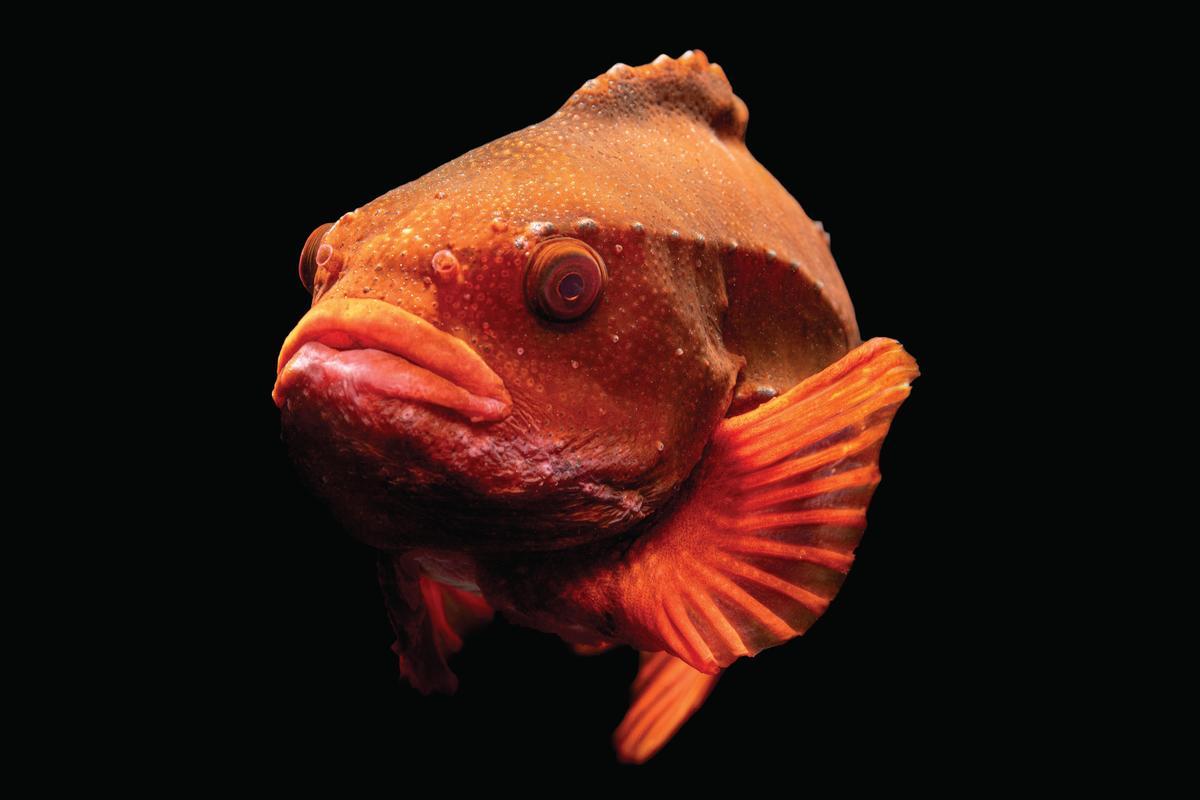
A breeding male lumpfish (Cyclopterus lumpus) turns orange red in color. In contrast, a female will turn blue green when breeding.
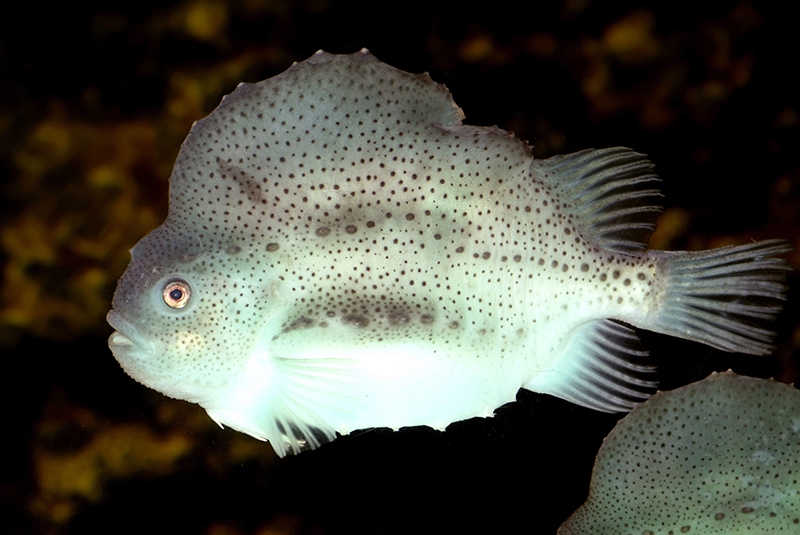
The enormous ridge along the lumpfish's back looks like a massive, meaty mohawk. The ridge is made up of a thick layer of skin covering the first dorsal fin.
© Alamy
Size
Some lumpfish species (like the Pacific spiny lumpsucker) are small and round and look like tiny, colorful chewing-gum bubbles. In contrast, Cyclopterus lumpus is bulkier, heavier, and lumpier. Males grow to 20 inches (50 cm) and females grow even bigger—up to 24 inches (61 cm)! The largest lumpfish can weigh up to 21lb (9.5 kg) but are typically much smaller.
Diet
A lumpfish isn’t a picky eater. They nosh on floating shrimp and jellies, or snap up small fish like herring and sand lance.
Habitat
In the first year of its life, a young lumpfish clings to seaweed in shallow nearshore waters. As adults, they move further from shore, spending more time in colder waters on the rocky seafloor.
The lumpfish lives throughout the North Atlantic. With a range spanning international borders, they’ve accumulated names in a variety of languages, including “henfish” and “lumpsucker” in English and “big sea chicken” (grosse poule de mer) in French.
Migration
A lumpfish spends the winters alone, feeding in cold waters. In the summer they migrate to warm, shallow waters to breed.
How do lumpfish reproduce?
During the breeding season, lumpfish leave the deep, cold waters of the open ocean and swim towards shore to spawn.
The male arrives first to make a nest in a bedrock crevice or depression in the seafloor. Next the female arrives, quickly deposits a spongy egg mass with 140,000 eggs or more into the nest, then swims off. She makes her way towards deeper waters and leaves most of the work to the male to raise the offspring.
Once fertilized, a lumpfish nest requires defense. The male takes on guard duty by suctioning himself next to the nest, fanning it with his fins, and chasing away any potential predators. He fasts this entire time and waits to eat until after the eggs hatch.
What eats lumpfish?
A variety of animals ranging from marine mammals to fish prey on lumpfish, with predators including seals, skates, sperm whales, sharks, and orcas.
Conservation
Lumpfish are designated ”Near Threatened” by the International Union for the Conservation of Nature and Natural Resources (IUCN).
Overfishing is an ongoing threat to their survival. Male lumpfish are considered a delicacy in some cultures, while female lumpfish are sought after for their roe which is sold as affordable caviar. Other threats the lumpfish faces include habitat change and seismic exploration, in which seismic waves are sent into the earth to help search for oil and gas.
Related videos
Watch a lumpfish swim

See the round suction cup on their underside? These modified pelvic fins form a round suction cup to help lumpfish save energy by clinging to rocks and kelp.
Cool facts
- For salmon farmers, the parasitic copepod known as sea lice are a big problem. They infest salmon, stunt their growth, and put their health at risk. Since lumpfish eat sea lice, farmers use them to protect cultured salmon as safe alternative to chemical treatments.
- These fish are right on the money! In Iceland, lumpfish earned a spot on the national currency–the 100 Króna ($0.80 USD) coin features a lumpfish.
Want to see amazing deep-sea creatures up close? Visit our exhibition, Into the Deep: Exploring Our Undiscovered Ocean (En lo Profundo: Explorando Nuestro Océano Desconocido).
Up next in deep sea
Animal
Whalefish
A whalefish feels their way through the deep sea.
Keep exploring
Animal
Giant siphonophore
When startled, the giant siphonophore glows with bright blue light.