

Risso's dolphin
Grampus griseus
- Not on exhibit
- Animal type
- Marine mammals
- Ecosystem
- Open ocean
- Relatives
- Bottlenose dolphin, common dolphin, Pacific white-sided dolphin, orca; Order: Cetacea; Family: Delphinidae
- Diet
- Squid, octopuses and fishes
- Range
- Tropical and temperate waters worldwide, excluding the Arctic Ocean and Southern Ocean
- Size
- Up to 12.5 feet (3.8 m), 650 pounds (300 kg) to 1,100 pounds (500 kg)
Meet Risso's dolphin
Like a battered boxer, the bulky, blunt-headed Risso's dolphin bears lots of scars. Its Latin species name griseus refers to the skin's ghostly gray-white mottling—an effect that is enhanced with age. The scars are made by the teeth of its own kind, and by the beaks and tentacles of squid, its preferred prey.
Watch in real time
Monterey Bay Cam
Check out this live cam – Monterey Bay CamStatus: Least concern
Least concern(active)
Near threatened
Vulnerable
Endangered
Critical
Extinct in wild
Extinct
Did you know?
Famous French anatomist Georges Cuvier formally described the species in 1812 and named it for naturalist Antoine Risso. One of the largest kinds of dolphin, the Risso's dolphin performs an array of acrobatic behaviors, including breaching, spyhopping (vertically poking its head out of the water) and slapping its tail flukes or pectoral flippers on the sea surface.
Most common along the continental slope or in the open ocean, the Risso's dolphin dwells over deep water to hunt vertically migrating squid, octopuses and other cephalopods at night. The marine mammal may seek the glow from its preys' bioluminescent bodies. The stomachs of stranded dolphins in the Mediterranean contained only the remains of cephalopods from 25 different species.
The Risso's dolphin typically gathers in groups of a few up to 30 related individuals of similar age and sex. But this dolphin has been known to form "super-pods" a few thousand strong. Recent research suggests this species has a unique form of social organization, with the most stable groups segregated by age and sex. The Risso's dolphin can be seen swimming alongside several other dolphin species, and with gray whales.
In Monterey Bay
Somewhere between 11,000 and 16,000 Risso's dolphins live along California and the Pacific Northwest coast. In recent decades, Risso's dolphins have been spotted more regularly in Monterey Bay and can be seen with Pacific white-sided dolphins and northern right whale dolphins. Some evidence suggests that Risso's dolphins are particularly abundant in the Monterey region during winter, and come closer to shore during periods of higher surface water temperature. Risso's dolphins are the largest dolphin species to visit Monterey Bay, other than the orca.
Further south, Risso's dolphin numbers have increased in the Southern California Bight, a coastal region from Point Conception to the Mexico border. This species has become common around Santa Catalina Island and may have displaced pilot whales along some stretches of the coast.
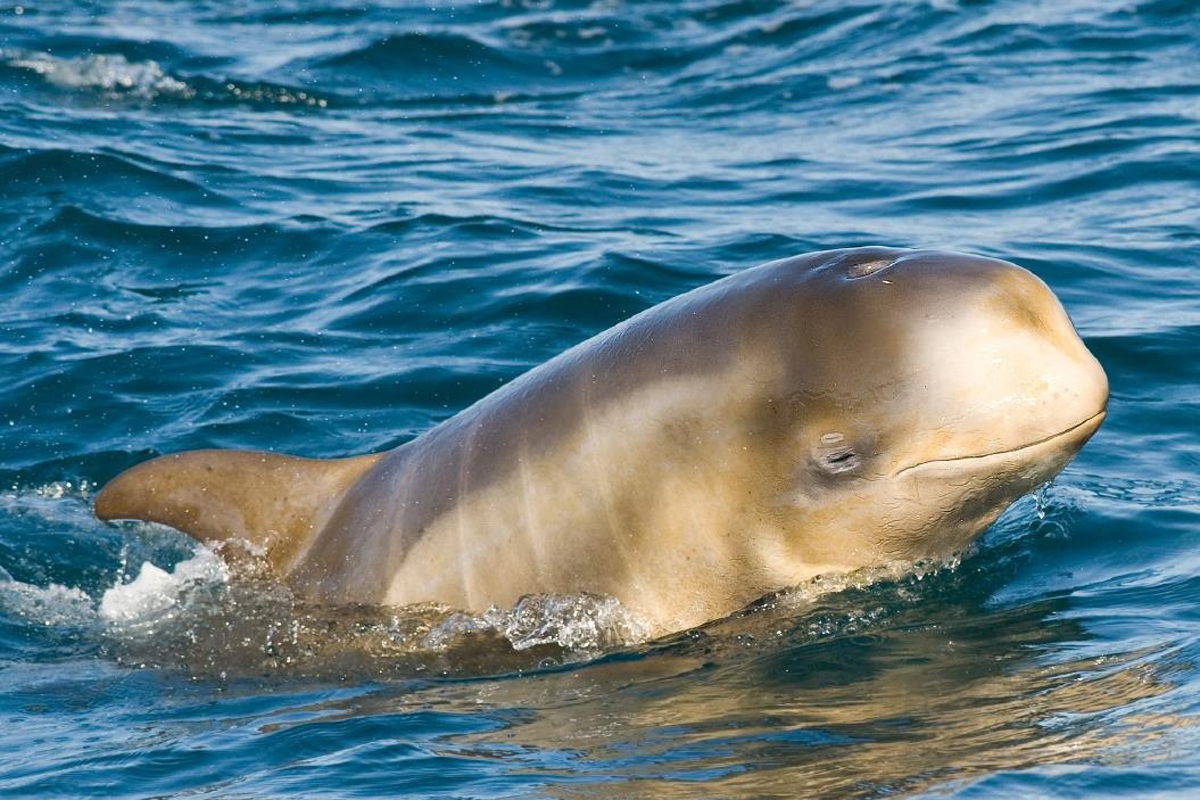
Young Risso's dolphin. Photo credit: © Jim Capwell/www.divecentral.com
Conservation
Historically, Risso's dolphins died in large numbers after being caught in purse seine nets along with tuna. This species benefited from regulation that led to more dolphin-safe tuna fishing practices. Unintended bycatch of dolphins in gillnet and longline fisheries poses a potential threat.
Risso’s dolphins are directly hunted for meat and oil in many parts of the world, including Japan, Indonesia, Sri Lanka, the Solomon Islands and the Caribbean (Lesser Antilles).
The Risso’s Dolphin is a species of “Least Concern” according to the International Union for the Conservation of Nature and Natural Resources (IUCN). Like all marine mammals, Risso’s dolphins are protected under the Marine Mammal Protection Act in the United States.
Cool facts
- The Risso's dolphin lacks teeth in the upper jaw and has no more than seven pairs of conical teeth in the lower jaw.
- The Risso's dolphin has a prominent dorsal fin, sometimes prompting observers at a distance to think it’s an orca or white shark.
- A Risso's dolphin named “Pelorus Jack” became famous for guiding boats across Cook Strait in New Zealand and sparked the first government protection for a cetacean after someone fired a rifle at the curious dolphin in 1904.
- The Risso’s dolphin has been known to hybridize with bottlenose dolphins in captivity and, occasionally, in the wild.
- In Monterey Bay, the Risso’s dolphin is frequently confused with the female and juvenile killer whales due to its large dorsal fin.
- Dives for this species can last over 30 minutes.
Wallpaper
Southern sea otter enrichment wallpaper
Download a beautiful southern sea otter enrichment wallpaper for your desktop or mobile device.
Get wallpaper – Southern sea otter enrichment wallpaperUp next in open ocean
Animal
Short-beaked common dolphin
Striking geometric patterns and yellowish side patches make this the most colorful dolphin species.
Keep exploring
Animal
Moon jelly
This dreamy jelly is named for their translucent, moon-like bell.