

Sea spider
Class Pycnogonida
- On view
- Into the Deep
- Animal type
- Invertebrates
- Ecosystem
- Deep sea
- Relatives
- Crustaceans and other arthropods
- Diet
- Sponges, molluscs, cnidarians
- Range
- Global
- Size
- up to 20 inches (50 cm) in leg span
Meet the sea spider
Sea spiders crawl along sandy seafloors around the world. They can be as small as a grain of sand or as long as a housecat. When a sea spider discovers a soft-bodied animal to snack on, they thrust their straw-like proboscis into the animal’s flesh, then sucks out their insides.
Classification
The class Pycnogonida comprises over 1,300 species of marine arthropods, also called sea spiders. Sea spiders are related to arachnids and crustaceans. As arthropods, they’re all characterized by their exoskeletons and jointed appendages. Despite dwelling in the ocean, the eight-legged sea spider is more closely related to a terrestrial spider than a marine crab. Sea spiders have many unique traits that set them apart, as they’ve been evolving on their own for hundreds of millions of years–the oldest sea spider larva discovered by scientists is over 500 million years old!
Habitat
While 20 percent of the world’s known sea spider species are found in Antarctica, these diverse arthropods are widely distributed in marine ecosystems around the world. They can live in tropical, temperate, and polar oceans from shallow water to the abyssal depths.
Size
Sea spiders range in size from .03 inches (1mm) to 20 inches (50 cm) in leg span—that’s about as long as a housecat!
Sea spider species found closer to the North and South Poles grow much larger than their relatives found in warmer waters. Scientists continue to investigate this mysterious phenomenon known as polar gigantism.
Tamaño
Las arañas de mar varían en tamaño desde 0.03 pulgadas (1 mm) hasta 20 pulgadas (50 cm) de envergadura de patas—¡eso es aproximadamente tan largo como un gato doméstico!
Las especies de arañas de mar que se encuentran más cerca de los Polos Norte y Sur crecen mucho más que sus parientes que habitan en aguas más cálidas. Los científicos continúan investigando este fenómeno misterioso conocido como gigantismo polar.
Related videos
Giant sea spiders eat by sucking fluids out of their prey

Anatomy
A sea spider has a head with a long tubular mouthpart called a proboscis and several simple eyes. They have three to four sets of appendages, including a pair of claws and two ovigers used for grooming and egg-carrying.
The sea spider’s most defining characteristic is their long, multi-jointed legs. These spindly stilts allow them to crawl along the sandy seafloor without getting stuck in sand and silt.
Their legs also house vital organs critical to many of their bodily functions–sea spiders even use their legs to breathe! Their intestines have pouches that extend all the way to the ends of their legs. As oxygen passes along their legs’ large surface area, their intestinal pouches diffuse oxygen throughout their tissues.
Feeding strategies
As a suctorial predator, a sea spider can use their proboscis—a long, tubular mouthpart—to puncture the body of small soft-bodied prey and suck out their internal fluids for sustenance.
Sea spiders can also act as parasites to larger animals by weakening them without killing them. In 2009 MBARI researchers discovered giant sea spiders next to pom-pom anemones in the deep-sea. Scientists at our research and technology partner MBARI observed that sea spiders had been sucking the juices from the anemones' tentacles, leaving them wilted but still alive.
Estrategias de alimentación
Como depredador suctorial, una araña de mar puede usar su probóscide—una parte bucal larga y tubular—para perforar el cuerpo de presas pequeñas de cuerpo blando y succionar sus fluidos internos para alimentarse.
Las arañas de mar también pueden actuar como parásitos de animales más grandes al debilitarlos sin matarlos. En 2009, investigadores de MBARI descubrieron arañas de mar gigantes junto a anémonas pompón en el mar profundo. Científicos de nuestro colaborador asociado en investigación y tecnología MBARI observaron que las arañas de mar habían estado succionando los jugos de los tentáculos de las anémonas, dejándolas marchitas pero aún vivas.
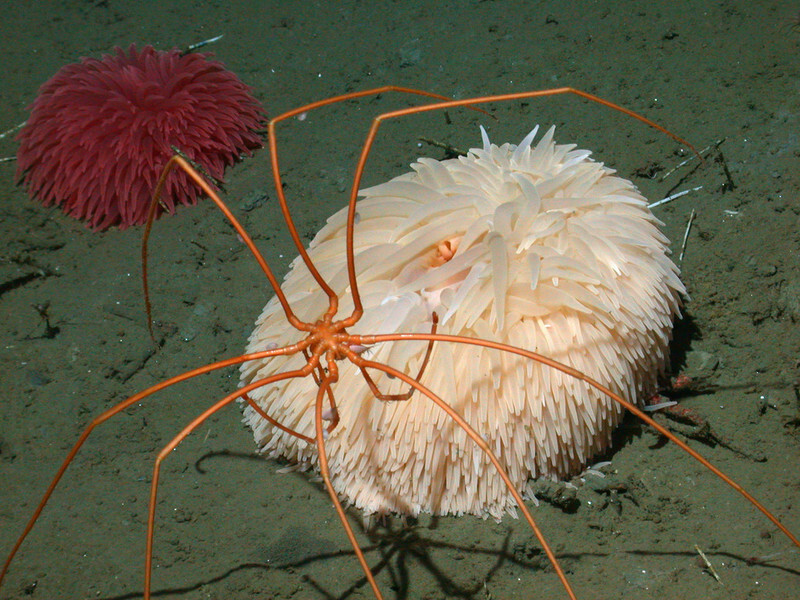
Researchers from MBARI discovered giant sea spiders dining on pom-pom anemones in Monterey Bay.
© MBARI
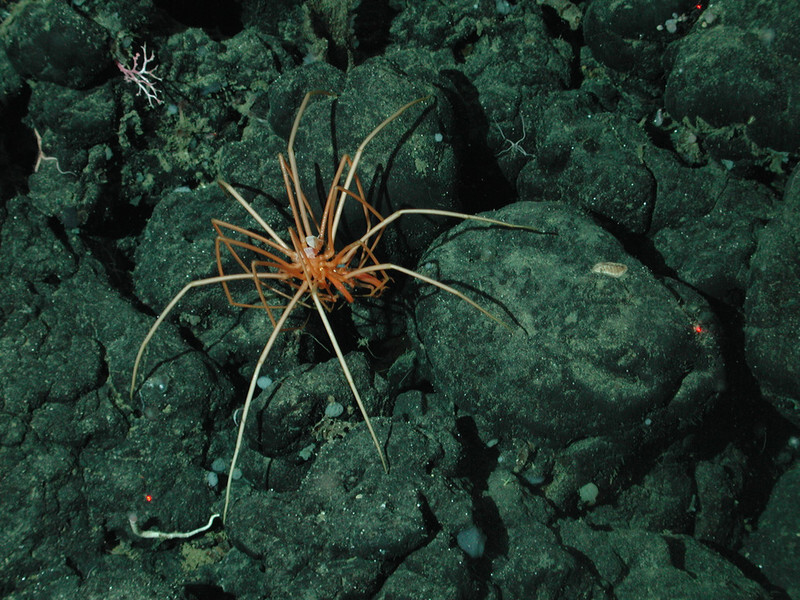
A giant sea spider molts at the Davidson Seamount in Monterey Bay
© MBARI
Diet
A sea spider feeds on soft-bodied animals like anemones, worms, jellies, sponges, soft corals, and nudibranchs.
Mating
Sea spiders mate by using genital pores in their legs. The male sea spider climbs onto the female and the pair adjusts until the pores are aligned. The female releases her eggs then the male combines them with his sperm. The male then carries the eggs on a specialized pair of appendages called ovigers until they hatch.
Predators
Sea stars, shorebirds, rays, crabs, and fishes eat sea spiders. Some sea spider species may hide from their predators by blending into their surroundings. Other species have been observed laying flat and making “sand angels” to burrow into the substrate!
Conservation
Many sea spiders live in sandy seafloor habitats that are heavily impacted by destructive human activities like trawling, where fishing nets are dragged over the seafloor.
Sea spider species from cold water ecosystems in the North and South Poles are especially vulnerable to warming ocean temperatures resulting from climate change.
Cool facts
- Sea spiders can move forward, backward, or sideways without turning their trunk.
- The sea spider’s egg-carrying organs called ovigers are also used for grooming!
- Female sea spiders are often larger than their male counterparts.
- One sea spider species, Ascorhynchus corderoi, has been described as hermaphroditic, meaning they have both ovaries and testes.
- All sea spiders molt as they grow larger.
- The proboscis mouthpart is not unique to sea spiders—many familiar terrestrial species have them, too! For example, bees and butterflies use a proboscis to gather nectar from flowers. The proboscis of mammals like anteaters, elephants, and aardvarks is an elongated nose or snout.
Datos curiosos
- Las arañas de mar pueden moverse hacia adelante, hacia atrás o de lado sin girar su tronco.
- Los órganos portadores de huevos de la araña de mar, llamados ovígeros, ¡también se utilizan para el acicalamiento!
- Las arañas de mar hembras suelen ser más grandes que sus contrapartes masculinas.
- Una especie de araña de mar, Ascorhynchus corderoi, ha sido descrita como hermafrodita, lo que significa que tienen tanto ovarios como testículos.
- Todas las arañas de mar mudan a medida que crecen.
- La parte bucal probóscide no es exclusiva de las arañas de mar; ¡muchas especies terrestres familiares también la tienen! Por ejemplo, las abejas y las mariposas usan una probóscide para recolectar néctar de las flores. La probóscide de mamíferos como los osos hormigueros, elefantes y cerdo hormiguero es una nariz o trompa alargada.
Up next in deep sea
Animal
California sea owl
This hungry sea slug crawls along the seafloor.
Keep exploring
Animal
Giant siphonophore
When startled, the giant siphonophore glows with bright blue light.