

As the early morning sun stretches up into the sky, MBARI's research vessel Rachel Carson slowly motors out of Moss Landing Harbor, past barking sea lions and basking sea otters. As the ship navigates across Monterey Bay, the scientists onboard finish their morning coffee and finalize the dive plan for the day. MBARI engineers and crew have teamed up with Aquarium scientists for a research expedition.
Their goal: find and collect deep-sea jellies and comb jellies.
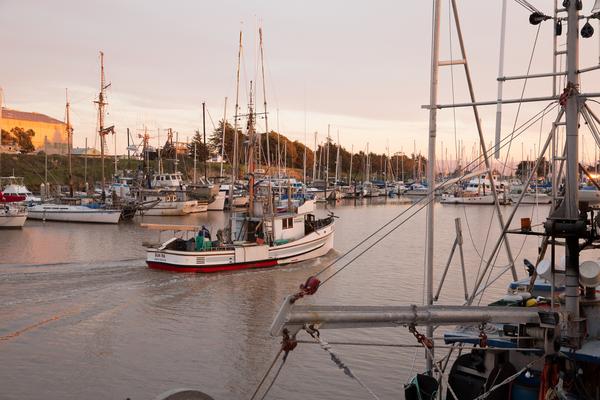
MBARI's research vessels are docked in Moss Landing Harbor.
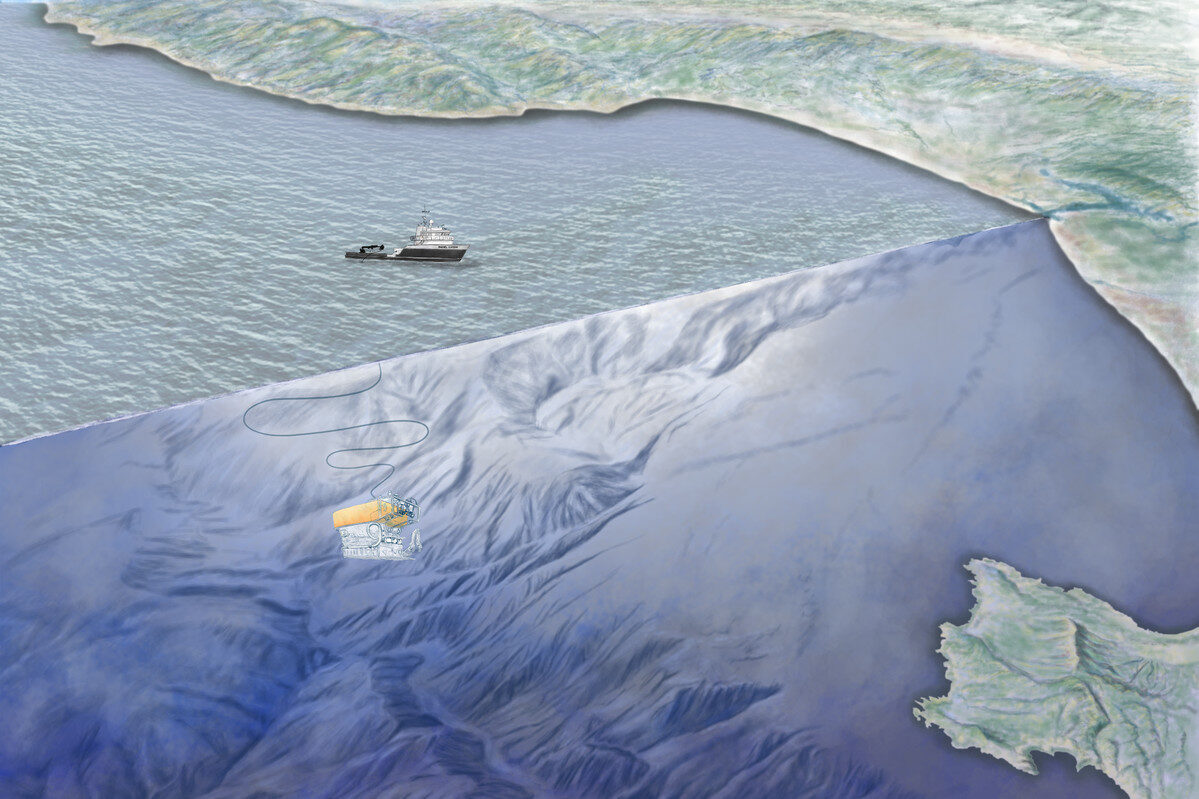
The proximity to the Monterey Bay submarine canyon allows MBARI and Aquarium scientists to more easily explore the deep sea.
© MBARI
Monterey Bay is about 25 miles wide, bisected underwater by the vast Monterey Canyon. The canyon starts just off Moss Landing, and twists and turns almost 250 miles (400 kilometers) out to sea. At its deepest point, it plunges to 2.5 miles (4 kilometers) deep—deeper than the Grand Canyon in Arizona. MBARI’s location at the mouth of the canyon is no accident. Proximity to the canyon allows MBARI and Aquarium teams to more easily explore the mysterious deep-sea environment on a day trip from their home port.
This expedition is one of many that MBARI and Aquarium scientists have undertaken over the years. As the Aquarium’s research and technology partner, MBARI’s mission is to advance marine science and technology to understand a changing ocean.
The explorers search the deep waters of Monterey Bay for animals—to learn about them and sometimes bring them back for public display. A voyage to the deep may result in the discovery of jellies or sea stars for our Into the Deep exhibition. Each trip also presents an opportunity to gather data about the deep-sea environment and its residents—and sometimes make exciting discoveries.
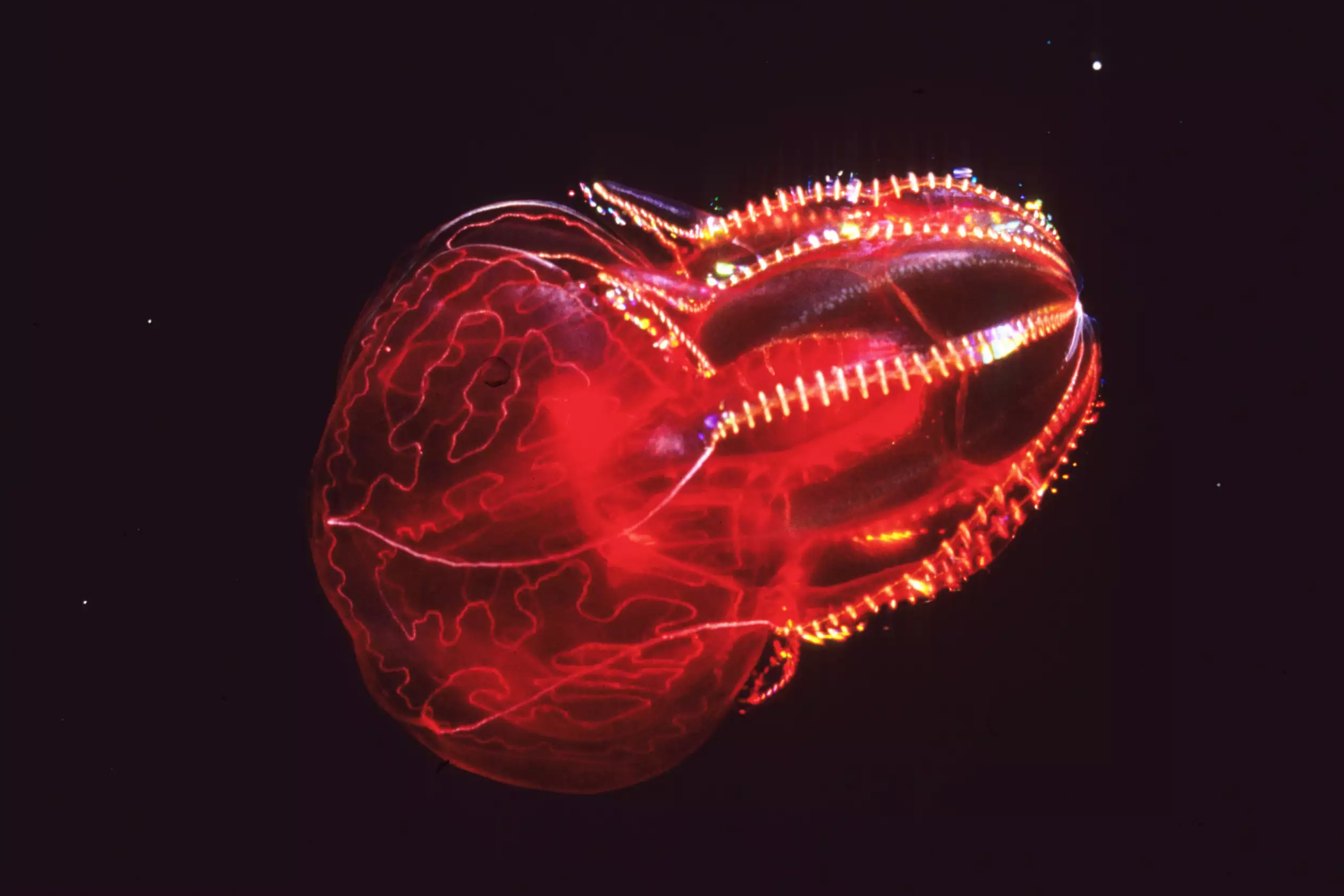
The brilliantly colored bloody-belly comb jelly (Lampocteis cruentiventer) was first described 20 years ago by scientists at our research partner, MBARI. And now, we're the first aquarium to exhibit Lampocteis in the United States as part of our new Into the Deep (En lo profundo) exhibit.
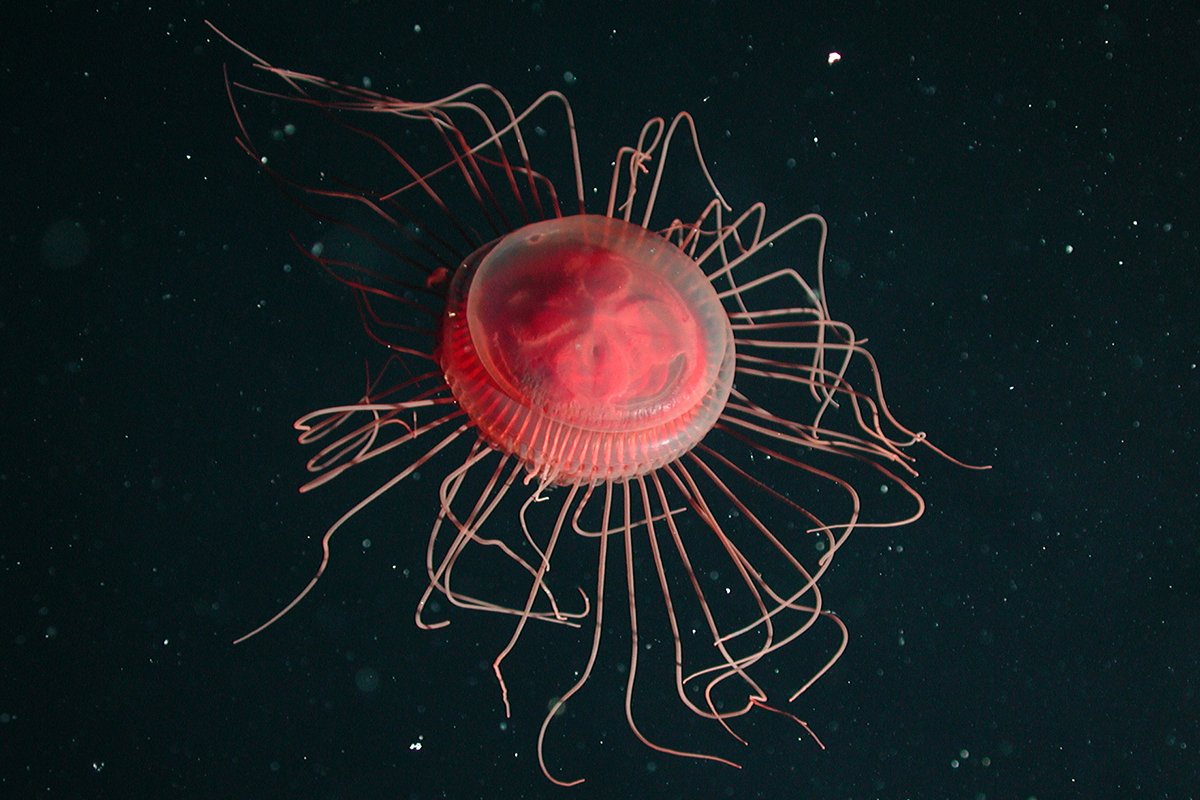
The red crown jelly is found in the deep waters of Monterey Bay.
© MBARI
Journeying for jellies
Once the Rachel Carson arrives at its destination, MBARI’s marine operations team jumps into action. A crane lifts the ROV, about the size of a car, over the side of the ship and into the cold water. The ROV remains attached to the research vessel by a long tether as it navigates through the midwater or along the seafloor. Equipped with two robotic arms, cameras, and a swappable sled of instruments, this crucial tool allows scientists—in tandem with the ROV pilots—to conduct an array of experiments deep beneath the ocean's surface. Today, its mission is to collect living specimens, water and sediment samples, and videos.
Aboard the Rachel Carson, the pilots and scientists sit together in the control room, their eyes trained on large screens mounted on every wall of the dark space. As the ROV descends, its onboard camera shows a flurry of marine snow on the control room screens. After several minutes, the ROV reaches its predetermined depth. The search begins. The pilots use joysticks to move the ROV slowly through the water as scientists scour the video screens for any sign of the deep-sea jellies they seek.
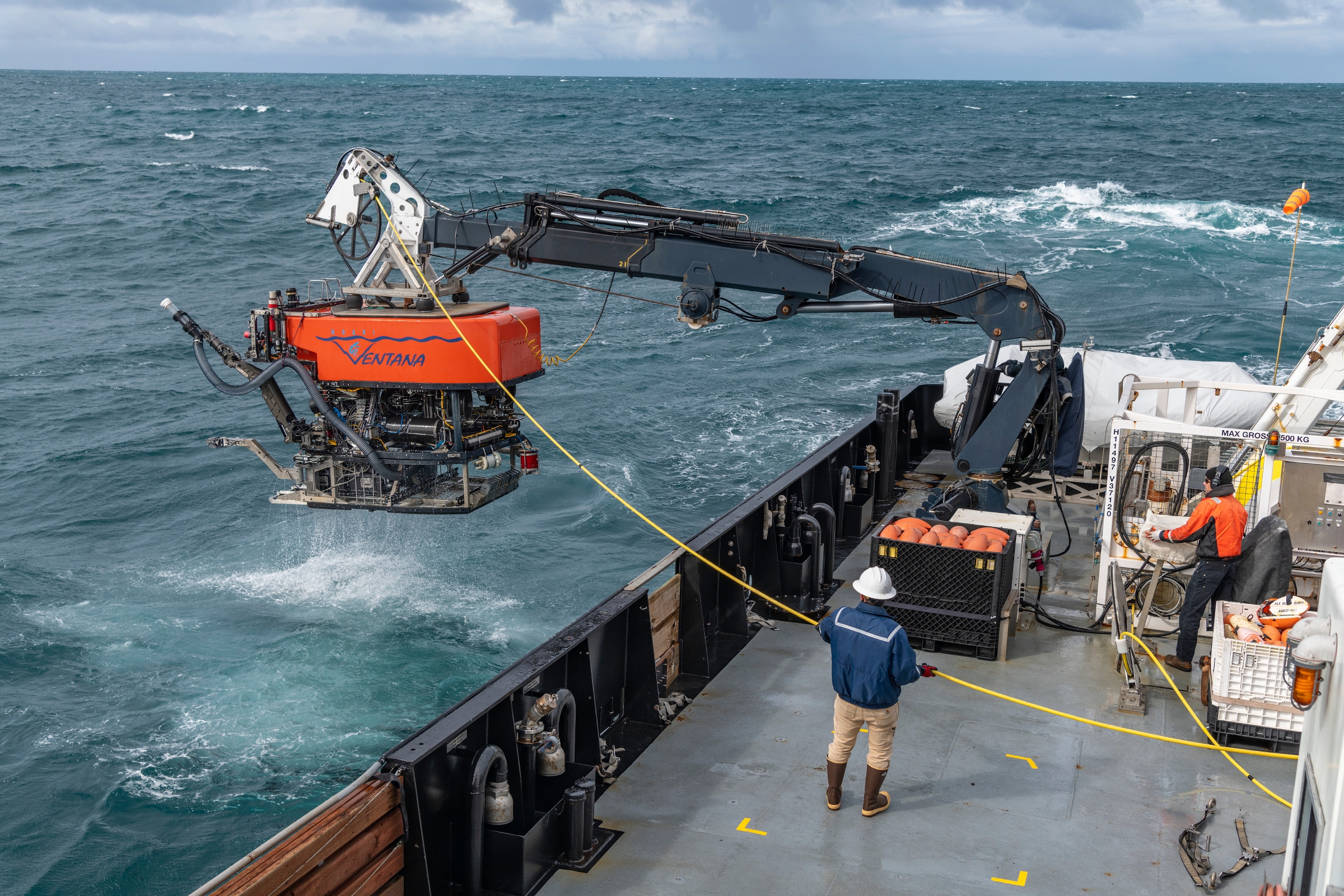
MBARI staff deploy the ROV Ventana over the side of a research vessel. This ROV, about the size of a car, remains attached to the research vessel by a long tether as it navigates through the midwater or along the seafloor. Equipped with two robotic arms, cameras, and a swappable sled of instruments, this crucial tool allows scientists to conduct an array of experiments deep beneath the ocean's surface.
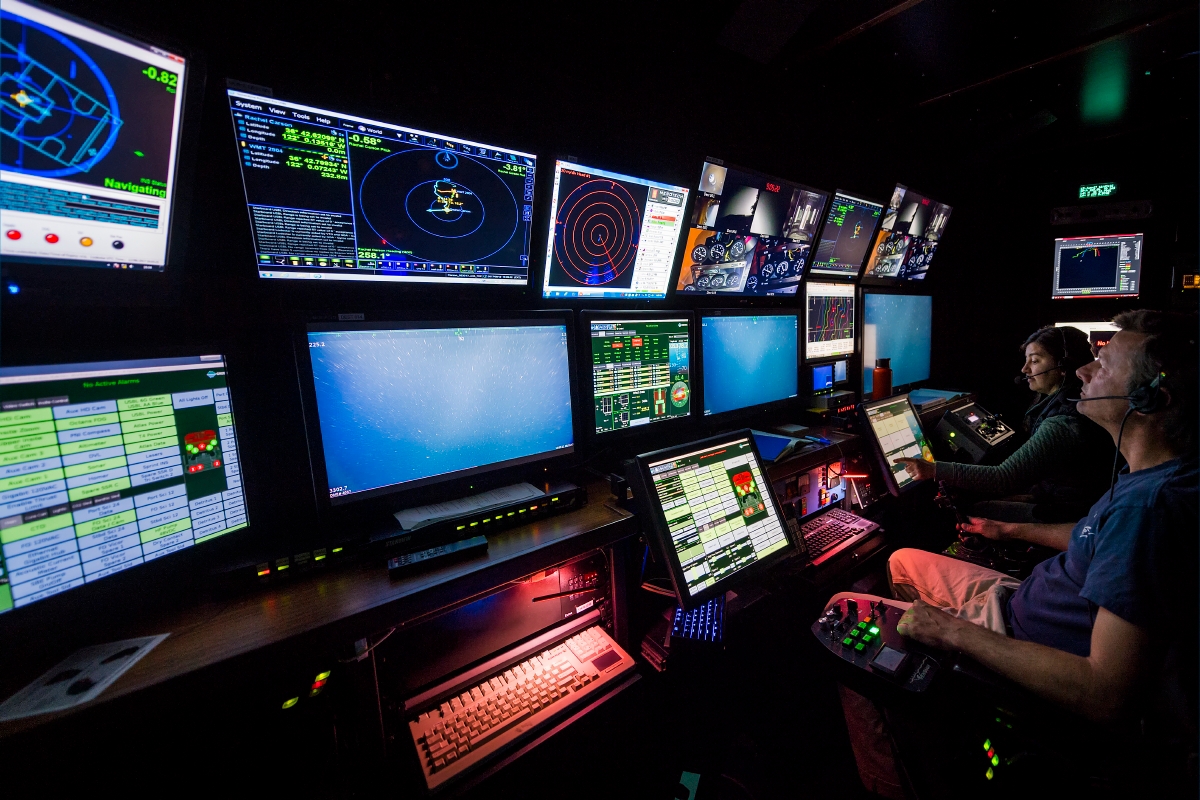
Pilots and scientists sit together in the control room aboard the R/V Rachel Carson, monitoring the large screens for signs of life.
Tools of the trade
Finally, a mostly transparent jelly comes into view. The control room erupts with excited shouts and pointing at the monitors. “There!” Once it’s determined that the specimen is of interest, the team goes about getting ready to collect it. The ROV pilot carefully extends one of the ROV’s robotic arms until it is near the jelly. On the end of the arm is a plexiglass container with a lid. The lid opens and the jelly is gently scooped into the container before the lid closes. The arm then retracts and places the container holding the jelly into one of the ROV’s storage areas.
On other expeditions, where scientists are looking to collect seafloor-dwelling animals like basket stars (Gorgonocephalus eucnemis), a small shovel-like attachment is placed onto the end of the ROV’s robotic arm. The ROV pilot skillfully scoops up the animal, opens a drawer in the bottom of the ROV, and places the basket star inside the drawer.
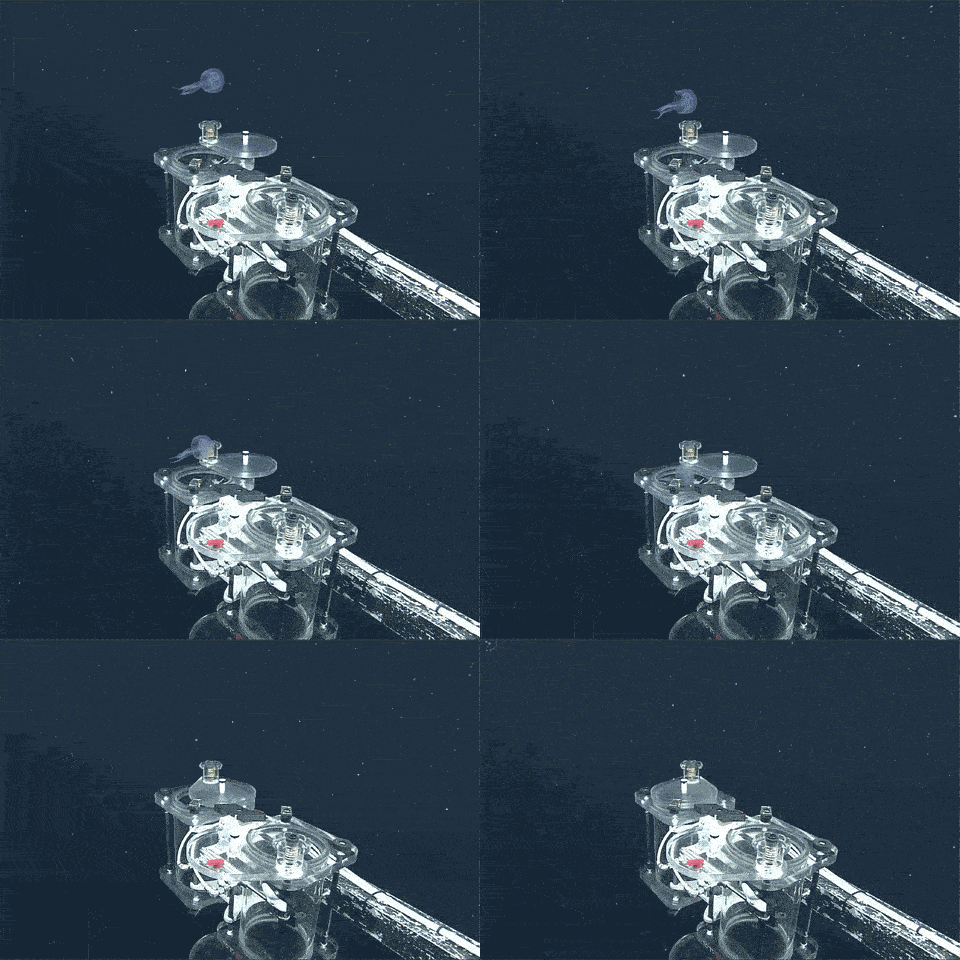
MBARI and Monterey Bay Aquarium staff use a remotely operated vehicle to collect animals in the midwater.
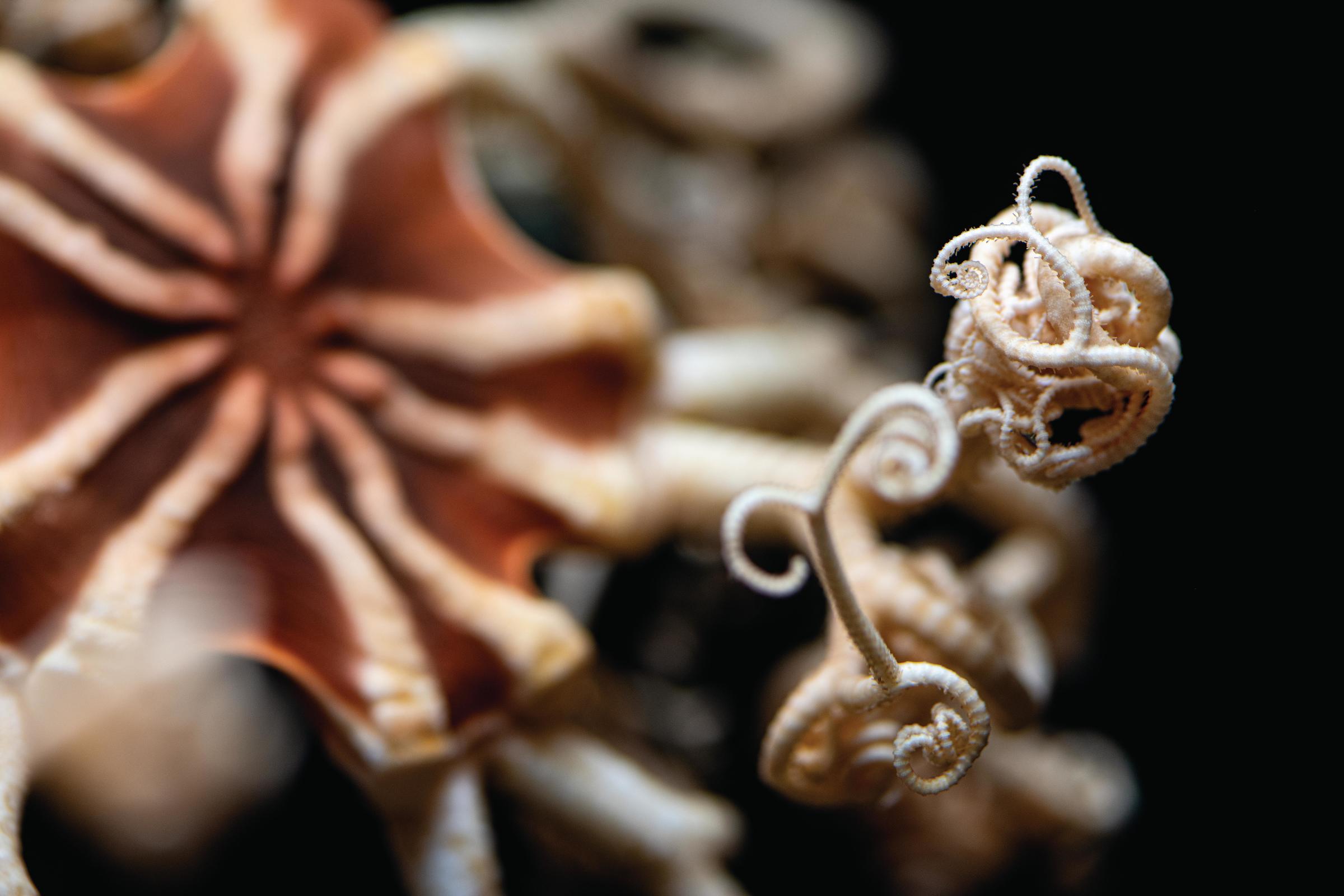
Aquarium and MBARI scientists collect basket stars from Monterey Bay for the Into the Deep exhibition.
A sight for orb eyes
These expeditions have led to several amazing deep-sea discoveries. On one recent expedition, aquarist Tommy Knowles and his team were operating the ROV Ventana when they encountered an uncommon sight: a barreleye fish (Macropinna microstoma).
Tommy recalls the spotting:
“We were diving at 650 meters depth at a site we have been to many times over the year. We were searching for bloody-belly comb jellies and other targets for the Into the Deep exhibition, but instead, we found something we never expected to see. As Knute piloted the ROV Ventana, the shape of a barreleye emerged from the murkiness, and we immediately recognized what we had found and how special it was.”
The barreleye is a peculiar fish known for its unique eyes—two bright green orbs visible through a transparent dome on its forehead. In 2009, MBARI researchers used underwater footage of the barreleye to reveal this animal's surprising feeding behavior: its upward-pointing eyes spot prey in the water above, then rotate forward to see what it is eating.
Such a sighting is extraordinarily rare. In more than three decades of deep-sea expeditions, MBARI's ROVs have logged more than 5,600 dives. Yet they've only encountered the barreleye fish nine times as of 2022. The research team doesn’t collect the barreleye. Instead, it captures video footage as it swims languidly in its habitat. We know little about animals like the barreleye, so opportunities to capture its movements on video add to what we’re learning about its distribution and behaviors.
Related videos
I spy a barreleye
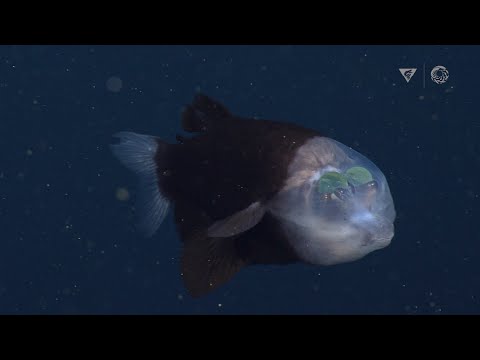
MBARI and Aquarium scientists spotted a rare sight: a barreleye fish (Macropinna microstoma).
MBARI spots a deep-sea dragonfish
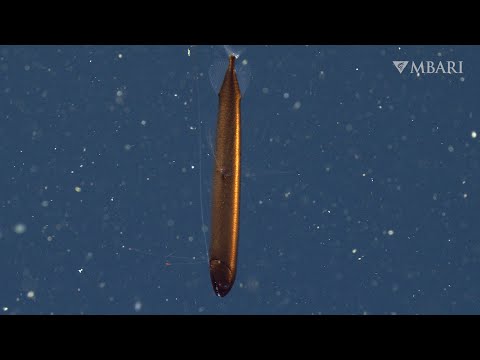
Sometimes, these expeditions lead to encounters that are even more exceptional. In early 2022, another MBARI ship, the Western Flyer, was exploring deep waters just outside Monterey Bay when its scientists spotted a beautiful bronze fish hanging vertically at a depth of nearly 980 feet (300 meters) in the midwater. It was a highfin dragonfish (Bathophilus flemingi).
This deep-sea predator uses a bioluminescent filament on its chin to lure prey close to its mouth. Once in reach, the dragonfish’s needlelike teeth capture the unsuspecting prey.
Although MBARI researchers have observed other species of dragonfishes, this is one of the rarest they’ve ever encountered. In more than 27,600 hours of undersea video footage dating back to the 1980s, they’ve only seen this particular species four times.
Related videos
Dragonfish lurk in the dark depths
Discovering new species
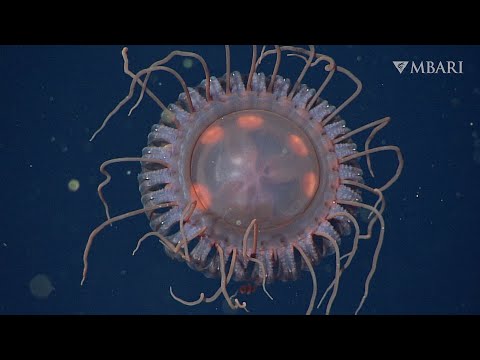
Deep-sea exploration has also led to one of the most exciting discoveries a scientist can make: encountering and describing a new species. The deep-sea crown jelly Atolla is a more common sighting and can be abundant in the deep sea. Atolla is notable for its scarlet-colored bell and having one stinging tentacle much longer than the rest.
Fifteen years ago, MBARI researchers spotted a jelly that looked like Atolla, but that lacked the telltale trailing tentacle. It piqued their curiosity. After using ROVs to observe and collect specimens over the years, MBARI has now confirmed this curious jelly is a new species of Atolla. They’ve named it Atolla reynoldsi in honor of Jeff Reynolds, the very first Monterey Bay Aquarium volunteer. Jeff went on to help develop software that allowed Aquarium presenters to share dozens of interactive video programs with visitors to the Aquarium’s auditorium. Through these programs, presenters share stories about sea otters, white sharks, climate change, as well as highlights from MBARI’s ongoing deep-sea research.
Related videos
Deep-sea crown jelly discovery
So much to learn
These rare sightings and new discoveries remind us that there is still so much to learn about the deep sea. Beyond the Monterey Canyon lies a vast global deep ocean—much of it still unexplored. Our work with MBARI is helping to shine light on the wonders of the deep sea and understanding the animals that call it home.
The Aquarium’s exploration of the deep sea also allows us to understand the needs of the animals that live there, so we can recreate these conditions for the animals on display in Into the Deep: Exploring Our Undiscovered Ocean (En lo Profundo: Explorando Nuestro Océano Desconocido). This exhibition invites the public to experience the deep sea and meet some of its fascinating and extraordinary animals.
Through the Aquarium and MBARI’s unique position to combine innovative research and new animal care techniques, we can be leaders in deep-sea research as well as education. This allows us to promote the protection of the deep sea on many levels—and protect it for future generations.
Keep exploring
Story
Nature is queer
We’re excited to sea-lebrate the queerness of nature!
Read story – Nature is queer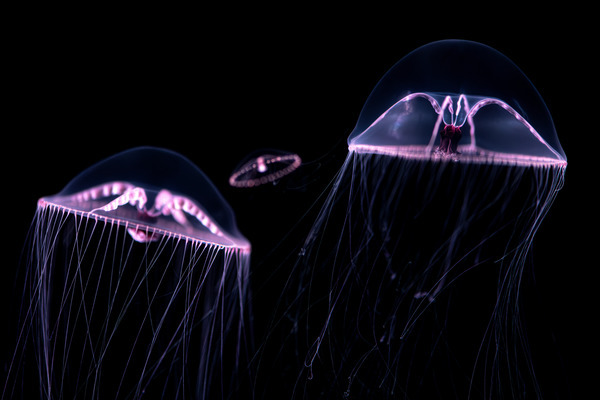
Story
2026 Lucile S. Packard Memorial Award and Youth Award recipients
We’re proud to announce the 2026 Lucile S. Packard Memorial and Youth Awards for outstanding volunteers!
Read story – 2026 Lucile S. Packard Memorial Award and Youth Award recipients
Story
Birdwatching tips: A guide to enjoying and identifying local birds
Here are our best tips to help keep you and the birds safe and healthy during a birdwatching adventure.
Read story – Birdwatching tips: A guide to enjoying and identifying local birds