

For decades, our Animal Care team has been learning about the needs of deep-sea animals.
We’ve worked with our research partners at MBARI (Monterey Bay Aquarium Research Institute) to study and collect denizens of the Monterey submarine canyon. Back at the Aquarium, our Applied Water Science department has been creating a sophisticated life support system.
After years of refining and testing, the result is Into the Deep: Exploring Our Undiscovered Ocean (En lo Profundo: Explorando Nuestro Océano Desconocido)—an innovative exhibition that showcases extraordinary deep-sea animals. Some are on display for the first time anywhere.
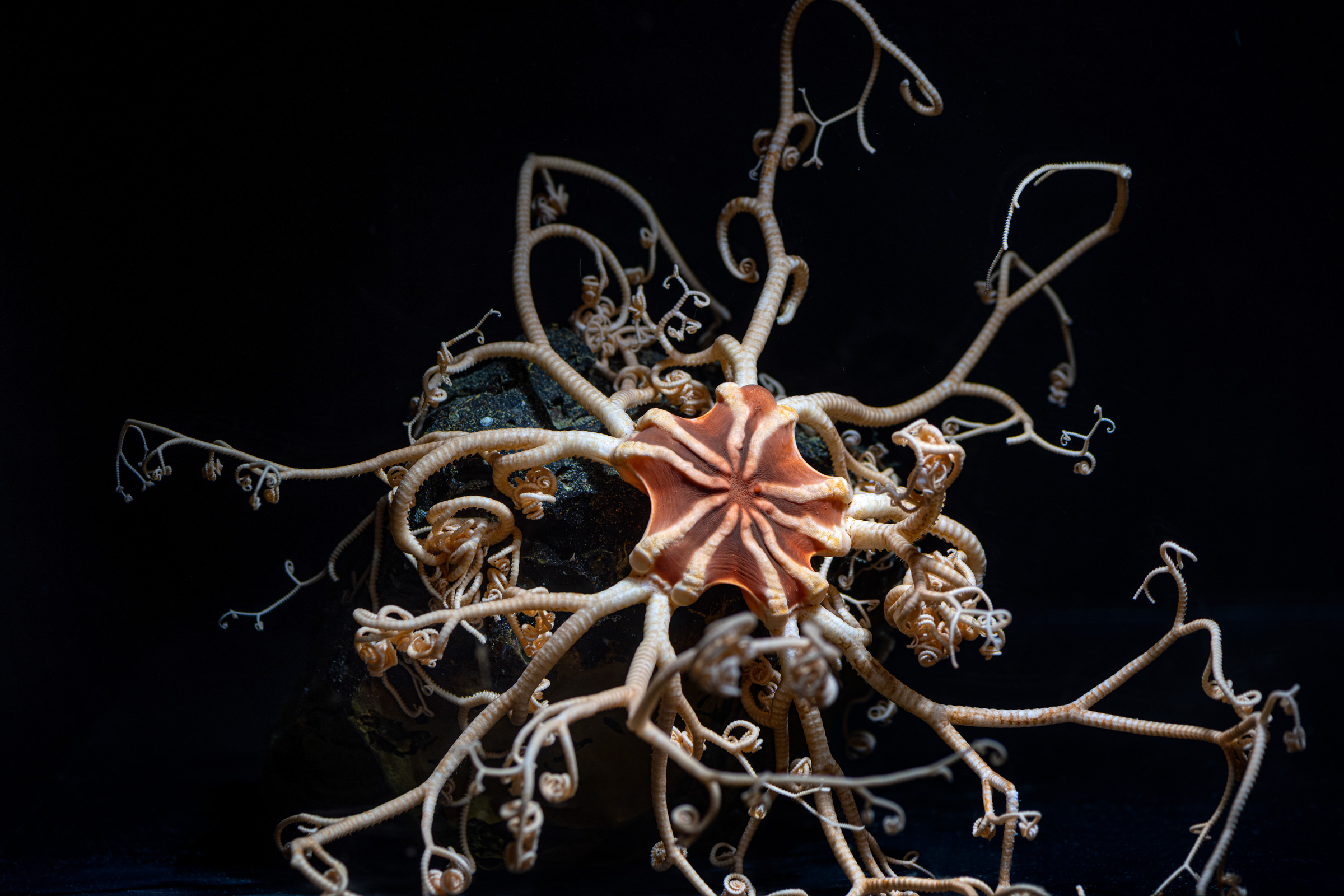
We’ve worked with our research partners at MBARI (Monterey Bay Aquarium Research Institute) to study and collect denizens of the Monterey submarine canyon, like this basket star (Gorgonocephalus eucnemis).
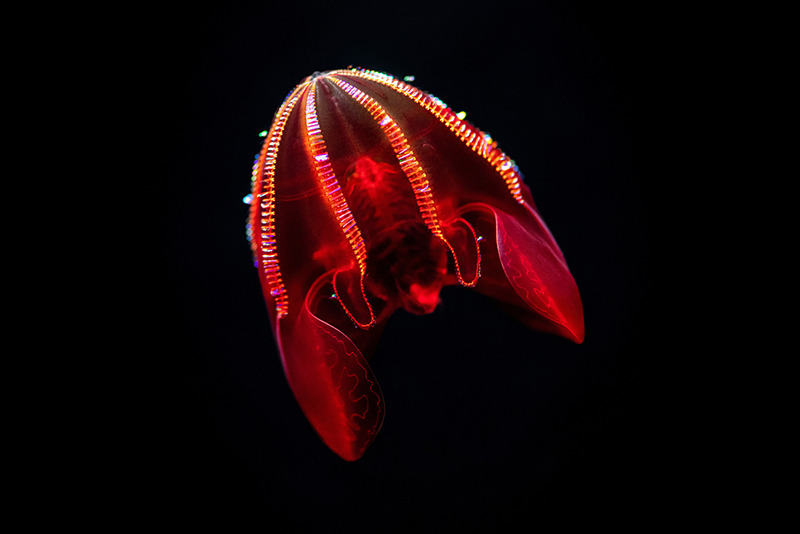
In Into the Deep, the bloody belly comb jelly (Lampocteis cruentiventer) is on view for the first time anywhere.
They’re not under pressure
The first question most folks have about our new exhibition is how we mimic the high-pressure environment of the deep sea. “The short and sweet answer is that we don’t,” says Paul Clarkson, the Aquarium’s director of husbandry operations.
“Deep-sea habitats are under what we would call soul-crushing pressure, and animals are adapted to live in those pressures. However, many of them adapt just fine to surface pressures,” he says. The animals we chose to exhibit are those that adjust well to the lower pressure of surface waters.
Pressurizing the exhibits was never an option.
“The technology to pressurize large volumes of seawater is still not practical,” Paul explains. Instead, deep-sea animals that thrive in high-pressure environments will be showcased through high-definition video and multimedia experiences like a deep-sea bioluminescence lightshow.
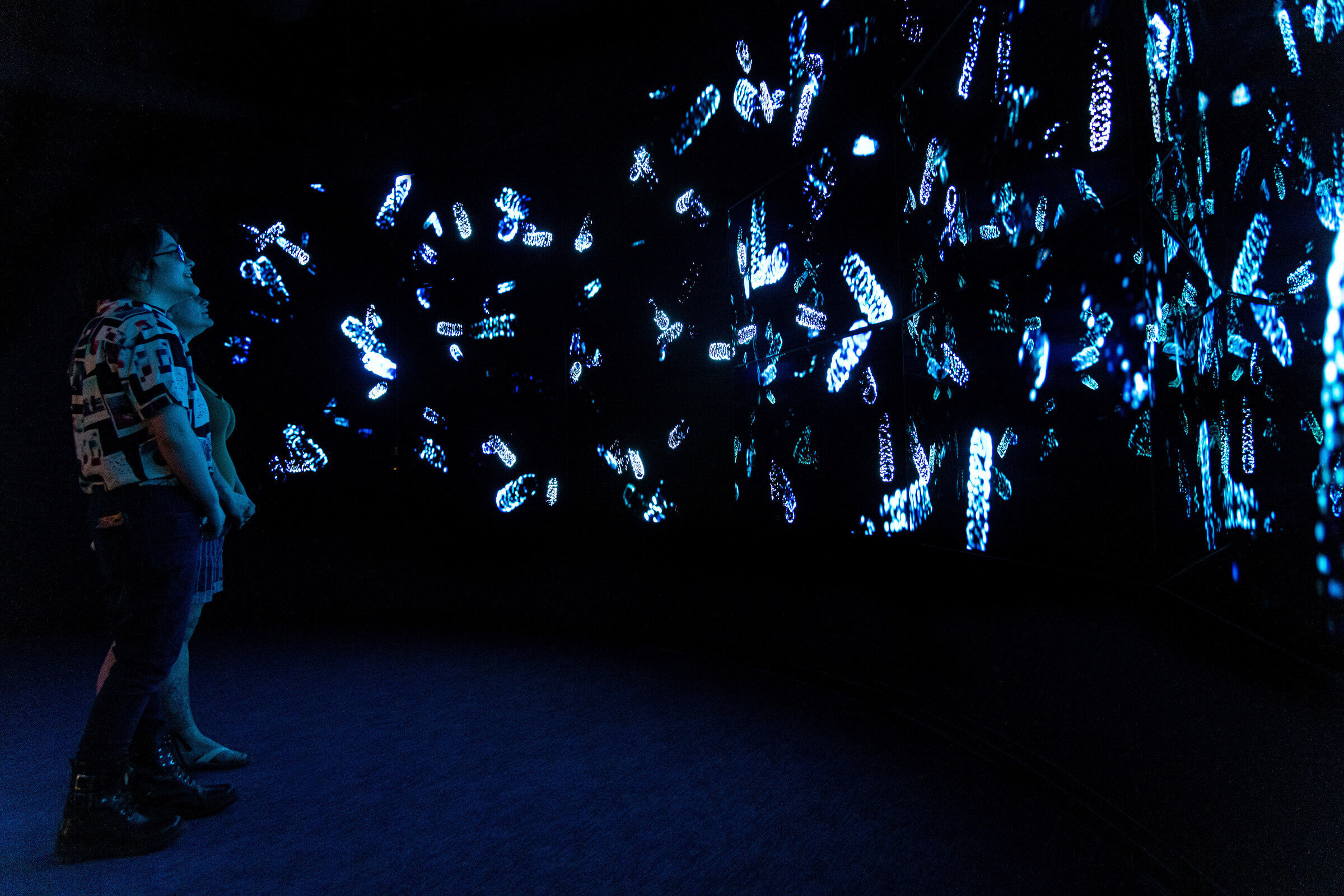
Among other multimedia experiences, visitors can experience a deep-sea bioluminescence lightshow in Into the Deep.
An ever-evolving exhibit
The species on display in Into the Deep will rotate out and change over time. “You may see one jelly on day one—and come back to see three different species during another visit,” says Paul. “If you visit us next month, it will undoubtedly be a different experience than when you come back in a few months or a few years.”
Rotating species through the exhibition poses another significant challenge for Aquarium engineers. How do you design and develop a life support system for an unknown collection of animals?
Our solution is flexibility: we can adjust conditions in the exhibits to accommodate the needs of individual species. For example, nine of our exhibits allow us to adjust oxygen, pH, and temperature independently. This means we can rotate multiple species through the exhibits over time, replacing them with others, all using the same infrastructure.
How do we know what the animals need?
The seawater that supplies Into the Deep comes through the ocean intake pipes that supply most of our other exhibits.
Then, we adjust it to meet the needs of deep-sea species. Deep-sea water is colder and many areas of the deep are much lower in oxygen. Seawater chemistry in the deep is often different from that at the surface, too.
To understand the particular needs of each animal we display, we work closely with our MBARI colleagues and other scientists studying the deep sea.
Researchers routinely send instruments to the deep sea to analyze conditions there. During collecting trips, these instruments measure temperature, pH, and oxygen concentration at the moment the animal is collected. We use this information to inform the conditions we recreate for them in the exhibit.
This work reflects a close collaboration between science and engineering—scientists document the ideal conditions deep-sea animals need to thrive, and engineers build systems that replicate those conditions in our displays.
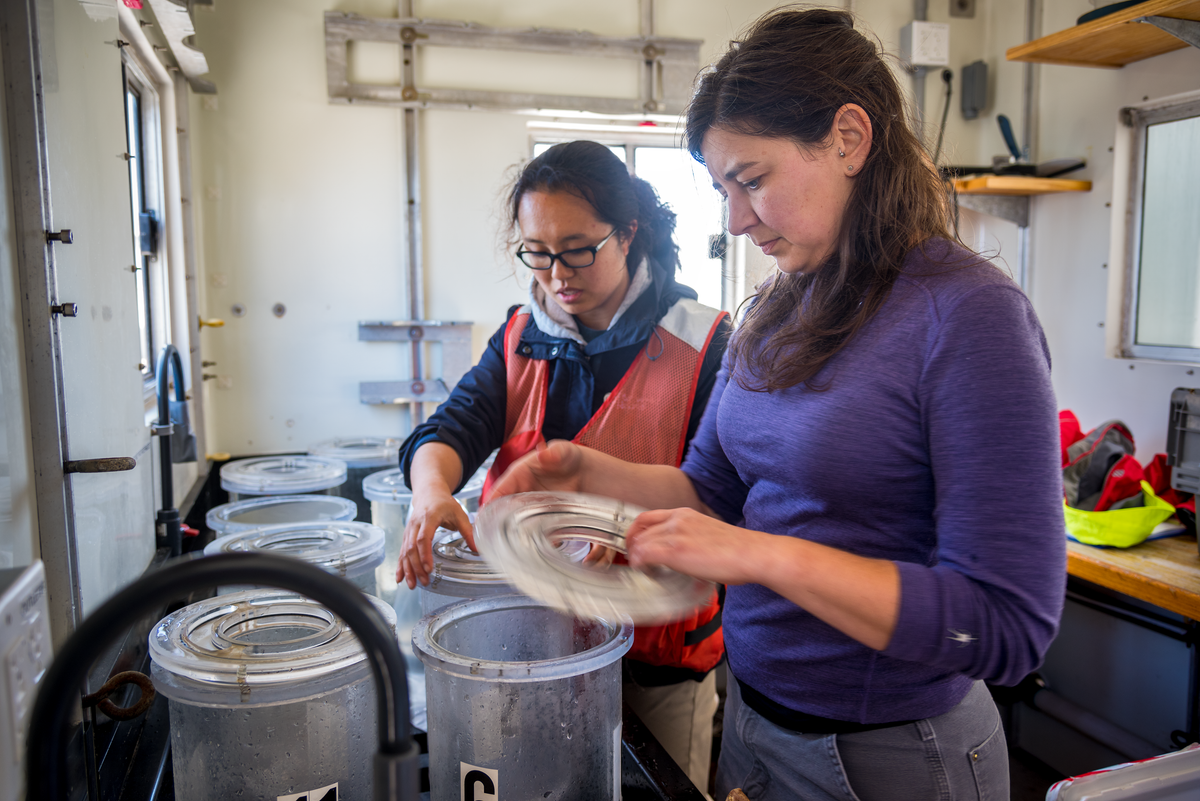
We work with MBARI (Monterey Bay Aquarium Research Institute) to research and collect deep-sea animals in Monterey submarine canyon.

Researchers send instruments to the deep sea to help us understand where the animals live, what they eat, and exactly what’s in the water. We use this information to inform the conditions we recreate for them in the exhibit.
Recreating the oxygen minimum zone
Many animals we exhibit live in low-oxygen environments, including the oxygen minimum zone, a region with very little oxygen found at depths from 200 to 1,000 meters (650 to 3,000 feet) deep.
For Into the Deep, “we were able to essentially recreate the oxygen minimum zone,” says Paul. Most of our animals are kept in water with oxygen saturation rates between five and 30 percent. By contrast, surface water on a sunny day might have oxygen levels from 80 to 105 percent saturation.
Our most sensitive animals—including the sea angel, bloody-belly comb jelly, and red paper lantern jelly—live in seawater with as little as three percent oxygen saturation!
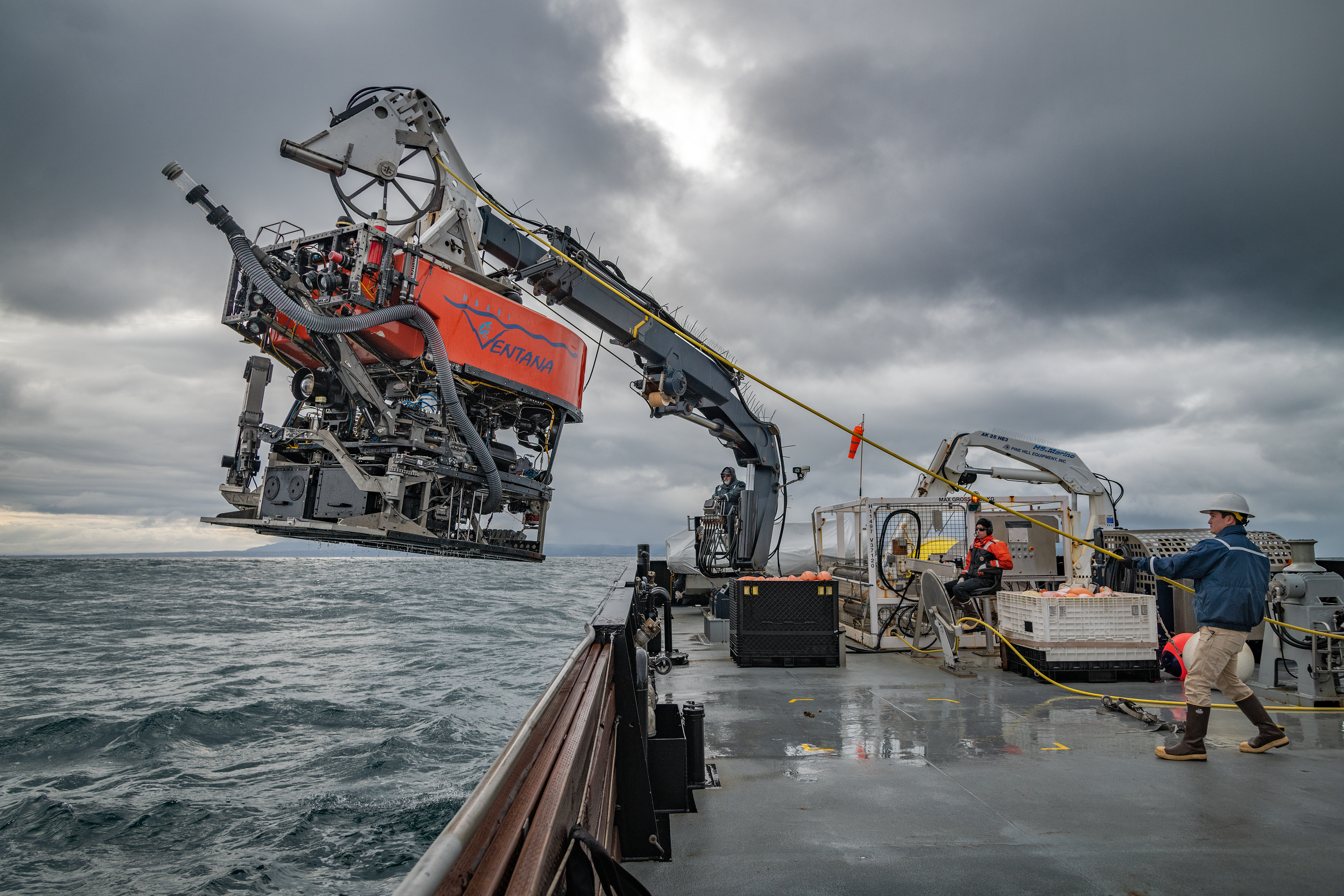
A remotely operated vehicle (ROV), Ventana, being lowered into the ocean during a research and collection trip aboard the Rachel Carson.
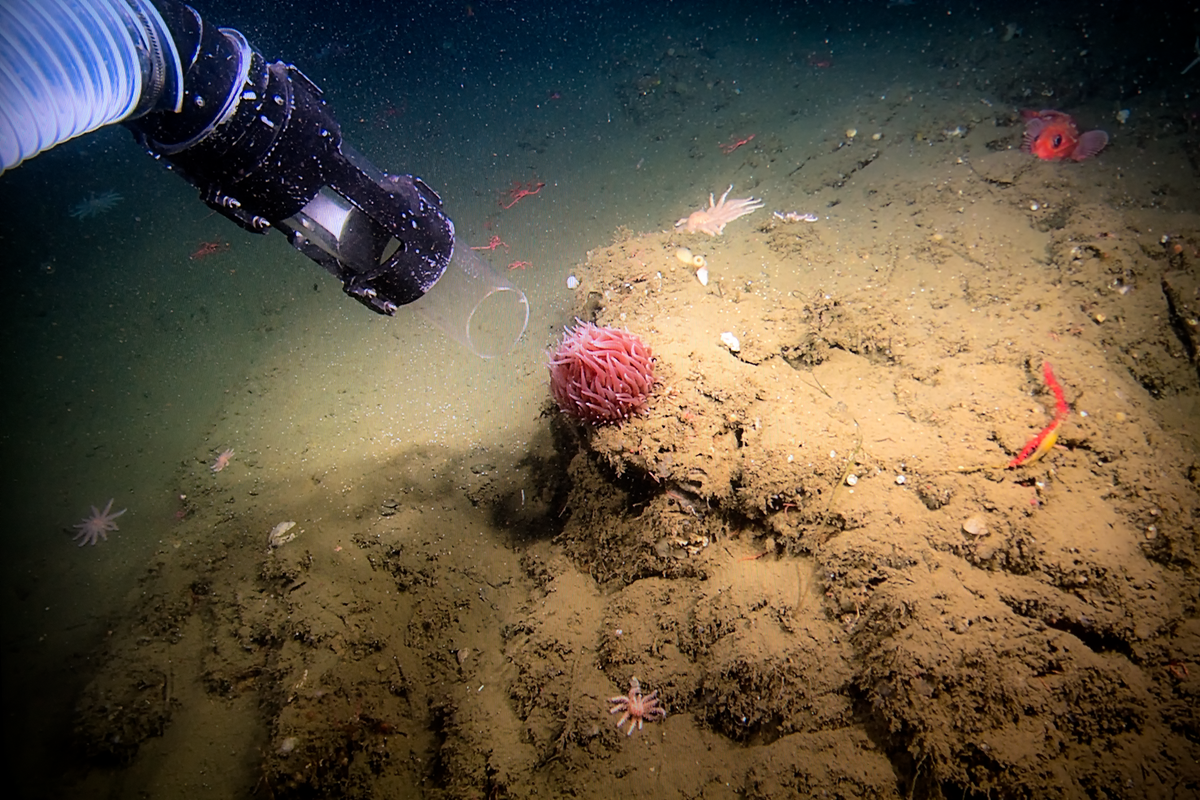
MBARI and Monterey Bay Aquarium staff use a remotely operated vehicle to collect animals on the seafloor.
Innovating a new technique
It takes extraordinary care to keep oxygen levels this low so we can display delicate deep-sea animals. That’s where water science and engineering come into play.
“In the past, we would bubble nitrogen into the water to push out the oxygen,” Water systems engineer Kyle Harrigan recalls. “This works for some animals, but not jellies because the process creates microbubbles.” These microbubbles can get caught in a jelly’s bell or interfere with how the animal floats. In fact, most animals we exhibit do better without microbubbles. “It’s a serious water quality challenge,” says Karen Tuttle, our water science laboratory manager.
To avoid producing microbubbles, “We had to flip everything topsy-turvy,” she says.
Brian Maurer, our manager of life support systems, led the team’s efforts to experiment and create a new design. “I love that we get to come up with new ways to do things. We can try things—and if we fail, we can try something else,” he says.
Their solution is a unique, never-before-used innovation. “We pull the oxygen out rather than push it out,” Kyle explains. The automated process uses gas transfer membranes bundled together like a batch of drinking straws. This system allows us to constantly adjust oxygen levels: “we can take in oxygen, then remove it, take it in, then remove it.”
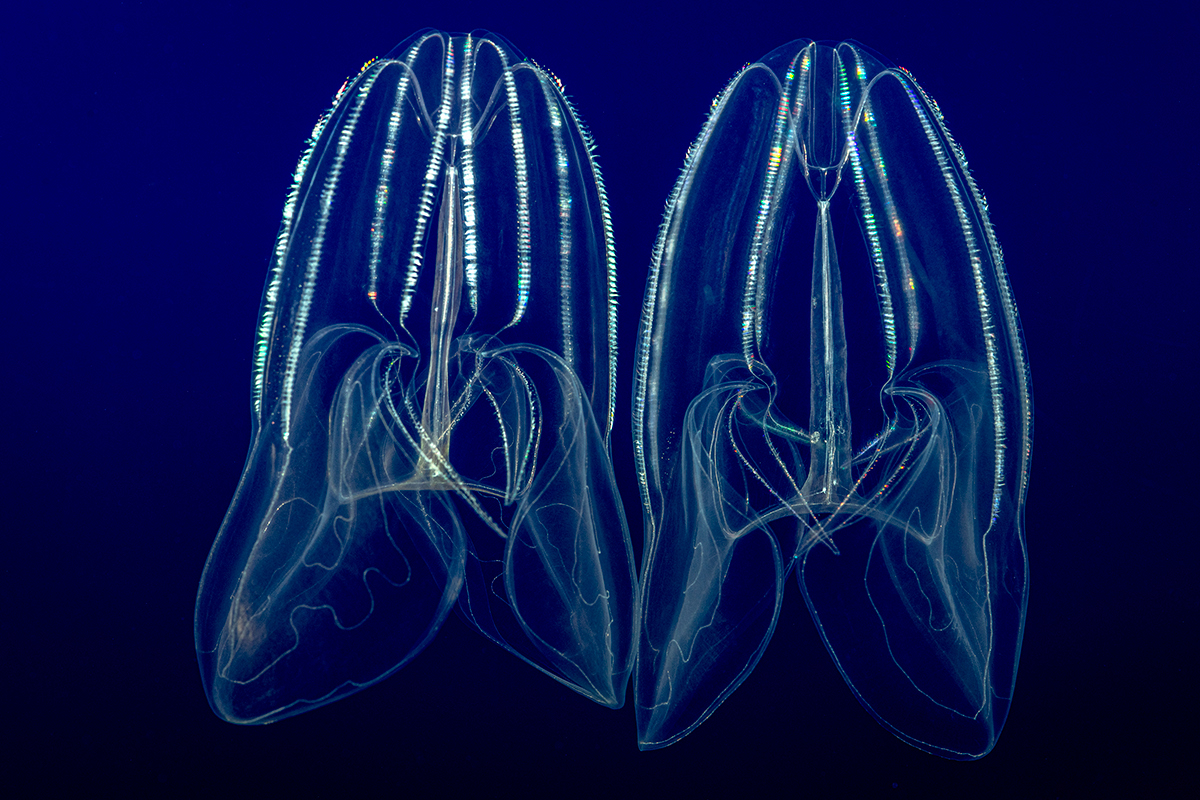
Deep-sea jellies like the lobed comb jelly (Bolinopsis infundibulum) require low-oxygen conditions. Brian Maurer, our manager of life support systems, led the Aquarium's efforts to design a low-oxygen life support system. “I love that we get to come up with new ways to do things,” he says.
MBA
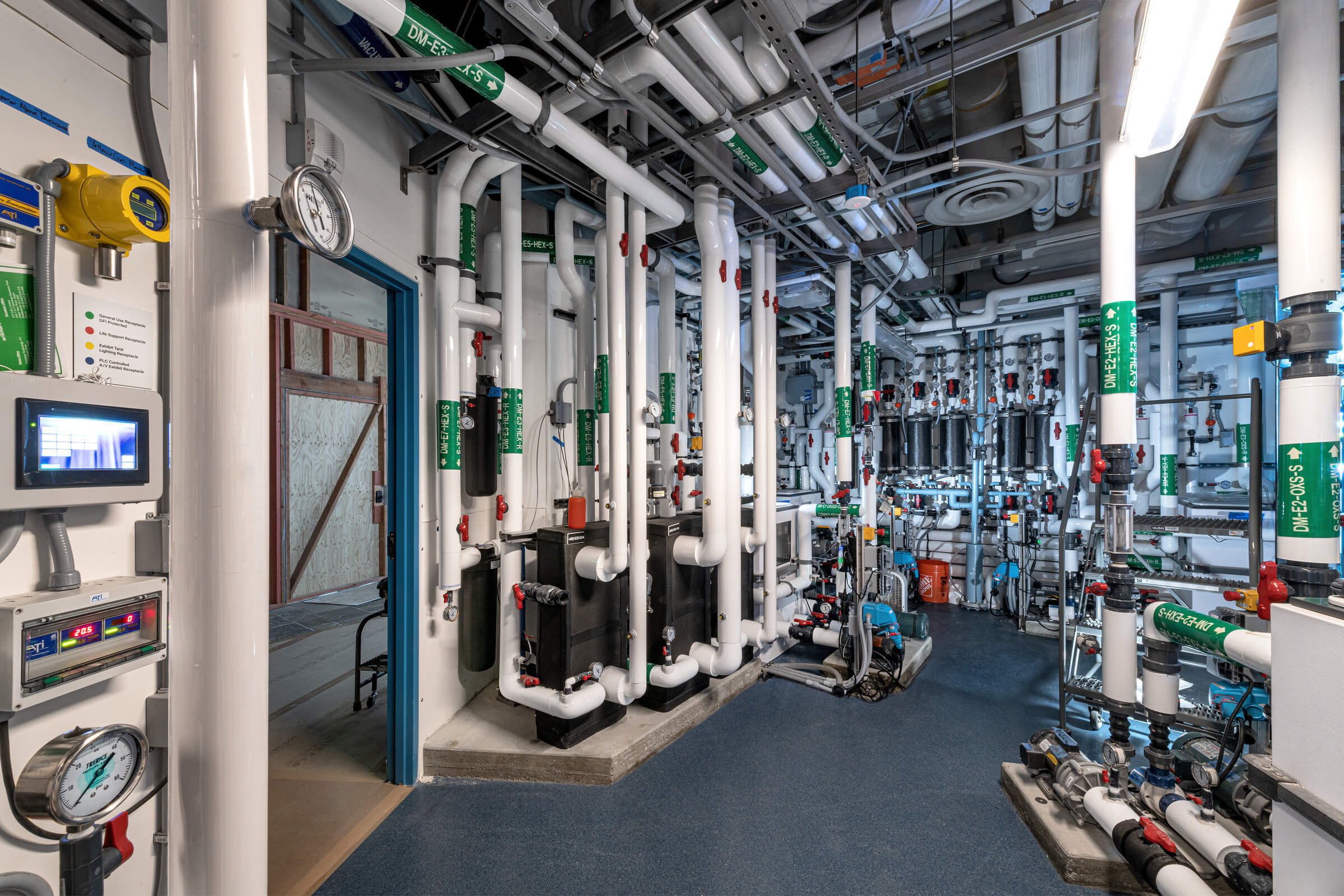
The Aquarium's water science team developed a unique, never-before-used approach to maintaining low-oxygen exhibits. Complex networks of pipes, valves, membranes, and computers are part of this automated system.
Keeping it cool
The waters of the deep sea are frigid. For animals in Into the Deep, we maintain temperatures between 40 to 50 degrees Fahrenheit. And we tailor the temperatures to the needs of different species.
The coldest temperatures we have are around 40 degrees for animals like deep-sea corals, paper lantern jellies, and comb jellies. Other animals are comfortable in warmer temperatures. The mauve stinger jelly, for example, floats in water kept around 65 degrees Fahrenheit.
For each exhibit, we carefully monitor the temperature 24/7.
Kyle explains that “valves automatically open or close to keep the temperature nice and stable at any target we choose.”
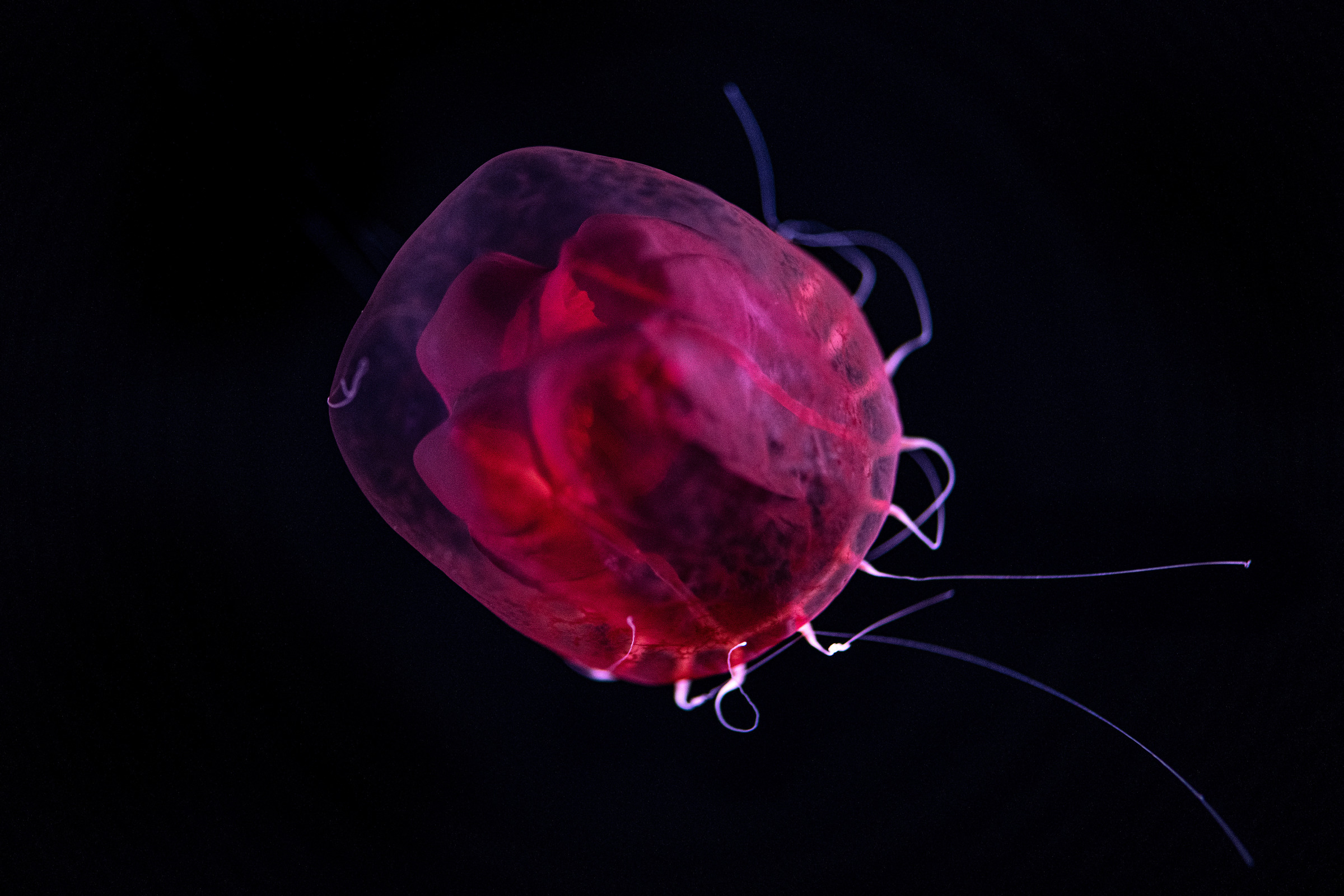
The red paper lantern jelly (Pandea rubra) lives in water that is about 40 degrees Fahrenheit.
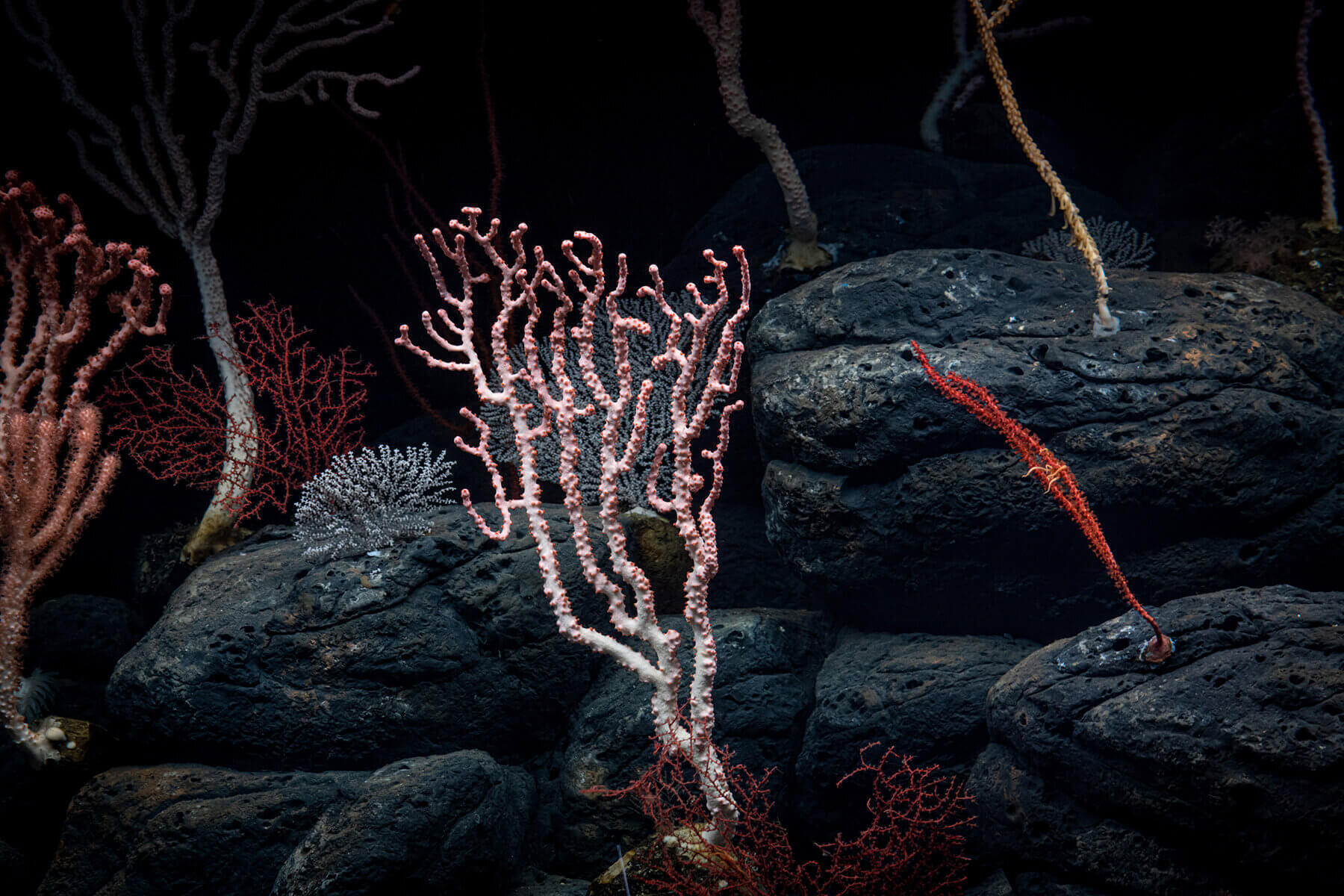
Bubblegum coral (Paragorgia arborea) at the center of the coral community in Into the Deep. This exhibit is also maintained at a chilly 40 degrees Fahrenheit.
Getting the pH just right
Deep-sea water has a lower pH (is more acidic) than surface water.
Our water science team is careful to get the pH just right for each deep-sea animal on exhibit.
For example, in the wild the mauve stinger migrates up to surface waters to feed at night, then back to the depths during daylight hours—so it’s comfortable in a higher pH environment similar to that at the surface. By contrast, the predatory tunicate spends all its life in the more acidic environment of Monterey Canyon’s seafloor; it requires lower pH water in its exhibit.
To keep pH levels steady, our team injects the water with carbon dioxide. It reacts with seawater to form carbonic acid, which increases the water’s acidity (or lowers its pH). This helps ensure our animals live in water that is perfectly calibrated to their needs.
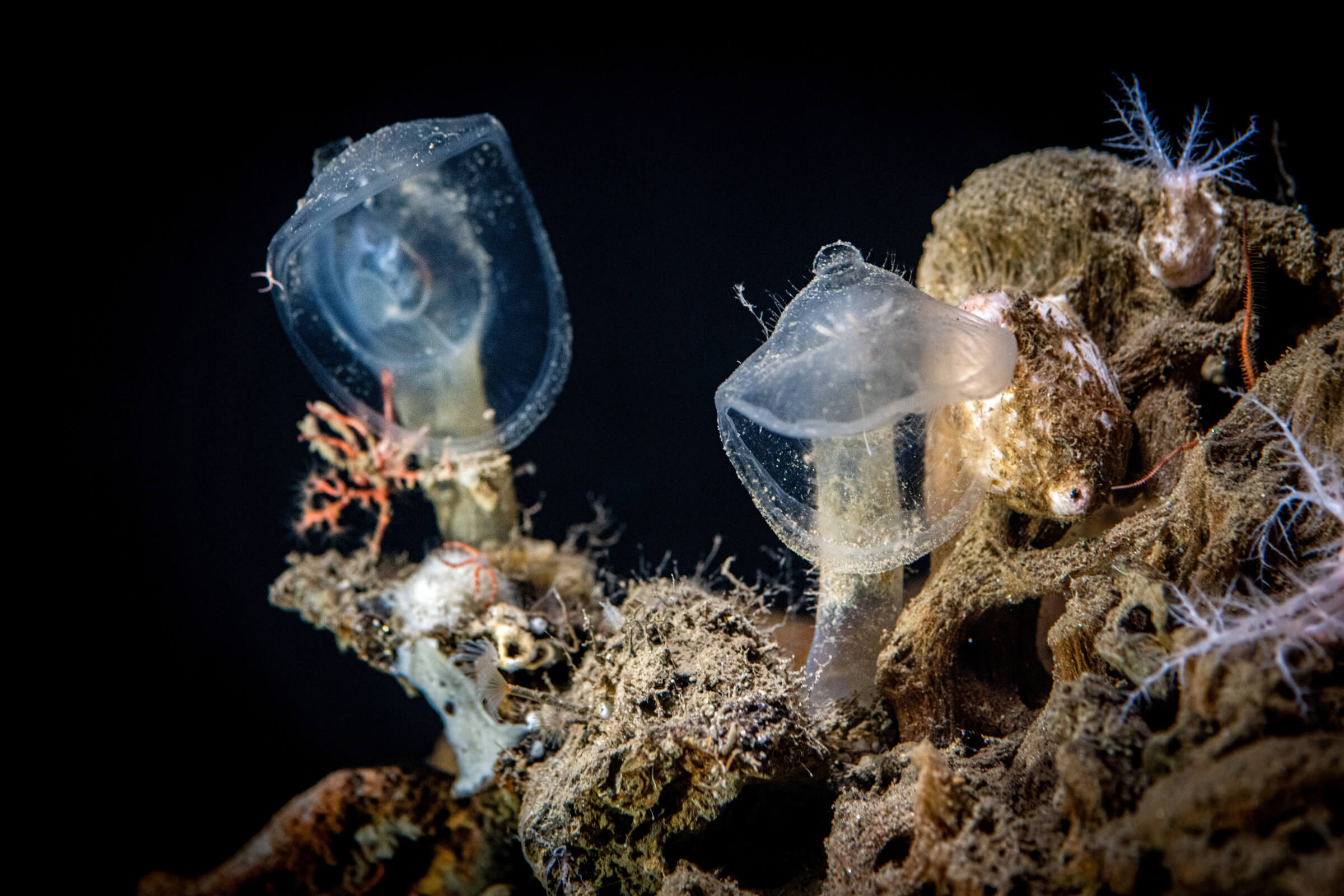
The predatory tunicate (Megalodicopia hians) lives on the seafloor. At the Aquarium, we maintain its water pH at 7.6, which is lower (more acidic) than for other animals.
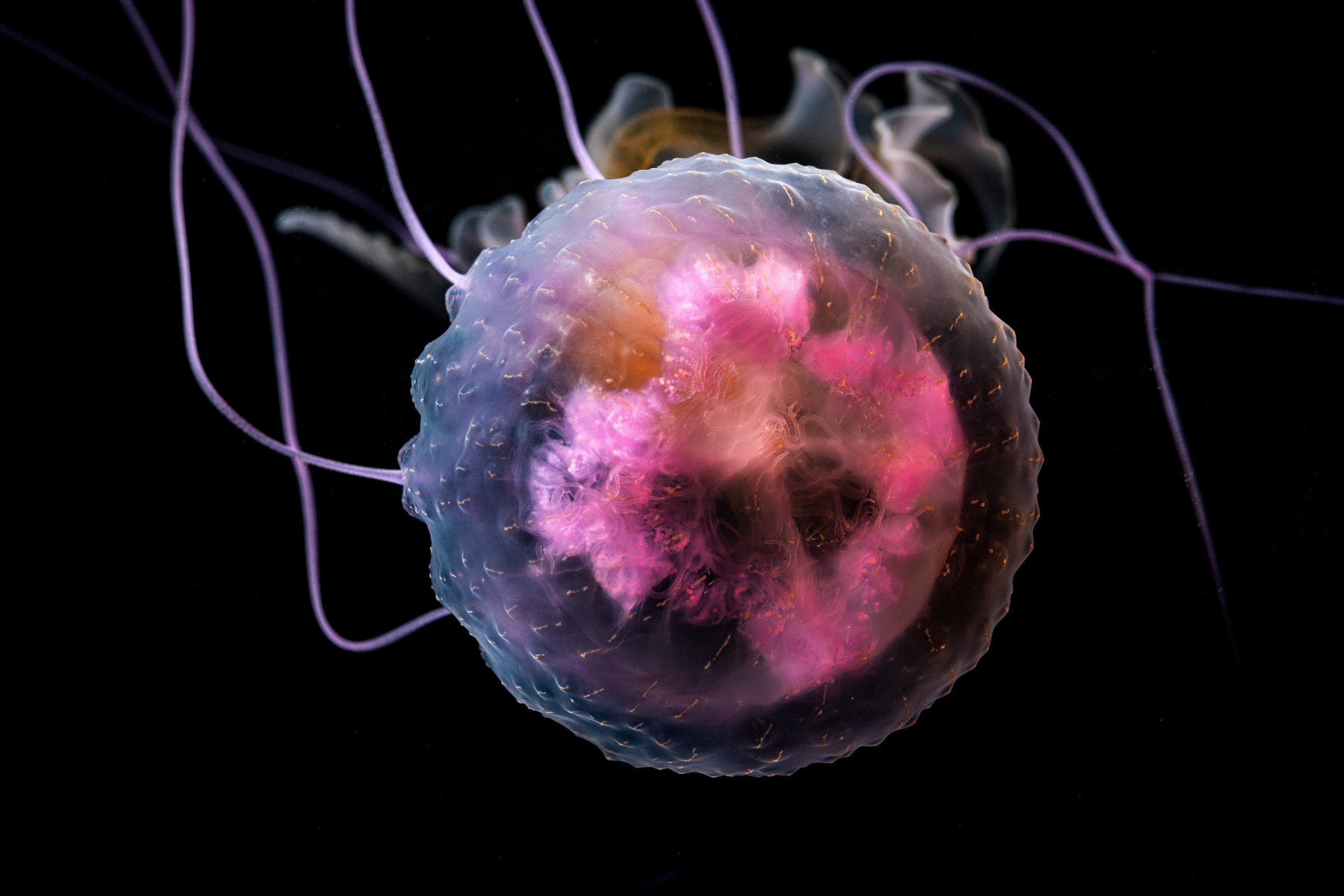
The mauve stinger (Pelagia flaveola) is comfortable in less-acidic environments and lives at a pH near eight. This animal is also comfortable in warmer waters — the seawater in its exhibit is one of the warmest at 65 degrees Fahrenheit.
Sweating the small stuff
Knowing the exact chemical composition of the water—down to individual elements—is another important part of keeping animals healthy.
For example, it’s important for our team to know the calcium levels in seawater where we display our deep-sea corals. Just as calcium helps humans maintain bone health, corals use calcium to build their skeletons. “We make sure the levels stay high enough for corals to be able to take calcium from the water and turn it into skeleton,” says Kasie Regnier, our director of applied water science.
On the flip side, there are some elements we want to keep out of exhibit water, including copper. When we’re doing electrical work in an exhibit, “we check before we put animals in to make sure the water is the perfect, optimal environment for them,” says Kasie.
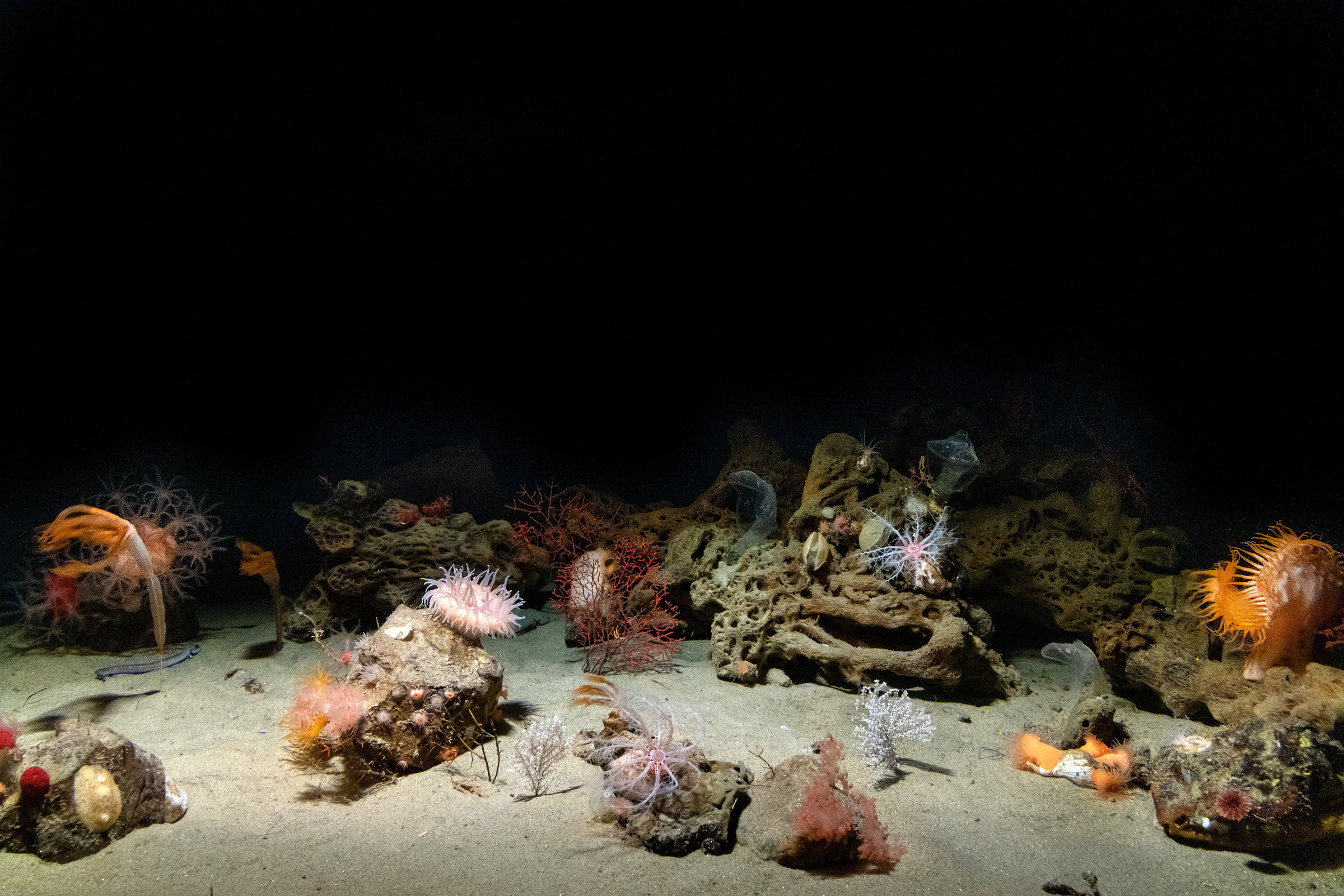
A deep-sea coral community in Into the Deep. Just as calcium helps humans maintain bone health, corals use calcium to build their skeletons. “We make sure the levels stay high enough for corals to be able to take calcium from the water and turn it into skeleton,” says Kasie Regnier, our director of applied water science.
Measuring trace elements
We use our new water science lab to get the exact chemical composition of our seawater. We use a tool called an Inductively Coupled Plasma Optical Emission Spectrometer, or ICP for short.
This machine went into service in February 2022. It measures 25 individual elements by vaporizing them into an argon plasma. “You can think of plasma as a really, really hot gas,” says Kasie. The argon plasma separates out the charged atoms of each element. These atoms, or ions, produce electromagnetic radiation at wavelengths characteristic of a specific element — telling us exactly what’s in the water.
The ICP has transformed how water is tested at the Aquarium.
“It used to take us weeks to get back trace element results from an outside laboratory,” says Karen, who manages the lab. Any time a new animal needed to move into an exhibit, the water went through this long testing process. “Now we can have a full panel of elements in as little as eight minutes.”
It’s accelerated the team’s capacity to react—and meet our animals’ needs.
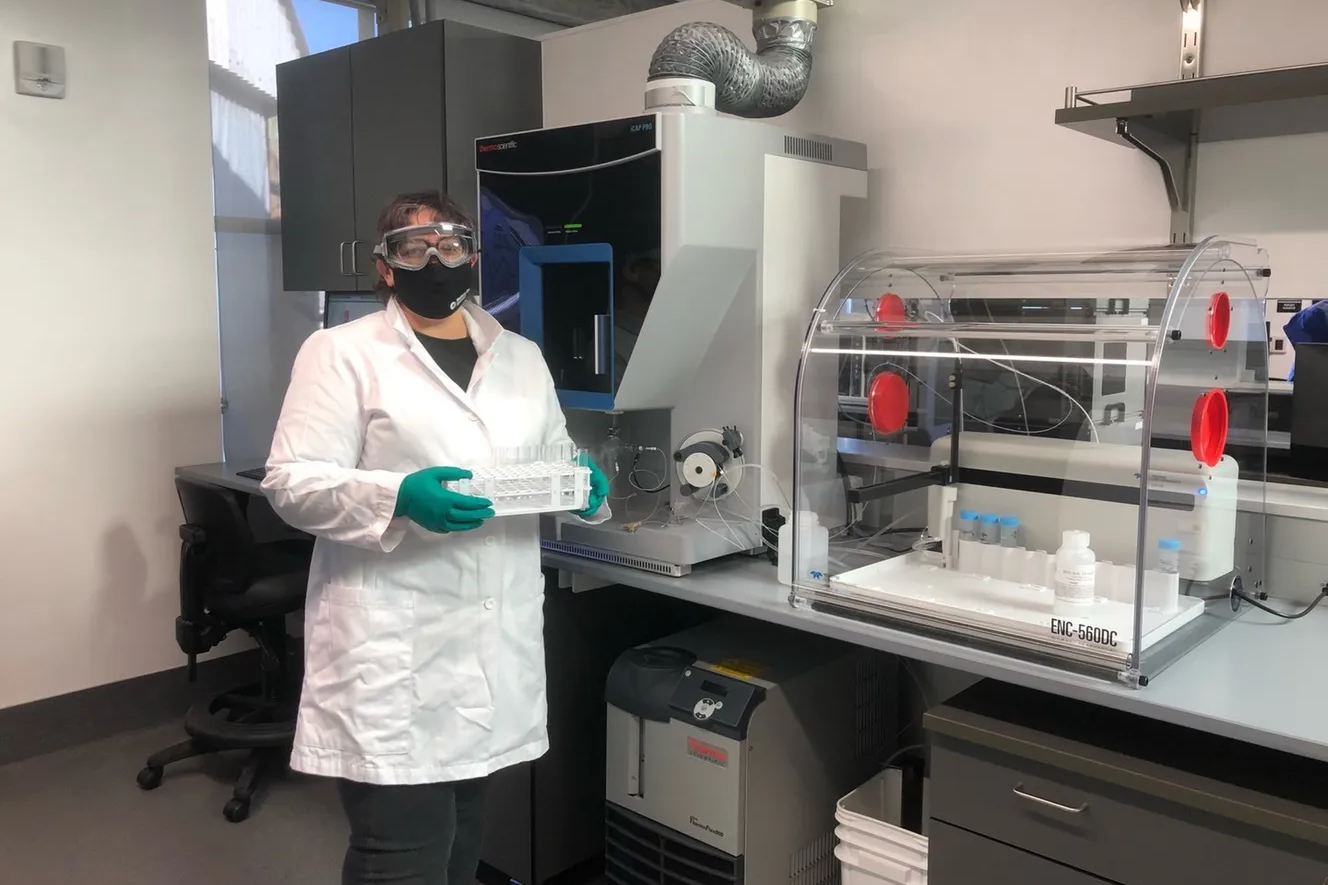
Our water science lab manager Karen Tuttle with the Inductively Coupled Plasma Optical Emission Spectrometer (ICP). This machine tells us which trace elements are in the water in as little as eight minutes.
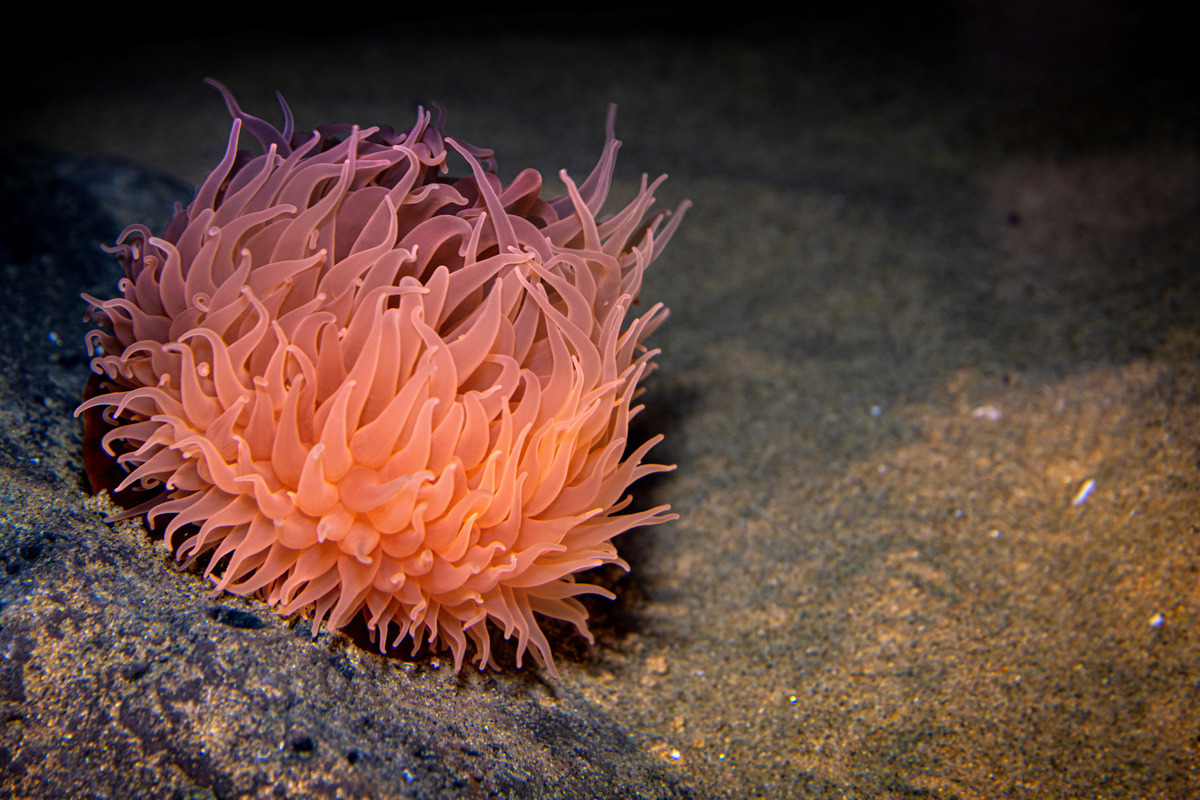
A pom-pom anemone (Liponema brevicorne) on display in Into the Deep. Any time we do work on an exhibit, we test the water for trace elements before putting animals back on display.
Around-the-clock life support
We monitor Into the Deep exhibits around the clock for any unexpected changes in water conditions.
Teams of people monitor the water's oxygen, temperature, pH, and nutrient levels—an astonishing 3,000 continuous data points.
Onsite and on-call 24/7, our controls engineers and life support operators get an automated alert anytime the numbers look off. “I’ve come in to troubleshoot everything from wet air filters to broken vacuum pumps,” Kyle says, and he’s not the only team member responding to changing conditions. There were a few late-night calls during the research and development phase of Into the Deep when “we were learning the nuances of these low-oxygen systems.”
When there's a problem, “either there’s a simple fix, a fun puzzle to troubleshoot, or something is clearly and immediately wrong,” Kyle says.
Once they’ve put an issue behind them, the water science and life support teams, control engineers, plumbers, and electricians collaborate to develop a long-term solution.
The start of a new chapter
Opening Into the Deep was an exciting time for our water science team.
Brian remembers the feeling the first time we turned on all the life support systems. “We turned the key on all the exhibit systems, fired them up — and finally knew it was all going to work,” he says. We’d tested and refined the life support systems at a smaller scale for more than five years. That day marked the culmination of years of work. “I like to call it ‘the high-five day’,” Brian says.
Now that Into the Deep is open, “it's honestly a little surreal,” says Kasie. “We've been spending so much time working on just the fine details and tiny little parameters. It’s fun to be able to take in the big picture now.”
She and her team are taking time to reflect on the results of their hard work: a one-of-a-kind exhibition of life from the largest living space on our planet.
“With the music playing, the lighting dialed in, and our exhibits fully inhabited—it hits home how many people came come together with their various talents to make this happen,” says Karen.
Kyle puts it another way: “There's not really anything else like this out there.”
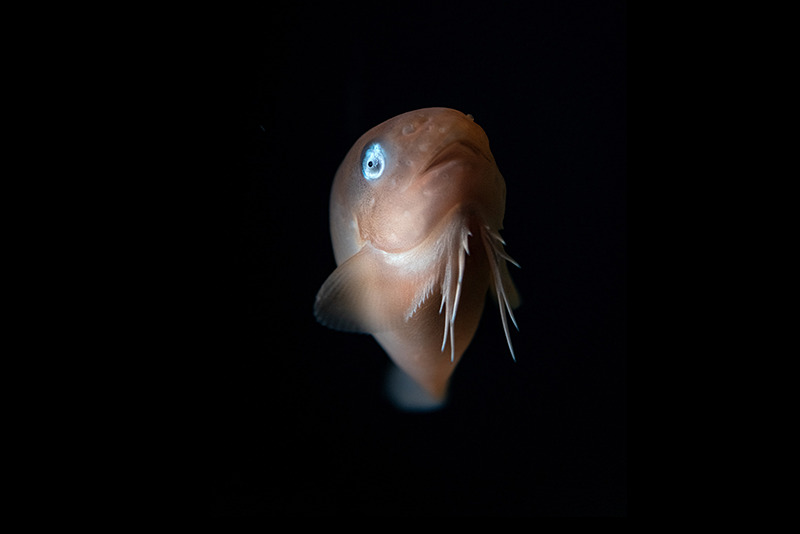
A salmon snailfish (Careproctus rastrinus) explores its environment as part of Into the Deep.
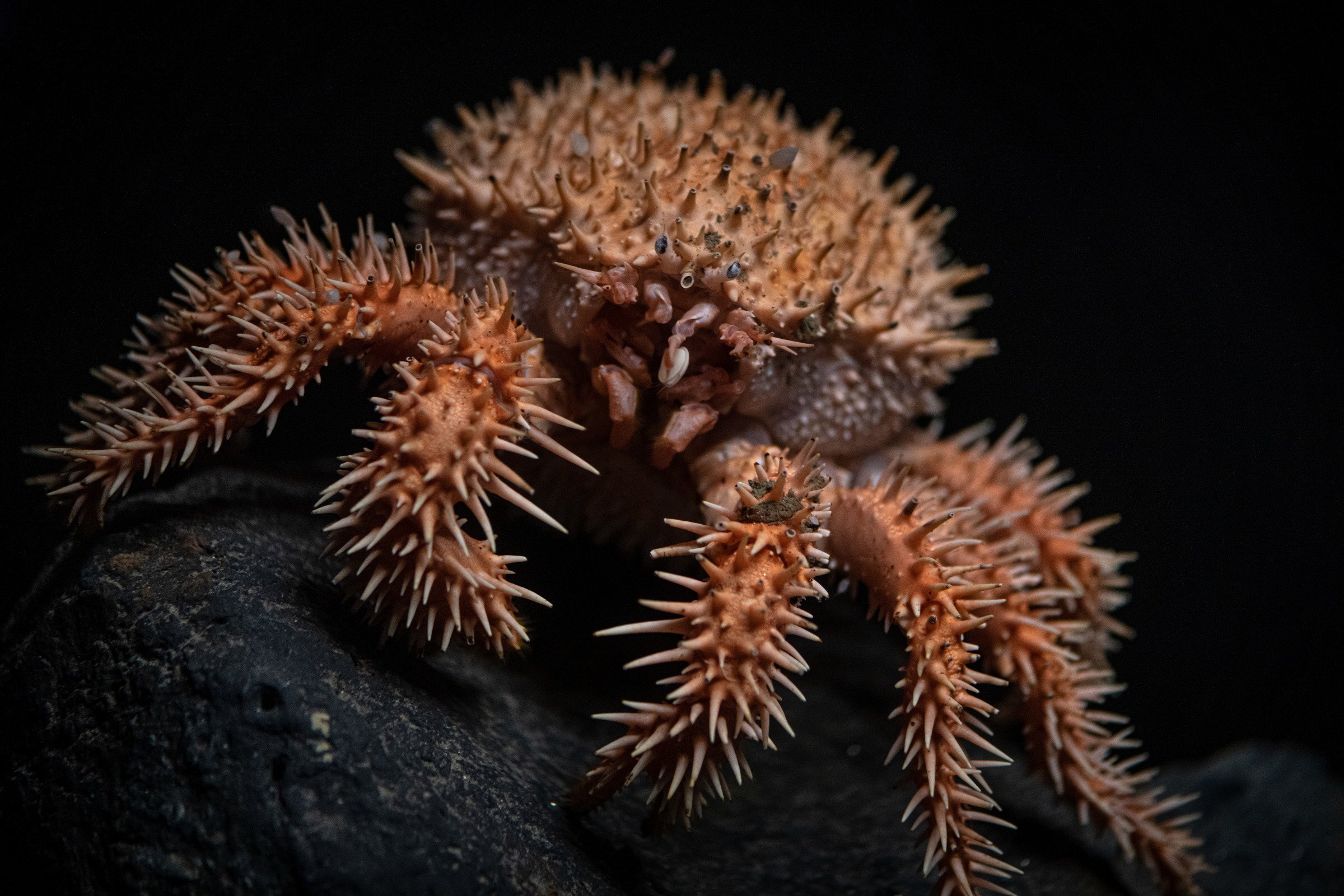
A Japanese porcupine crab (Paralomis histrix) in Into the Deep.
Keep exploring
Story
2026 Lucile S. Packard Memorial Award and Youth Award recipients
We’re proud to announce the 2026 Lucile S. Packard Memorial and Youth Awards for outstanding volunteers!
Read story – 2026 Lucile S. Packard Memorial Award and Youth Award recipients
Story
Chumash Heritage National Marine Sanctuary is almost here
Chumash Heritage National Marine Sanctuary protects marine life and cultural resources on California’s coast.
Read story – Chumash Heritage National Marine Sanctuary is almost here
Story
From krill shakes to salmon steaks: A peek into our food room
Step into our food room—the hub where 75,000+ animals and plants get sustainable diets year-round.
Read story – From krill shakes to salmon steaks: A peek into our food room