

For over 30 years, the Animal Care staff has exhibited and cultured a diverse variety of jellies and hydrozoans to share with Aquarium guests. Open-water jellyfish like the iconic sea nettles and moon jellies are staple residents at the Aquarium. The opening of Into the Deep/En lo Profundo has taken the challenge of keeping these delicate animals to new depths. Because of the team’s talents, and our collaboration with MBARI (Monterey Bay Aquarium Research Institute) there’s always something new to see in the exhibit’s midwater gallery.
Floating with jellies
Exhibiting midwater and deep-sea jellies is extremely challenging. To this day, few Aquariums in the world exhibit deep-sea animals—with the Monterey Bay Aquarium being the first to exhibit the diversity of these animals to such a scale.
The Aquarium has been a leader in raising and exhibiting jellies since the late 1980s, starting with moon jellies donated by colleagues at Tokyo Sea Life Park in Japan and continuing with innovations in culturing purple-striped jellies (Chrysaora colorata) and other open-ocean species.
Culturing jellies at the Aquarium started decades later with the sea walnut (Mnemiopsis leidyi). Thirteen years later, the Jellies team continues to make waves through innovative technologies and lots of patience—making us the first Aquarium to successfully culture many midwater jellies such as purple-lipped jellies. Figuring out effective methods to culture jellies that no one has raised before can require unexpected means and—in the case of the common siphonophore—be discovered through an unexpected accident.
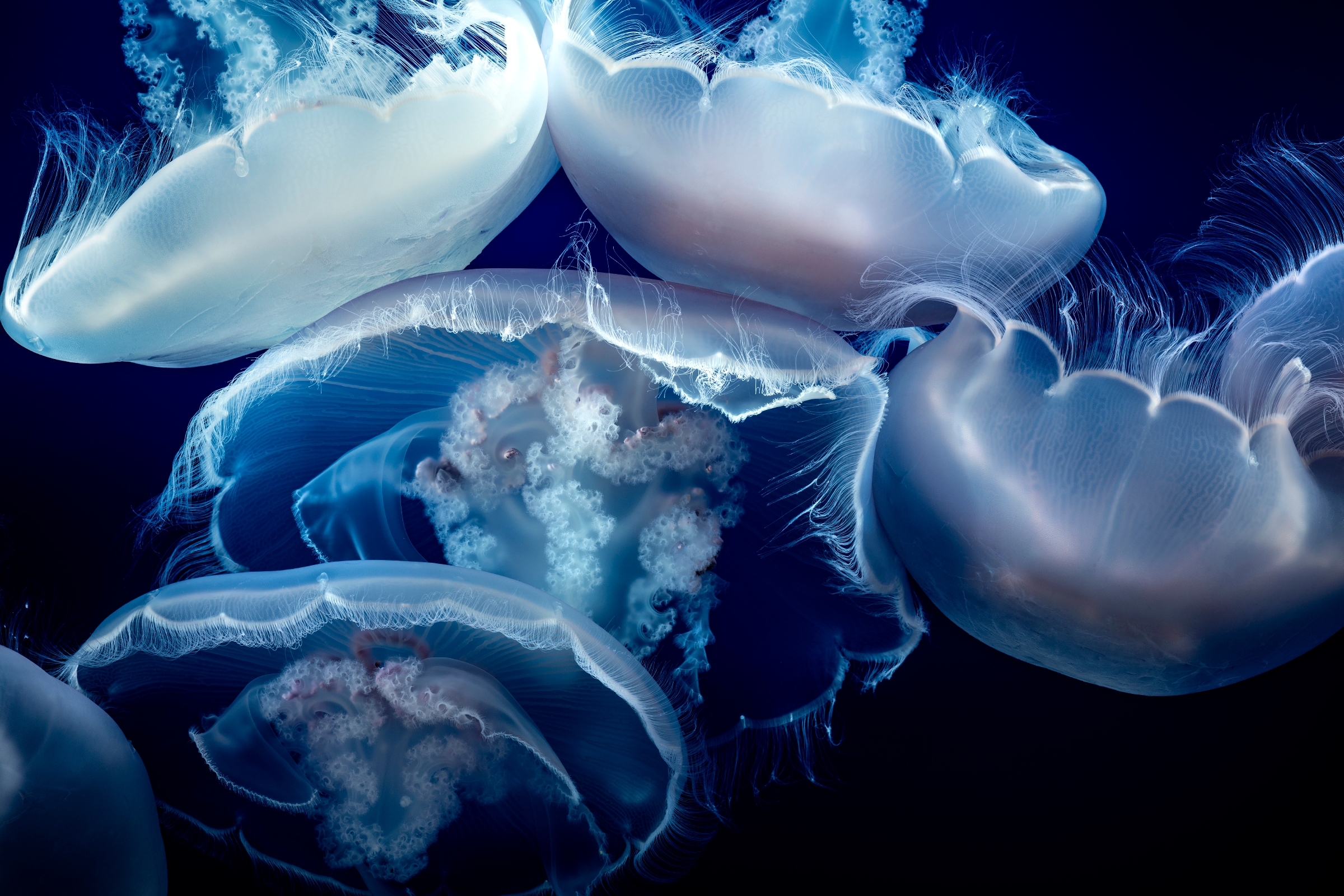
The Aquarium's journeey in raising and exhibiting jellies began in the late 1980s with moon jellies donated by colleagues at Tokyo Sea Life Park in Japan.
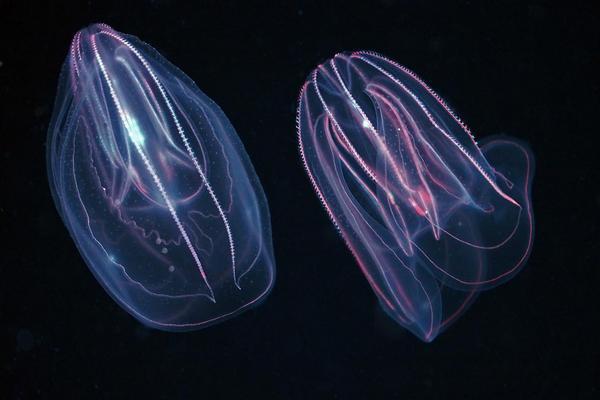
Thirteen years ago, the journey to culturing jellies at the Aquarium began with the sea walnut comb jelly (Mnemiopsis leidyi), otherwise known as the warty comb jelly.
© Charlene Boarts
Hydrozoans
Hydrozoan species have a sessile hydroid stage and a planktonic medusa stage. Siphonophores are an example of colonial hydrozoans—each individual segment of the animal specializes in a specific task such as feeding or reproduction. In the case of other hydrozoan species of jellies, such as the dinner plate jelly, the medusae are not colonial. Known also by its scientific name, Solmissus, this species of jellyfish was exhibited at the Aquarium in winter of 2023—another world-first.
What are siphonophores?
Siphonophores are often referred to as a colonial organism and they are a relative to jellyfish and corals. They may look like a single animal but they are in fact composed of an array of animal segments (also known as zooids) that specialize in specific tasks to help the siphonophore function as a whole. These organisms are as complex as they are varied and they can be found worldwide. The World Register of Marine Species has described 175 species of siphonophores thus far.
Floating delicately and looking like a string of connected beads, the common siphonophore is among the most abundant species of siphonophores in the midwater. They are among the trillions of animals in the ocean that participate in vertical migration every day—sinking into the deep ocean during the day to conserve energy and floating up to the surface at night to feast in food-rich waters.
“We collect common siphonophores locally where the water is cold, so we assumed that culturing this species requires cold water as well,” says MacKenzie Bubel, an Aquarium biologist who works primarily with the Jellies team. “But we learned that’s not quite the case through a rather unconventional method.”
The team started by putting a few siphonophores in a tank structure they’d originally developed to raise comb jellies: a tube-within-a-tube design, known as diffusion tubes. The design allows for some gentle flow of new water into the tube where the jellies are living and minimizes the chance of these fragile animals coming into contact with the hard acrylic surfaces of the tubes.
While the team was away, the water inlet hose fell out, creating a sharp increase in the temperature of the tubes. When they returned to check on the tubes, they noticed a sudden spawn of common siphonophores.
“While they partake in vertical migrations, they are used to differences in temperature even if they come from cold waters.” says Ellen Umeda, another Aquarium biologist works closely with MacKenzie. “Through that experience we realized they can handle warm waters very well. Now we raise them at a temperature of 16C (nearly 61F), which is much warmer than what we would’ve considered trying.”
What is a dinner plate jelly?
The dinner plate jelly gets its name from its flat-shaped bell, which can grow to be almost 8 inches (20 cm) in diameter. While the common siphonophore is a stationary predator that waits for krill to drift nearby before striking its prey, the dinner plate jelly is an active hunter that feeds on gelatinous zooplankton and other jellies. There is still much for us to learn about this fascinating animal. Because the dinner plate jelly is native to the deep waters of the Monterey Canyon, we’ll have the opportunity to study and understand this jelly more in the coming years.
Swimming through the challenges
Jellies and siphonophores are sensitive animals that require an incredible amount of care in their culture and exhibition. Since each jelly is unique in its life history, each requires different methods of handling and care. Even with the help of our MBARI colleagues, the chances to exhibit dinner plate jellies regularly will be quite rare, and there’s much more for scientists to learn about them.
There are a number of other challenges the team faces in exhibiting midwater hydrozoans “They are extremely sensitive to light. They can also tangle easily, or eject body parts if they are slightly stressed,” says Aquarium biologist Evan Firl regarding the common siphonophore. “Sometimes you dedicate a month of work and suddenly, poof! You’re back to square one because of a slight change that you may or may not figure out quickly.” In a sense, much of the work that the Jellies team does with deep-sea hydrozoans is science in the making.
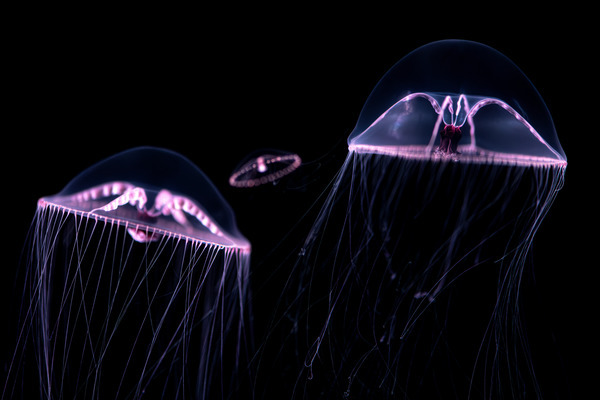
The Aquarium's Jellies team are the first biologists in the world to be able to culture these delicate drifters, known as the purple-lipped jellies.
Flexibility is key
The dedication of the Jellies team, and the immersive guest experience of our award-winning exhibit wouldn’t be possible without the foundational work of the Applied Water Science team.
The life support system of the midwater gallery is truly amazing. Each individual exhibit has its own customizable temperature, oxygen, and pH levels and we can dial things to what’s appropriate for each animal.
Manny Ezcurra (he/him)Curator of fish and invertebrates
Because the Applied Water Science team created a system the Animal Care staff can fine tune, Manny says, “you’re not stuck to a certain structure. If an animal isn’t suited to one area, we can move things around to make sure each deep-sea creature is thriving.”
The complex engineering ingenuity behind the public-facing galleries is what makes Into the Deep/En lo Profundo an ever-evolving exhibit—helping us make waves in the field of deep-sea research, exhibition, and conservation.
Keep exploring
Story
2026 Lucile S. Packard Memorial Award and Youth Award recipients
We’re proud to announce the 2026 Lucile S. Packard Memorial and Youth Awards for outstanding volunteers!
Read story – 2026 Lucile S. Packard Memorial Award and Youth Award recipients
Story
Chumash Heritage National Marine Sanctuary is almost here
Chumash Heritage National Marine Sanctuary protects marine life and cultural resources on California’s coast.
Read story – Chumash Heritage National Marine Sanctuary is almost here
Story
From krill shakes to salmon steaks: A peek into our food room
Step into our food room—the hub where 75,000+ animals and plants get sustainable diets year-round.
Read story – From krill shakes to salmon steaks: A peek into our food room