

When Eric begins talking about his love of the ocean, his voice quickly fills with passion and a smile appears as a seemingly permanent fixture on his face.
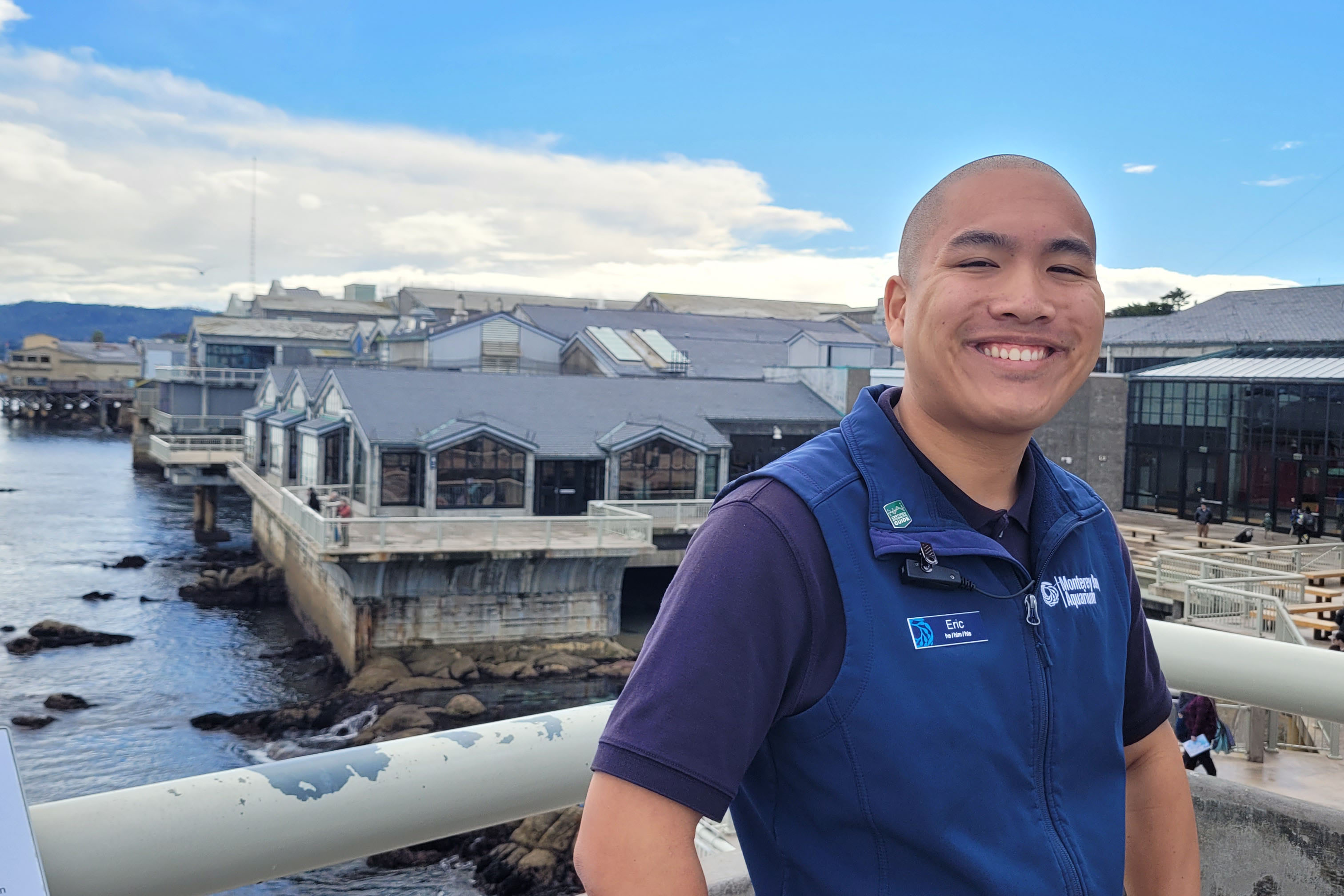
A local to Monterey County and a recent graduate of UC Santa Cruz with a Bachelor’s of Science in marine biology, Eric began his journey in the Aquarium’s Teen Conservation Leaders program in 2016. He continued each summer in numerous capacities, including as a mentor and program assistant.
During the pandemic, as the world adjusted to a new set of norms, Eric played a valuable role as an intern in our Education department, creating and managing several activities to help launch the Aquarium's online courses and learning-at-home opportunities. Today, guests often recognize Eric from his appearances in the Fin-tastic Sharks online course.
Eric’s journey as a staff member began as a Guest Experience representative and most recently as a naturalist. With every new opportunity, Eric reflects on a motivating factor for all the work that he does: his deep relationship with the ocean.
It’s important to talk about how the ocean protects us, how we protect it, and how we can protect each other. The ocean is like a family to me, and as a person who's been adopted, the concept of found family is very close to me.
Eric Wahl
Related videos
Eric Wahl at the Aquarium
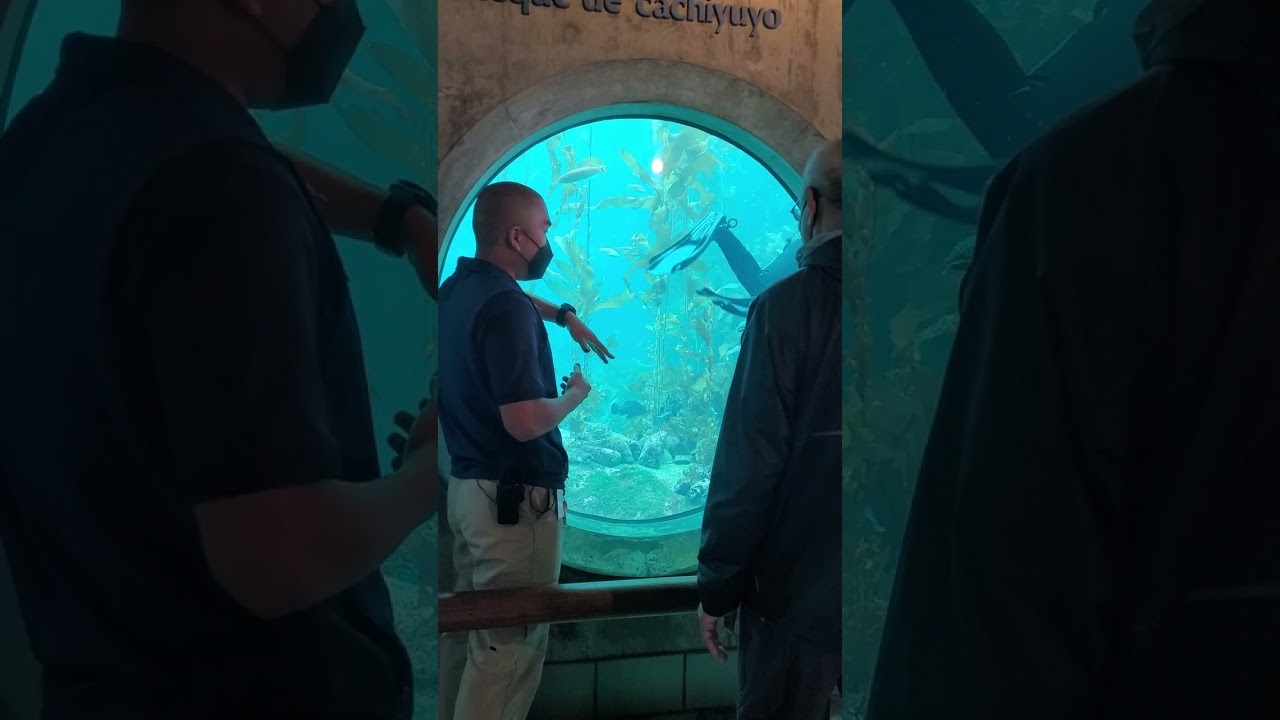
Question: What sparked your interest in the Aquarium and how long have you been working here?
Answer: My earliest memories of the ocean go back to when I was a toddler and fell in love with the ocean on the sandy beaches of Carmel. As I grew older, I knew that I wanted to work in a field where I'd be interacting with the ocean on a daily basis. By the time I was in high school, I joined the Teen Conservation Leaders program and had a transformative experience. Since then, I knew that the Aquarium was somewhere I would come back to frequently.
Through that program, I got to tap into what I love while being surrounded by a really great community. The Aquarium’s mission of ocean conservation was something I really connected to, and even as I went off to college, I was still involved with the Aquarium in one capacity or another. Seven years since my first experience here, I am now working full-time as a naturalist and loving it!
Q: Do you have a favorite exhibit? You can also share something about the Aquarium that has emotionally stood out to you over the years.
A: The giant Pacific octopus is my favorite animal so it’s no surprise that the deep reef exhibit, and more specifically the giant Pacific octopus exhibit, has been my favorite. I love how intelligent they are and how they show their personalities. I think there’s something special about that exhibit because it encourages people to empathize with an animal so removed from their daily lives, thus serving a mission.
Back in 2016, we had a giant Pacific octopus that laid eggs, meaning that she was at the end of her lifetime. She was always a big performer, but by this time, she was slowing down and rarely moving. Eventually, she stuck to the wall and cared for her eggs for months until she eventually passed away. As I was explaining this to the guests, it suddenly started to hit me that my friend was going away. It was a big growing moment for me and helped reinforce the stories that you tell and how you relate it to people.
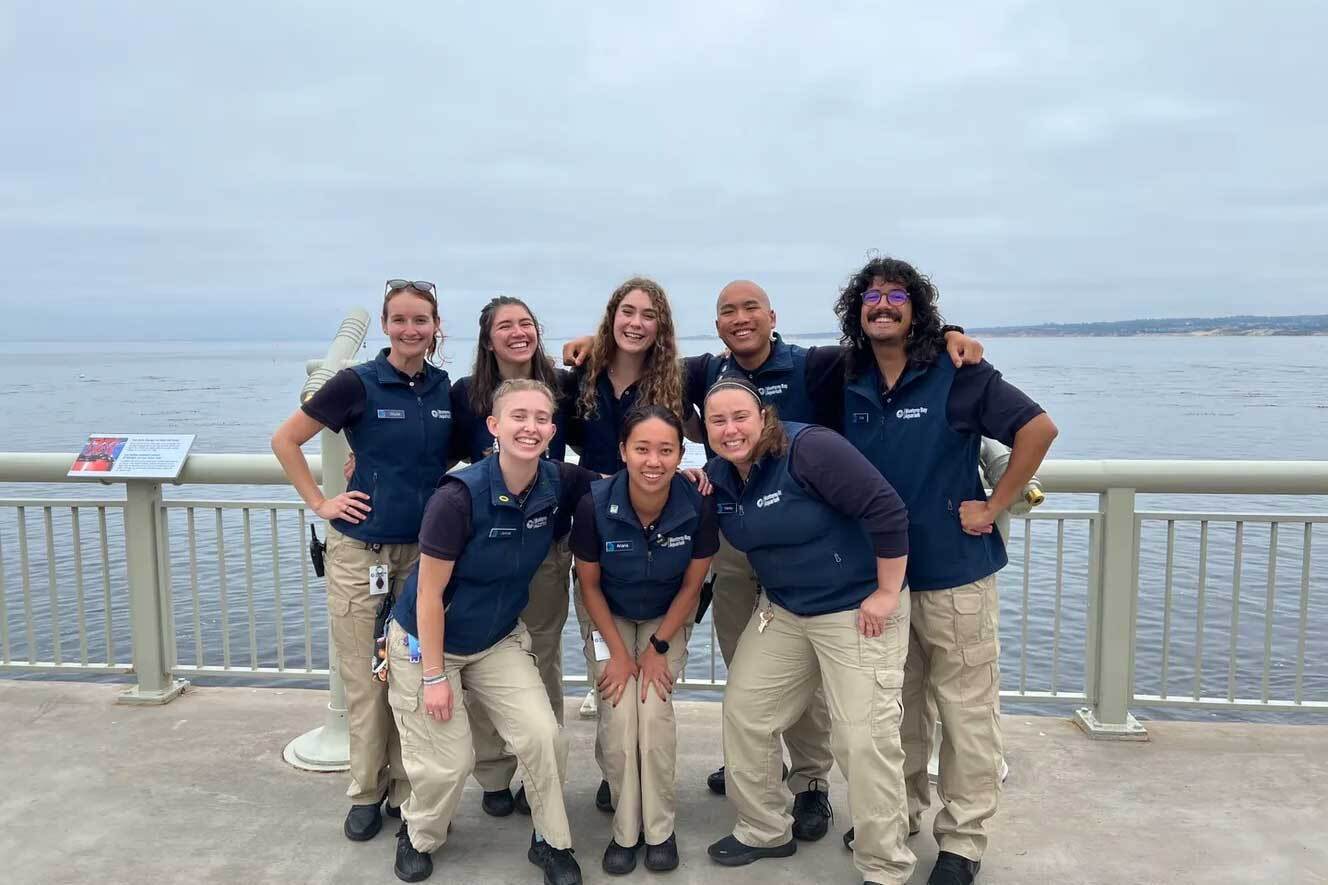
Group photo of the 2022 Naturalist team. From left to right on the top row: Skylar Wolfe, Jamie Marie, Madi Frazier, Eric Wahl, and Nick Gonzales. On the Bottom row: Jenna Mann, Ariana Bondoc, and Hailey Martin.
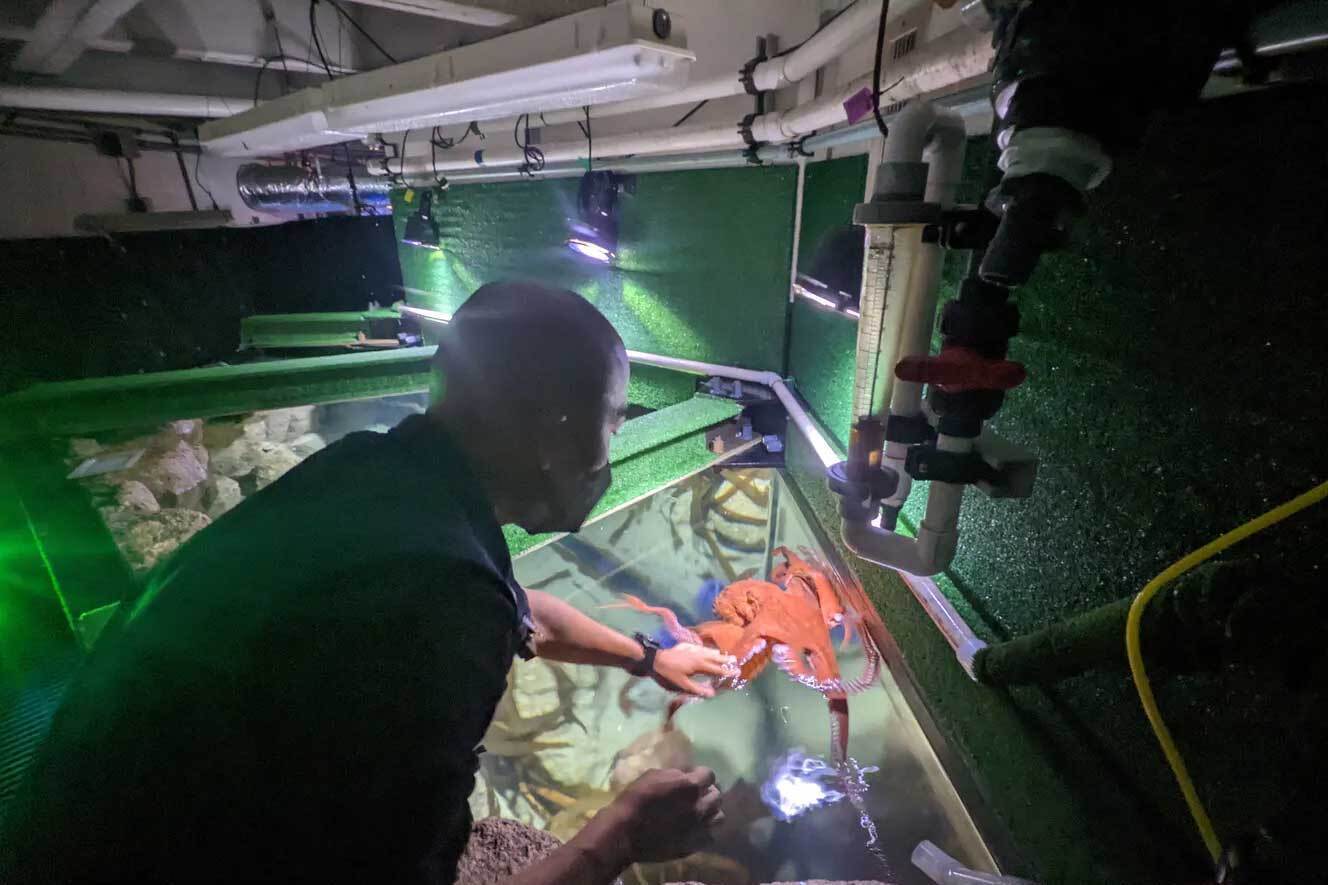
Eric feeding one of our giant Pacific octopuses during a rare opportunity in summer of 2022.
Q: You have worked extensively with the Teen Conservation Leaders program from 2018 to 2020. How would you describe TCL and its values? What are some key characteristics that make this program special?
A: Teen Conservation Leaders program is an opportunity for young students to find a place and a voice with the Aquarium, as well as learn and engage with science and ocean conservation. Our motto at TCL is “Conservation, Inspiration, Action," providing tools to be innovative, and addressing conservation from multiple directions, so that students can find spaces to take action and pass the knowledge they gather to the general public at their level and beyond. I know so many TCL alums who have gotten into ocean advocacy at the local and state level. For example, Shelby O’Neil, who was in my cohort, spearheaded the No Straw November movement, which quickly turned into a national movement.
Q: What kinds of challenges and opportunities do you see yourself experiencing in your new role as a naturalist? What are some goals you have in your new role?
A: Short term, my goal is to be as well-rounded as I can be. I have built a lot of knowledge from my time with the Aquarium and my undergraduate studies, but there are always gaps and opportunities to continue learning. Being pillars of information on the floor doesn’t mean we know everything, and we always lean on each other. One thing that excites me in this new role is that we have learning days where we can brush up on our knowledge and dive deep into a topic that interests us. It’s like college but with fewer deadlines. We also get checked off on being able to present certain programs, and I look forward to reaching more milestones that way.
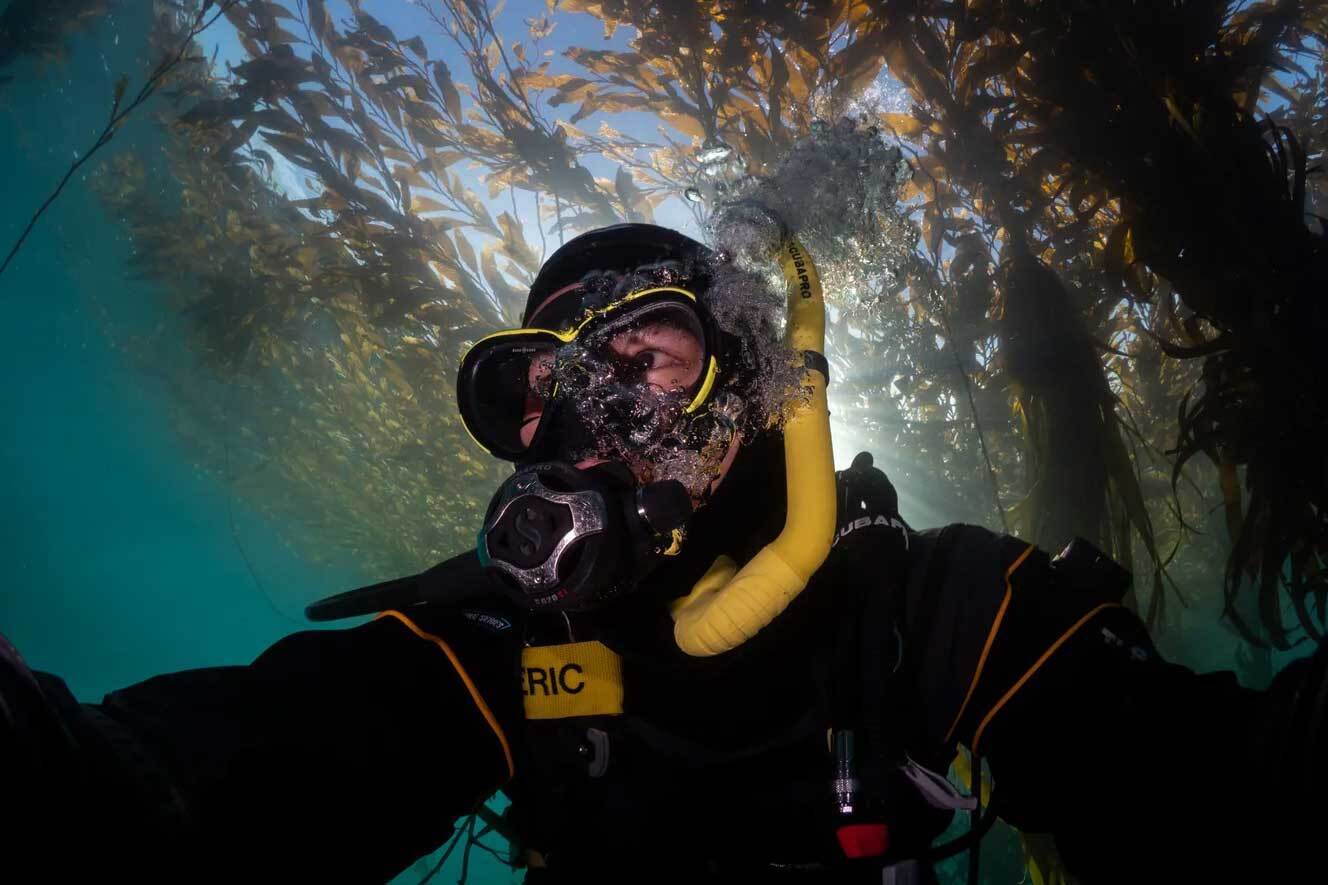
Eric is an avid SCUBA diver. He recently acquired a certificate in scientific diving research to do field studies.
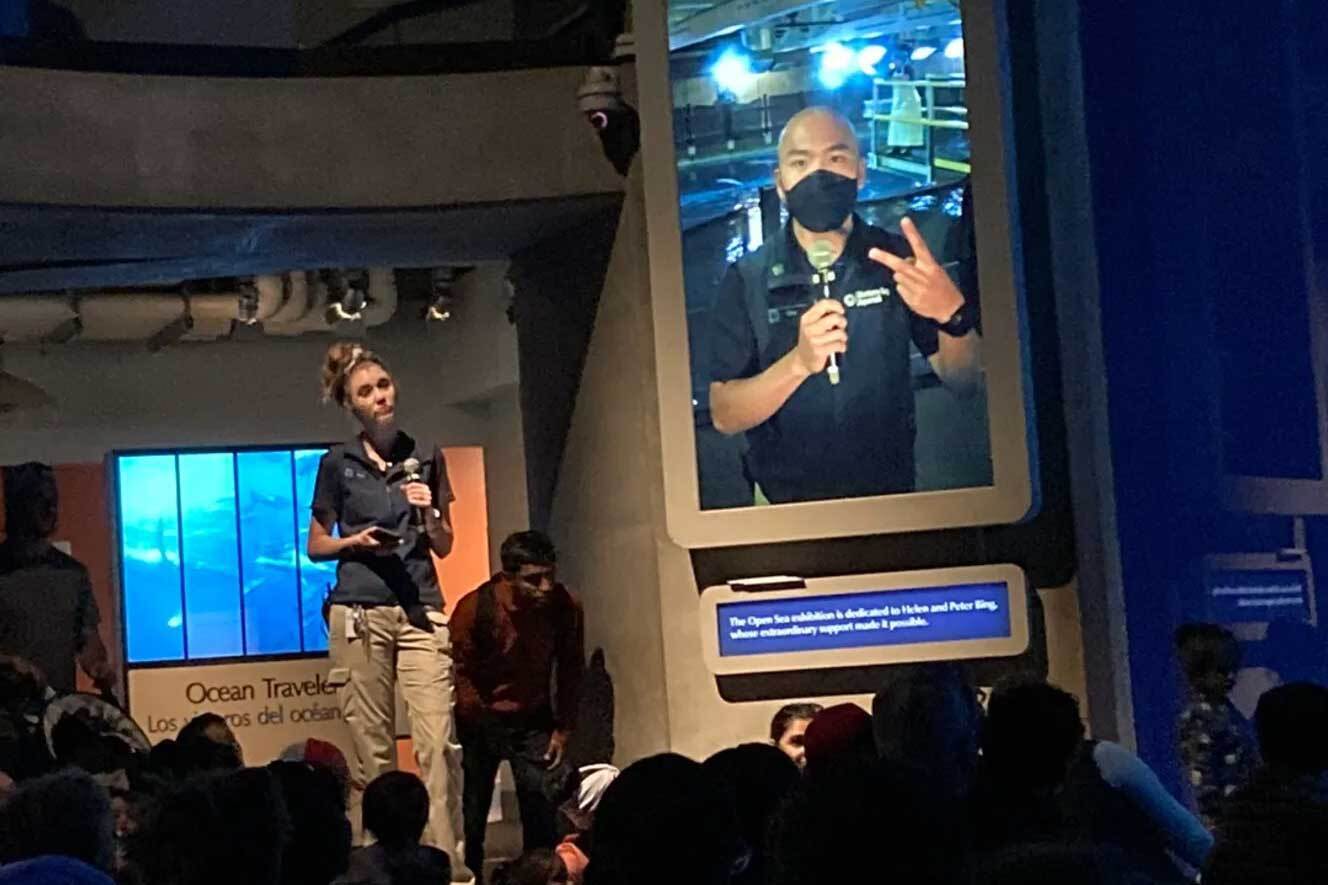
Eric presenting at the Open Sea in 2022 with colleague Madi Frazier.
Q: Traditionally, science spaces have been marketed and featured towards White-presenting people, what are your thoughts on the science spaces that you’ve interacted in, both through educational and professional careers? How do you see these spaces shifting in the future?
A: It is no secret that historically, science has excluded people of color. Most of the papers I read in high school and college were written by White people. I went to a fairly diverse university that has opportunities for anyone regardless of their background, but they aren’t as advertised. When you don’t see yourself represented in your field of interest, it can at times be discouraging and can feel inaccessible. But I think it’s still important to go for it whenever there’s an opportunity that interests you, whether your racial or ethnic background is represented in that space or not. I do think that with social media and recent campaigns for diversity in all fields, especially in STEM, we are turning the tides in representation.
While working on the floor, I get a lot of people coming up to me and mention that they don’t seem to have opportunities in their area and that’s where I try to give them tools from my toolkit, share with them what I did, and offer recommendations on how to get in the field.
Eric Wahl
Q: What are your thoughts and recommendations for students, scientists, and people of color who are interested in stepping into your field?
A: As much as I encourage it, it’s daunting to say go for it, that can be hard. If that’s the case, the first step can be reaching out to people you see in the position that you’re interested in. I get so happy when children of color come up to me and ask how they can get to where I am and I love sharing my story with them. I still go up to my colleagues and ask them about their path and experiences, not just for myself but also to carry that information to our visitors and help them see the diverse pathways that they can go through. Another great step would be to just express that interest.
If someone comes up to us and says they are fascinated by, for example, how the kelp forest grows, that’s a big green light for us and we’ll remember you. It’s important to note that not everyone that works at the Aquarium, especially in the GE and naturalist field, walked down a straight path to where they are, but we all came together to the Aquarium at one time or another guided by our skills and our passion for marine life and conservation of the ocean.
Keep exploring
Story
Nature is queer
We’re excited to sea-lebrate the queerness of nature!
Read story – Nature is queer
Story
Q&A: Julie Packard and Dr. Jenny Gray
Get to know incoming Chief Executive Officer Jenny Gray in this Q&A with Julie Packard.
Read the Q&A – Q&A: Julie Packard and Dr. Jenny Gray
Story
2026 Lucile S. Packard Memorial Award and Youth Award recipients
We’re proud to announce the 2026 Lucile S. Packard Memorial and Youth Awards for outstanding volunteers!
Read story – 2026 Lucile S. Packard Memorial Award and Youth Award recipients