

Bat ray
Myliobatis californica
- Animal type
- Sharks & rays
- Ecosystem
- Sandy seafloor, Reefs & pilings
- Relatives
- Spotted eagle rays, common eagle rays; Subclass: Elasmobranchii (skates, rays and sharks); Family: Myliobatidae (eagle rays)
- Diet
- Molluscs, crustaceans and small fishes
- Range
- Eastern Pacific from Oregon to the Gulf of California and near the Galapagos Islands
- Size
- Female wingspan to 5.9 feet (1.8 m) and weight to 200 pounds (90.7 kg); males are smaller
Meet the bat ray
A bat ray swims gracefully by flapping its batlike wings (pectoral fins)—a feature that gives this ray its common name and family name, “eagle ray.” It’s found in muddy and sandy-bottom bays, kelp forests, and close to coral reefs.
Watch in real time
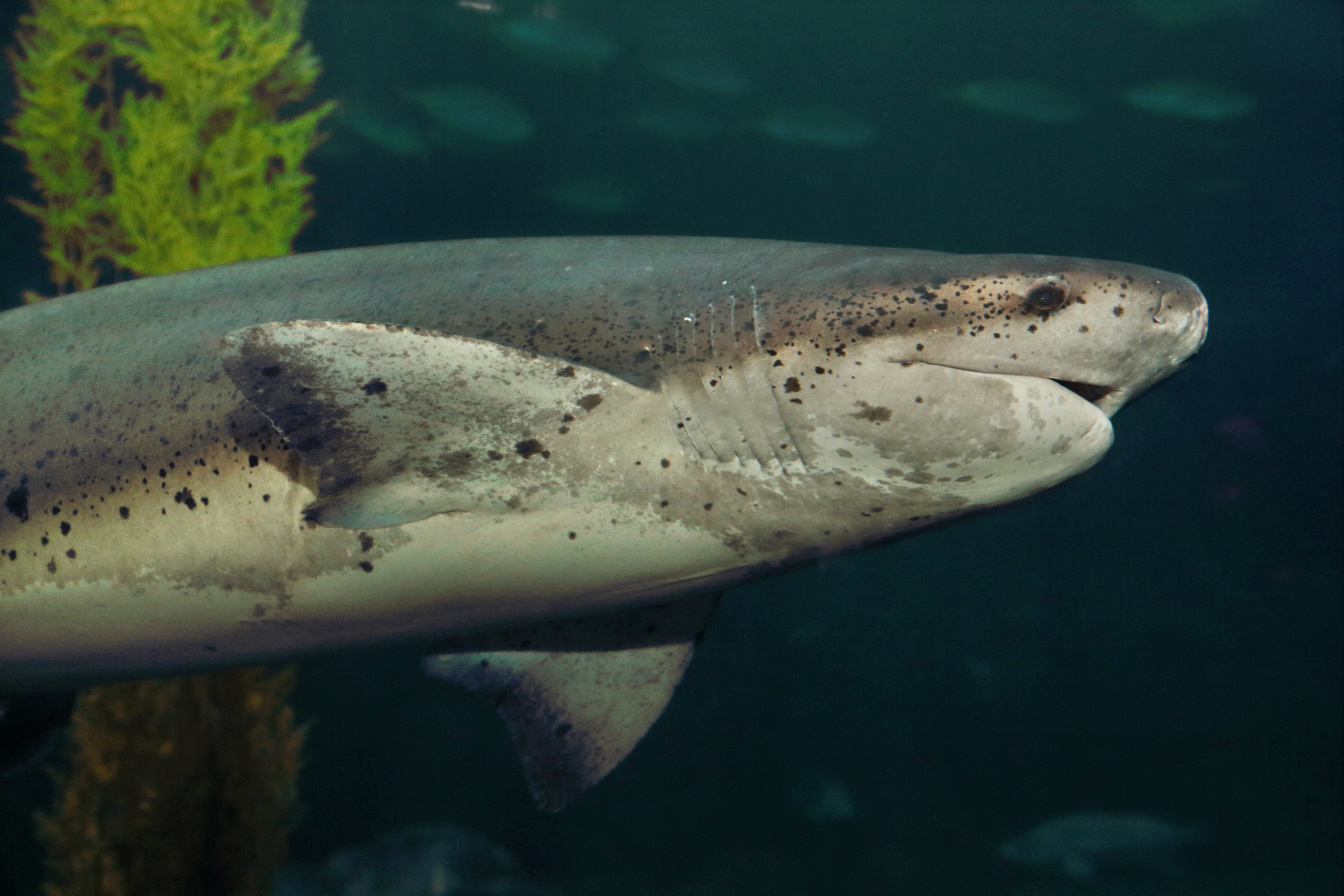
Shark Cam
Check out this live cam – Shark CamNatural history
Those batlike wings also aid rays in the hunt for food. A bat ray flaps its pectoral fins in the sand to expose buried prey, like clams. An important benthic predator, it’s found in muddy and sandy-bottom bays, kelp forests, and close to coral reefs.
The bat ray also uses its lobelike snout to dig prey from sandy bottoms. The resulting pit can be up to 13 feet (4 m) long and eight inches (20.3 cm) deep—uncovering small prey for fishes that can’t dig. A bat ray has one to three venomous barbed spines at the base of its long tail, where the tail meets the body. But this docile animal only stings to defend itself.
Bat ray teeth are fused into plates that can crush the strongest clam shells. The ray crushes the entire clam (or other molluscs) inside its mouth, spits out the shells, and then eats the soft, fleshy parts. If a tooth breaks or wears out, a new one replaces it. A ray grows new teeth continuously, like its shark kin.
Conservation
Because the ray struggles actively when caught, it’s popular with and even sought after by sport fishermen. There are no commercial fisheries along the California coast, but commercial fishing exists in Mexican waters, where the bat ray is a food fish.
For many years, oyster growers trapped bat rays because they thought bat rays ate large numbers of oysters. But recently researchers discovered that bat rays rarely eat oysters and that crabs were destroying the oyster beds. The oyster growers were actually causing the destruction of their own oyster beds by trapping bat rays, which eat crabs.
Cool facts
- Several bays and wetland areas along the California and Pacific Coast of Baja, including nearby Elkhorn Slough, are important nursery and feeding grounds for bat rays.
- Sea lions, white sharks, and broadnose sevengill sharks prey on bat rays. Divers have seen a “pack” of juvenile broadnose sevengill sharks attack a large bat ray.
- The bat ray reproduces annually, mating during spring or summer. A female bat ray is ovoviviparous—her eggs develop and hatch inside her body. After a gestation period of nine to 12 months, she gives live birth to two to 10 pups—the number depends on the size of the mother. Pups emerge tail first, with their wings wrapped around their bodies. To prevent injury to the mother, the pups’ stinging spines are pliable and covered with a sheath that sloughs off after birth. The spine soon hardens and is ready for defense within a few days.
- Bat rays and other types of rays often rest, semi-buried, in the sand. Beachgoers can reduce the risk of stepping on a ray and getting barbed by doing the “sting ray shuffle.” Shuffle your feet in the sand when you walk instead of picking your feet up to take steps.
- The bat ray usually leads a solitary life, but may be found in groups of thousands. If disturbed while resting on the seafloor, a bat ray raises itself on the tips of its pectoral fins with its back arched, ready to swim away if a diver approaches too closely. The bat ray is known for its ability to jump out of the water and skim along the surface. In aquariums, observers have seen bat rays swim upside down on the water’s surface.
Up next in sandy seafloor
Animal
Sand dollar
The sand dollar's mouth has a jaw with five toothlike sections to grind up tiny plants and animals.
Keep exploring
Animal
Globe crab
When they're not hiding in the seabed, the globe crab scuttles this way and that, leading pursuers on a merry…