

Horned puffin
Fratercula corniculata
- Not on exhibit
- Animal type
- Birds
- Ecosystem
- Coastal waters
- Relatives
- Tufted puffin, Atlantic puffin
- Diet
- Fish and marine invertebrates
- Range
- North Pacific
- Size
- Up to 15 in. (35 cm)
Meet the horned puffin
Horned puffins live primarily on the open ocean, but return to coastal nesting grounds in summer, where they mate and raise their chicks. They nest in crevices on cliffs and rocky islands, often in dense, large, mixed colonies with other puffins and auks. Unlike tufted puffins that nest in burrows, horned puffins seek out rocky crevices and outcroppings for their nests, though some nest in burrows.
Status: Least concern
Least concern(active)
Near threatened
Vulnerable
Endangered
Critical
Extinct in wild
Extinct
Natural history
In the summer breeding season, horned puffins have characteristic white “cheeks.” During winter, the white patch becomes darker and the “horn” above each eye disappears. The bill becomes smaller and duller.
Horned puffins take advantage of the sea’s bounty. While nesting and raising their chicks, these birds eat mostly fish, bringing back beakfuls of sand lance and capelin to their young. Horned puffins can dive to depths of 250 feet (76 m) to catch prey, but typically dive to around 98 feet (30 m).
Related videos
Puffins in the Open Sea exhibit
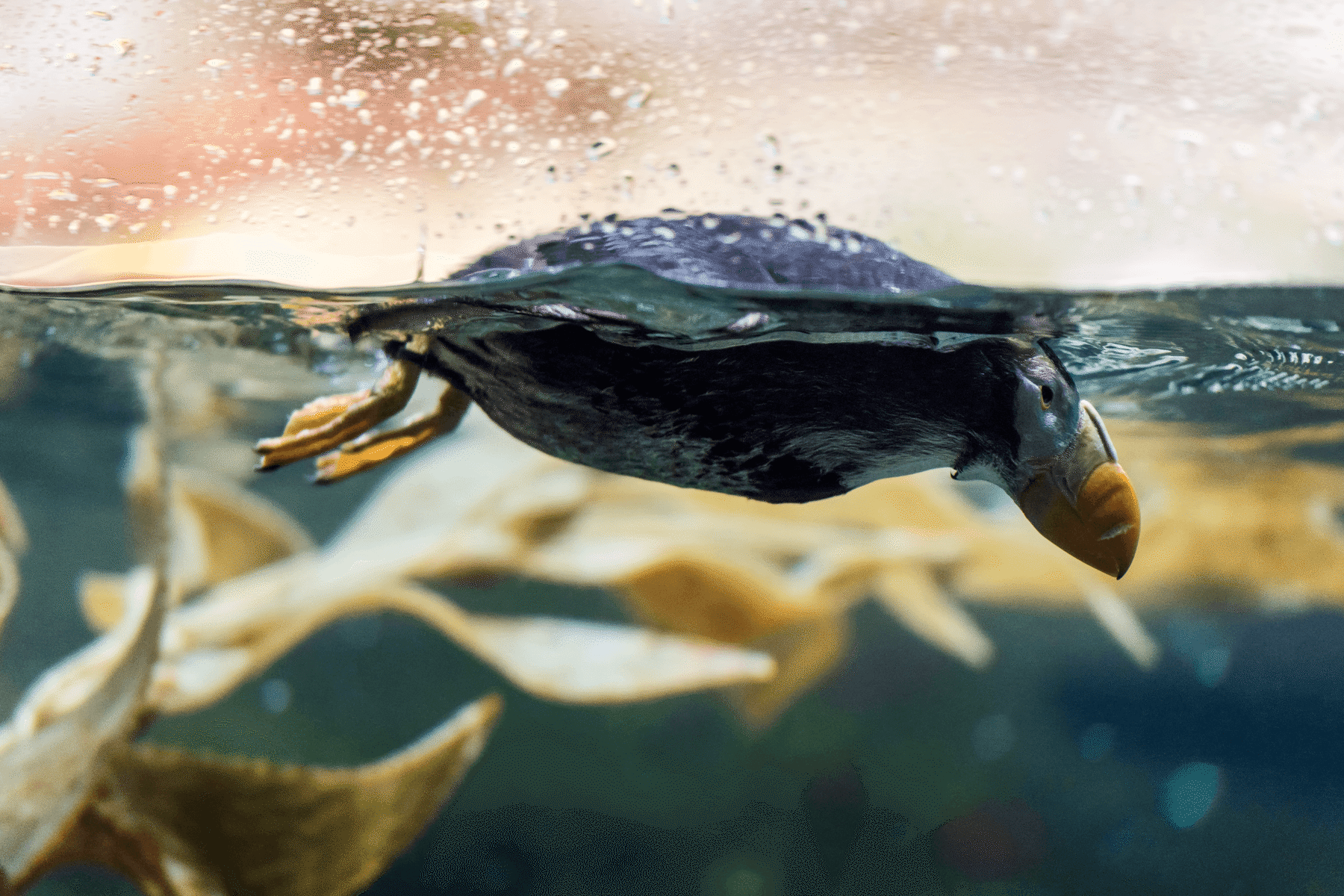
See a tufted puffin "fly" underwater in our Open Sea exhibit—this animal usually dives for 20–30 seconds but can stay underwater for up to a full minute.
Conservation
Today tons of plastic trash swirls on ocean currents. Seabirds, looking for flashing fishes, frequently mistake shiny plastic debris for food. With their stomachs full of plastic instead of fish, many oceanic birds risk starvation. You can help: choose reusable alternatives to single-use plastic. Less plastic on land means less plastic in the sea.
Cool facts
- While puffins do fly, they mostly swim while at sea. Their legs are set far back on their bodies, which means they’re not very graceful on land, but they’re very good swimmers.
- Puffins use countershading to hide from hungry predators. A puffin’s “back” is dark and blends in with the dark water. The light color on the underside helps them hide from predators swimming below.
- Puffins can carry more than one fish at a time in their beaks. The average is about 10 fish per catch, but one bird was recorded with 62 fish in its mouth! A puffin’s raspy tongue holds fish against spines on its palate, while it opens its beak to catch more fish.
Up next in coastal waters
Animal
Northern anchovy
Anchovies tend to swim with their mouths wide open, straining tiny plant plankton from the water.
Keep exploring
Animal
Sea otter
Beyond their cute faces and fluffy fur, sea otters play an irreplaceable role in their coastal habitats.