

Wunderpus
Wunderpus photogenicus
- Not on exhibit
- Animal type
- Octopus & kin
- Ecosystem
- Coastal waters
- Relatives
- Other octopuses, squid, cuttlefishes and the chambered nautilus; Phylum: Mollusca; Class: Cephalopoda; Family: Octopodidae
- Diet
- Small crustaceans and fishes
- Range
- Shallow waters of Indo-Malayan Archipelago, extending from Vanuatu to Papua New Guinea, Indonesia and Malaysia, north to the Philippines
- Size
- Up to 9 inches (22.9 cm), arm span to 16 inches (40.6 cm)
Meet the wunderpus
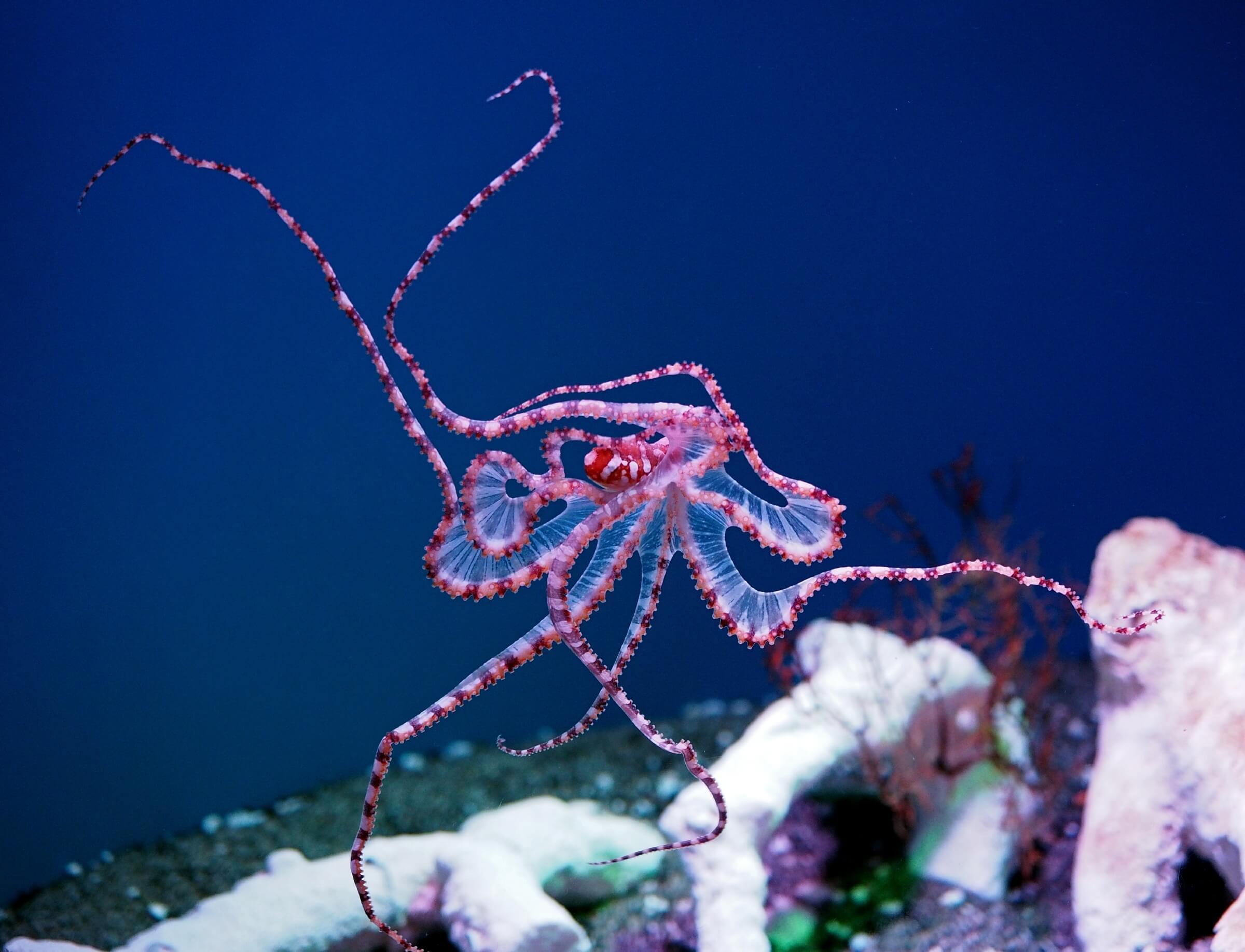
Named after the German word “Wunder,” meaning “marvel” or “wonder,” the wunderpus has long, thin arms and spectacular patterns. It’s a striking copper-brown color, with dramatic white stripes and spots all over its smooth body. Its pattern is fixed but can change in hue and contrast.
Natural history
This quick-change artist alters its color, shape and movements to mimic other sea animals as a warning display for potential predators. In a flash, the wunderpus can impersonate a venomous species, transforming its patterns into those of a lethal lionfish with poisonous spines or a sea snake.
Found on soft sediment habitats in shallow waters of the Indo-Malayan Archipelago, it lives in the burrows of other animals or digs its own. This small species typically emerges at dusk and dawn to forage in the twilight, preying on small crustaceans, such as crabs, as well as fishes.
Anatomy
The wunderpus has long arms—five to seven times the length of its mantle—that are especially useful for hunting. The octopus extends them over sand or coral rubble to trap its prey. Or, it reaches into holes to probe and catch a meal.
Small eyes atop long stalks often give this animal's head a Y-shaped appearance. The white spots on the head are unique to each animal, making it possible for biologists to identify and study individuals.
Conservation
The wunderpus is commercially important to underwater photographers, dive tourism and home aquarium trades. Little is known, however, of its life history and behavior, as the species is relatively new to science. It was discovered in the 1980s and only officially described in 2006.
Cool facts
- It appears that this species is capable of dropping an arm when attacked, allowing the octopus to escape from predators. It’s then able to regenerate the lost body part.
- The wunderpus is frequently confused with the similarly colored, long-armed mimic octopus.
Up next in coastal waters
Animal
Harbor seal
Awkward and cumbersome on land, harbor seals maneuver with grace and agility in the water.
Keep exploring
Animal
Sea otter
Beyond their cute faces and fluffy fur, sea otters play an irreplaceable role in their coastal habitats.