

What is bioluminescence?
If you’ve ever seen a firefly light up the evening sky, you’ve witnessed bioluminescence. Bioluminescence is the ability of living organisms to create their own light, using a chemical reaction. On land, the phenomenon of bioluminescence is rare—limited to fireflies, some mushrooms, glowworms, and a few other organisms. But in the ocean, bioluminescent animals create an underwater light show. According to a study by MBARI, 75 percent of deep-sea animals make their own light. From tiny microscopic single-celled algae to the giant Humboldt squid, ocean animals have adapted to use light to their benefit, in a variety of ways.
How do deep-sea animals emit their own light?
Bioluminescence is a chemical reaction that occurs when luciferin (a light-emitting molecule) reacts with luciferase (an enzyme). The product of the reaction is a photon of light. Some animals, like the angler fish, don’t create their own light. Instead, they rely on symbiotic algae (housed inside their body) to do it for them.
Animals display bioluminescence in different ways. Some have illuminating cells on their sides, the underside of their stomachs, surrounding their mouths, or on the tip of their tentacles. Others release a bioluminescent fluid or “bombers” into the surrounding water.
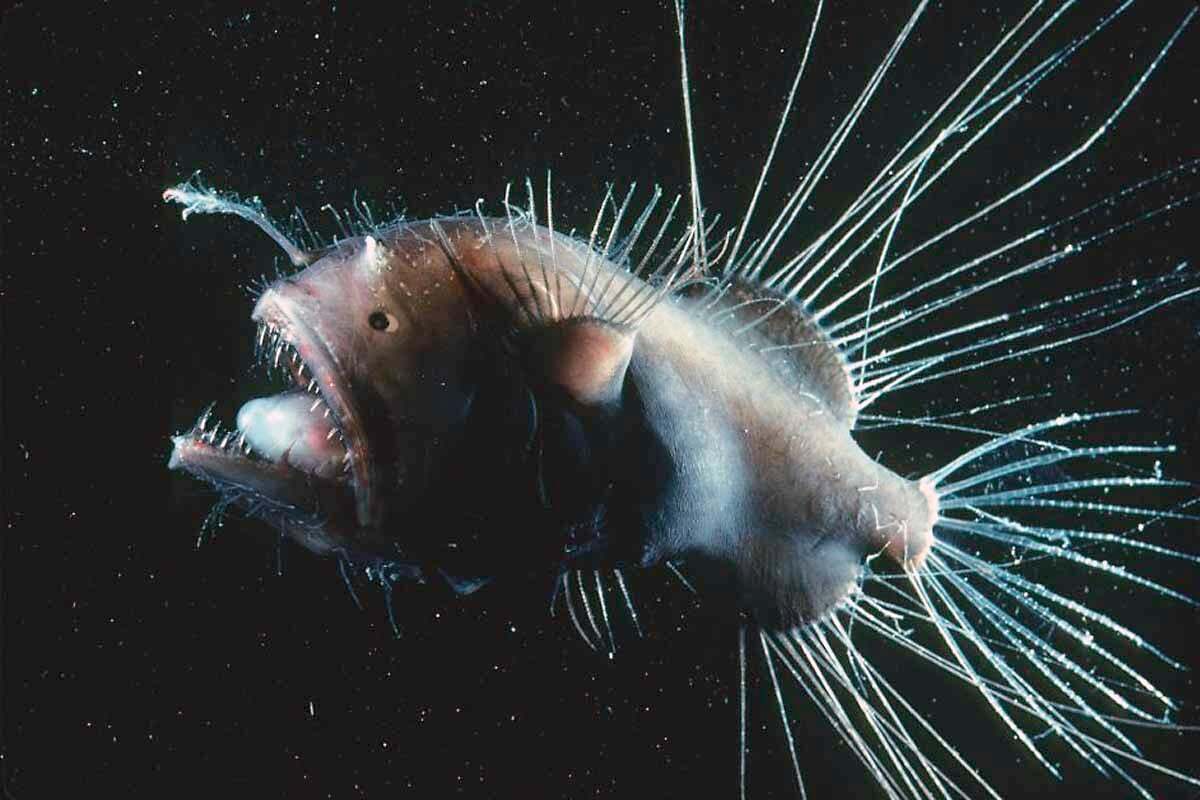
A fanfin anglerfish's glowing lure attracts fishes and other deep-sea animals.
What colors is bioluminescence?
Bioluminescence is most commonly blue-green, probably because the short wavelengths of blue and green light travel longer distances in the sea. Other animals emit red light, which helps them see things in the deep sea where all the red light has been filtered out. More unusual is the glowing yellow fluid that the gossamer worm (Tomopteris sp.) releases.
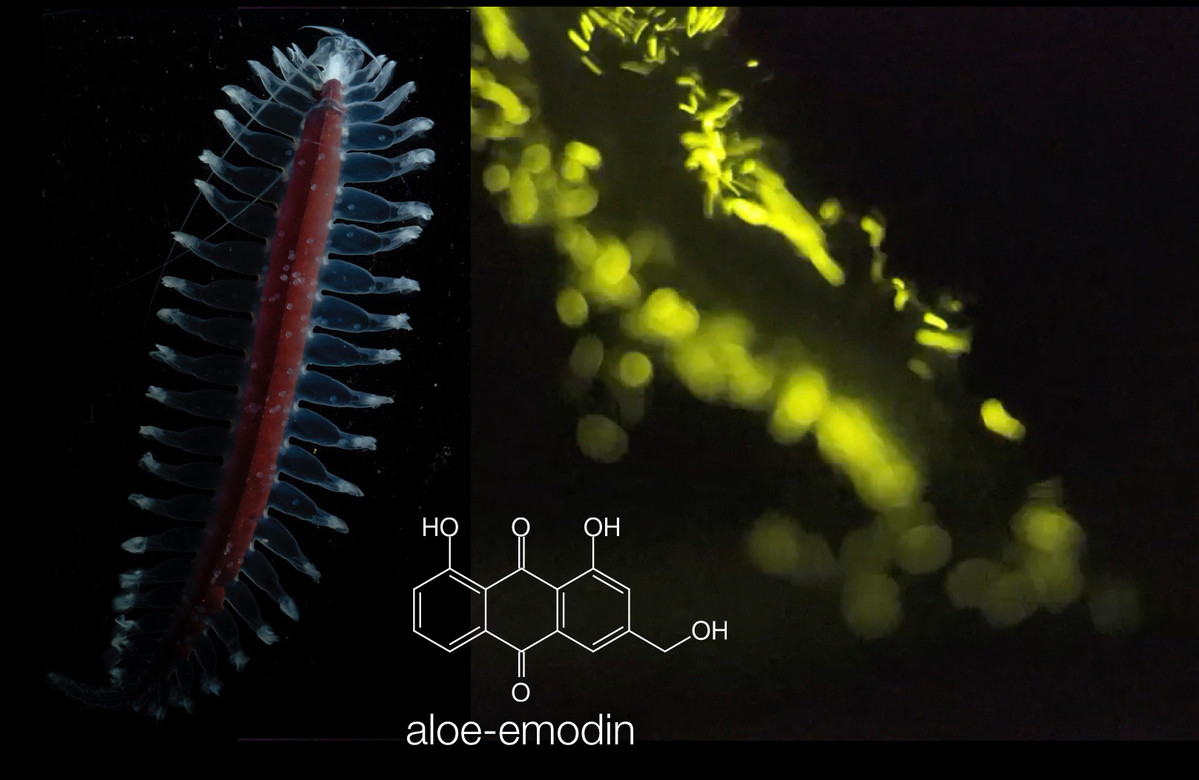
Although most animals in the sea make blue bioluminescent light, the gossamer worm (Tomopteris sp.) is one of the few that makes yellow light. The chemical that gives it this yellow color was discovered by MBARI researchers.
© Steve Haddock /MBARI
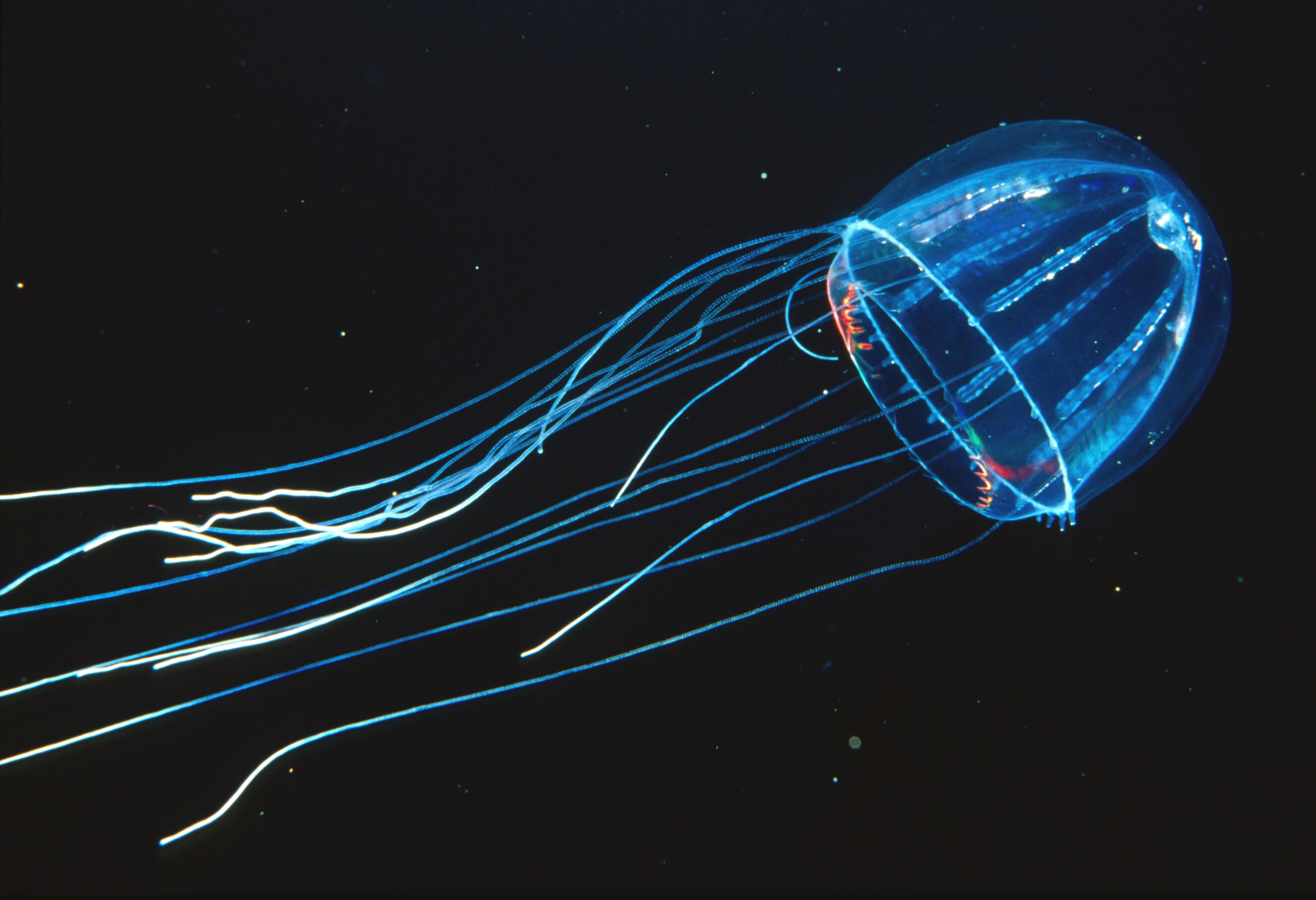
This midwater jelly can light up its long tentacles to distract a potential predator long enough to escape. If that doesn't work, it can detach its tentacles and flee.
© Steven Haddock/MBARI
Why do organisms use bioluminescence?
In the deep sea where little sunlight penetrates, deep-sea animals have adapted to use light to their benefit. They can turn it on and off, for a variety of both offensive and defensive strategies ranging from avoiding predators to finding their next meal—or even a mate.
Defense
Deep-sea animals use bioluminescence in several ways to deter or hide from predators. The vampire squid releases a cloud of glowing fluid, instead of ink, that distracts the predator while it swims away. As a bonus, the predator is left covered in brightly lit fluid—making it glow and leaving it vulnerable as potential prey. Some animals like the octopus squid use bioluminescence as a type of smoke screen. Similar to a lizard that drops its tail, the squid drops a glowing arm while it makes its escape.
Camouflage
Deep-sea animals live in an environment where dim blue light is shining down from above. If there’s a predator beneath them looking up, it would see the shadow cast by the prey against the surface light. To avoid being spotted, some deep-sea animals use bioluminescence as a cloaking device. Hatchet fish have light-producing organs in rows along their bellies that allow them to avoid detection — a strategy called counter illumination. These organs shine a pale blue light that matches daylight filtering down from above. This hides hatchetfish from predators lurking below. Counter illumination is not a foolproof strategy—the barreleye and strawberry squid have special proteins in their eyes that allow them to see through the illuminating camouflage.
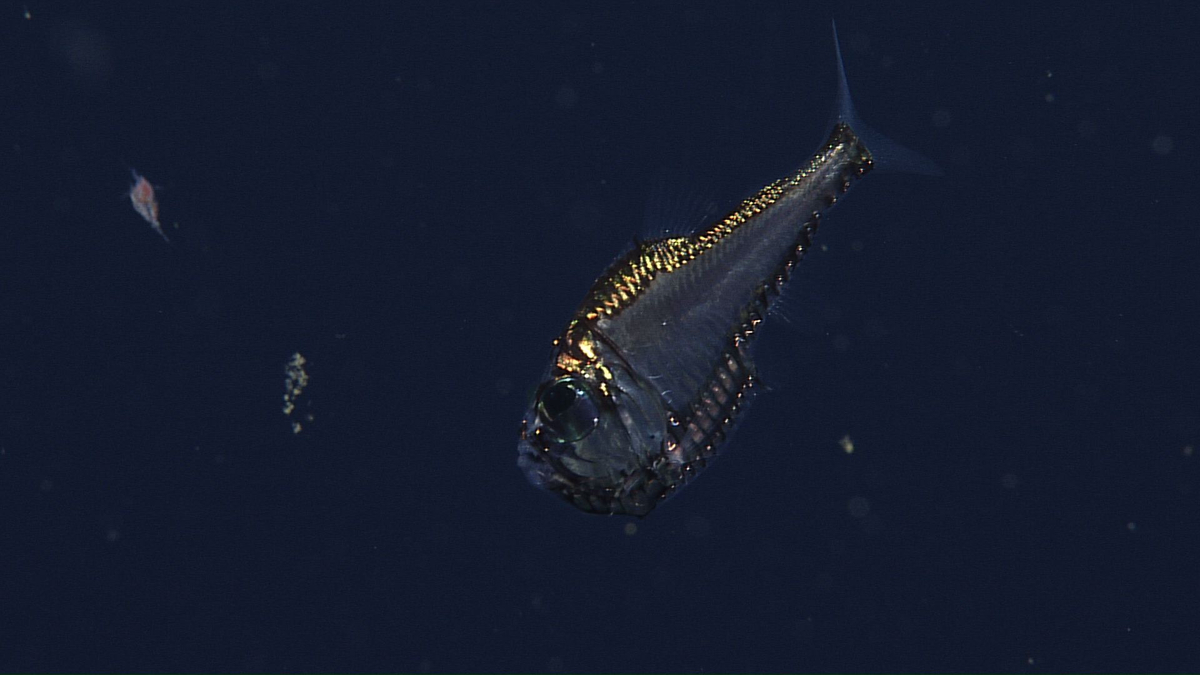
Hatchetfish have light-producing organs in rows along their bellies. These organs shine a pale blue light that matches daylight filtering down from above and hides them from predators below.
© MBARI
Finding food
Food can be sparse in the deep sea. Instead of expending energy hunting for dinner, many animals—like the anglerfish—use bioluminescence to lure prey to them. Similar to how a moth is attracted to a light source, a bright light in the deep sea is alluring to animals. They approach it—possibly mistaking it for something good to eat—and put themselves within grabbing distance of the predatory fish.
The angler siphonophore has tentacles with stinging cells. It also has bioluminescent lures on the tips of the tentacles, next to the stinging cells, that mimic the appearance of copepods, a common prey item for deep-sea fishes. The illuminated lures attract fish in search of a meal, allowing the siphonophore to sting and eat the fish.
The loosejaw dragonfish use bioluminescence to find prey in another way. This animal has an organ that emits red light located under its eyeball. Red light does not penetrate to the deep sea. Many deep-sea animals use this fact to their advantage—their red-colored bodies make them near impossible to see at depth. But the loosejaw dragonfish emits red light from under its eye, illuminating these red-colored animals. For red animals hoping to hide in the dark, this fish has night vision goggles coming after them.
Finding a mate
Some deep-sea fish may use bioluminescence to help them find a mate. Male and female lanternfishes have different patterns of light on their sides. It’s thought that the different light patterns allow them to pick out a mate of the same species in the darkness. Flashy displays of bioluminescence may also be used to entice a mate or signal when an animal is ready to mate.
Related videos
Learn more about bioluminescence

MBARI scientist, Dr. Steve Haddock, sat down with our social media team to dive into all things that glow in the deep sea.
Keep exploring
Story
Nature is queer
We’re excited to sea-lebrate the queerness of nature!
Read story – Nature is queer
Story
Birdwatching tips: A guide to enjoying and identifying local birds
Here are our best tips to help keep you and the birds safe and healthy during a birdwatching adventure.
Read story – Birdwatching tips: A guide to enjoying and identifying local birds
Story
Chumash Heritage National Marine Sanctuary is almost here
Chumash Heritage National Marine Sanctuary protects marine life and cultural resources on California’s coast.
Read story – Chumash Heritage National Marine Sanctuary is almost here