

Vampire squid
Vampyroteuthis infernalis
- Not on exhibit
- Animal type
- Octopus & kin
- Ecosystem
- Deep sea
- Relatives
- Other octopodiformes
- Diet
- Marine snow, zooplankton, mucus, and excrement
- Range
- Worldwide in both temperate and tropical waters, mostly well-known within the oxygen-minimum zone in Monterey Bay
- Size
- Mantle length up to 12 inches (30 cm)
Meet the vampire squid
Don’t be fooled by the misleading name—this cephalopod is neither a vampire or a squid! The vampire squid is a gentle scavenger floats through the deep sea collecting drifting debris called marine snow with long feeding filaments. The unique characteristics that set them apart from other cephalopods help them survive in the ocean’s darkest depths.
Classification
Scientists named this animal Vampyroteuthis infernalis, which means “vampire squid from hell.” But the vampire squid is no squid at all—they’re the only living member of the family Vampyroteuthidae in the phylum Mollusca.
This misleadingly-named cephalopod has a storied history of misclassification. When this species was first discovered in 1903,they were classified as a type of cirrate octopus like the flapjack octopus due to the webbing between the arms and pair of fins on the mantle. In the 1940s and 1950s, however, scientists determined that it was neither an octopus nor squid, but part of a different group based on its unique features.
Appearance
What big eyes you have!
One of the vampire squid’s most striking characteristics is their large eyes—the biggest eyes of any living animal in proportion to their body size. Their eyes are about one inch in diameter, while their bodies can grow up to 12 inches in total length. If a human had the same proportions, our eyes would be about 9 inches in diameter!
If you watch a video of a vampire squid in the deep sea, you’d think their eyes glow bright blue. But that’s actually a trick of the light. When the clear eyes of a vampire squid are illuminated by the lights of a remotely operated vehicle, they reflect the surrounding water and appear blue in the footage captured by scientists.
Related videos
An ancient species faces new dangers in the deep

Get to know this elusive animal in this video from our research and technology partners at MBARI.
Bright blue bits
A light-producing organ produces bright blue bioluminescence at each tip of a vampire squid’s arms.
Tentacles and filaments
The vampire squid has two fine tentacles, or filaments, that can extend up to eight times the length of their body. Each filament has tiny hairs and sensory nerves that help them sense their surroundings and possibly detect food.
Cloak
A vampire squid inverts their webbed arms when startled, producing a “cloak” that covers the mantle. This motion exposes spikey-looking appendages called cirri on the undersides of their webbed arms. The cirri are usually iridescent, reflecting the light of remotely operated vehicles as they move.
Colors
Vampire squids are a reddish rust color. Many cephalopods have special muscles that control their pigment sacs called chromatophores that allow them to change their color. Vampire squid lack these muscles, so you won’t see a vampire squid shifting color.
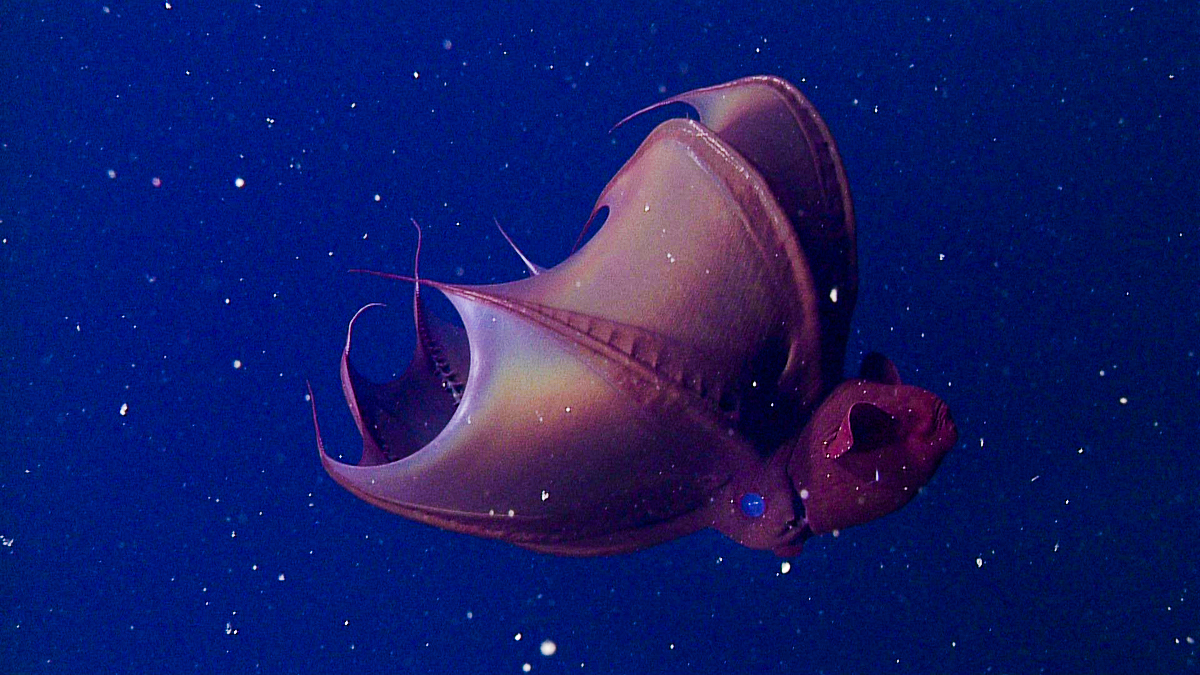
MBARI photographed this vampire squid with arms spread wide at more than 600 meters (2,000 feet) deep.
© MBARI
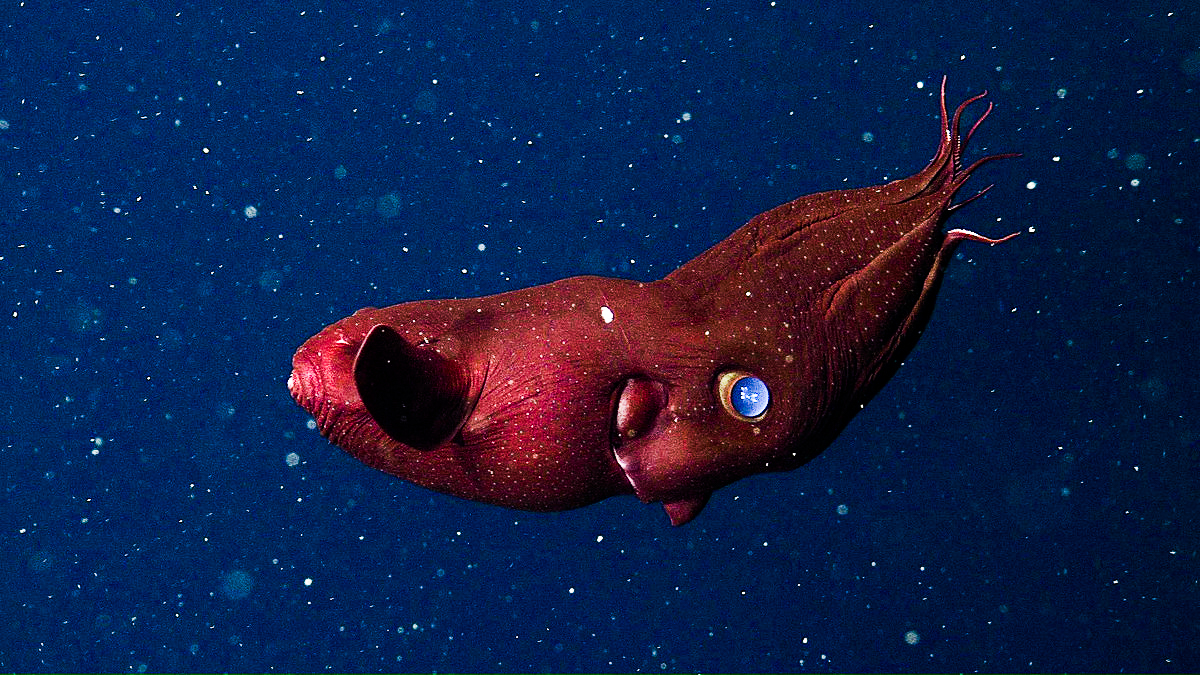
A vampire squid's eyes are clear, but when illuminated by the light of a remotely operated vehicle they reflect the color of the surrounding water and appear blue.
© MBARI
How does the vampire squid survive in the deep sea?
Though the cold, dark, low-oxygen waters of the deep sea make survival difficult for most animals, the vampire squid is most often found in the oxygen-minimum zone. The vampire squid has evolved to survive in the extreme conditions of this harsh deep-sea environment.
Energy efficiency. The waters of the deep sea have low oxygen and unpredictable food, so a vampire squid must conserve energy. They have the slowest metabolism of any cephalopod so energy from food lasts longer. They’re also neutrally buoyant—that squishy, gelatinous body is only slightly denser than the seawater surrounding them so they can remain suspended in the water column without expending much energy.
Waste not, want not. The vampire squid uses their large surface gill area to makes the most of the little oxygen available in their environment. They have a respiratory pigment called hemocyanin in their blood that carries oxygen. They have the highest affinity for oxygen of any known cephalopod species!
A see-food diet. The vampire squid’s keen sight likely allows them to spot the largest particles of marine snow to snack on.
Diet
The vampire squid don’t share the same diet of their batty namesake. They’re detritivores, meaning they dine on dead organic material, and they're the only living cephalopod species that doesn't primarily consume live prey. Some studies find that older, larger vampire squids may occasionally consume fish, crustaceans, and jellies. But for the most part, vampire squids are gentle drifters who prefer a drifting, decaying buffet.
So what’s on the menu? Mostly marine snow—particles of dead animals, rotting materials, poop, and snot. Yum! Marine snow gently drifts down to the deep sea from above and looks like an underwater snowfall.
To feed, the vampire squid extends its two thin filaments covered in adhesive mucus. The animal traps the marine snow in its filaments, then pulls them through its arms, scraping off trapped food particles along the way. Suckers on its arm secrete mucus that envelops the food particles, creating a sort of marine snow mucus dumpling. The mucus dumpling is slowly moved to its mouth underneath its mantle, where it’s then eaten.
Related videos
What the vampire squid really eats

The elusive vampire squid is an ancient animal that shares many characteristics with squids and octopods. But unlike these cephalopods, the vampire squid’s a drifting detritivore.
Mucus dumplings
To feed, the vampire squid extends its two thin filaments covered in adhesive mucus. The animal traps the marine snow in its filaments, then pulls them through its arms, scraping off trapped food particles along the way. Suckers on its arm secrete mucus that envelops the food particles, creating a sort of marine snow mucus dumpling. The mucus dumpling is slowly moved to its mouth underneath its mantle, where it’s then eaten.
Defense strategies
The vampire squid doesn't produce ink. They've evolved other strategies to stay safe from predators.
The pineapple pose
The vampire squid wards off predators by pulling their arms up and over their body and shrouding themself in a cloak-like web. This motion hides the mantle and exposes spikey-looking fleshy appendages on the back of its webbed arms called cirri. Scientists nicknamed this unique defense strategy the “pineapple pose”!
Mucus cloud
The vampire squid may eject a luminous mucus cloud to distract predators.
Re-growing limbs
A vampire squid can regenerate the top of an arm that’s broken or bitten off by a predator—a small price to pay for a quick escape!
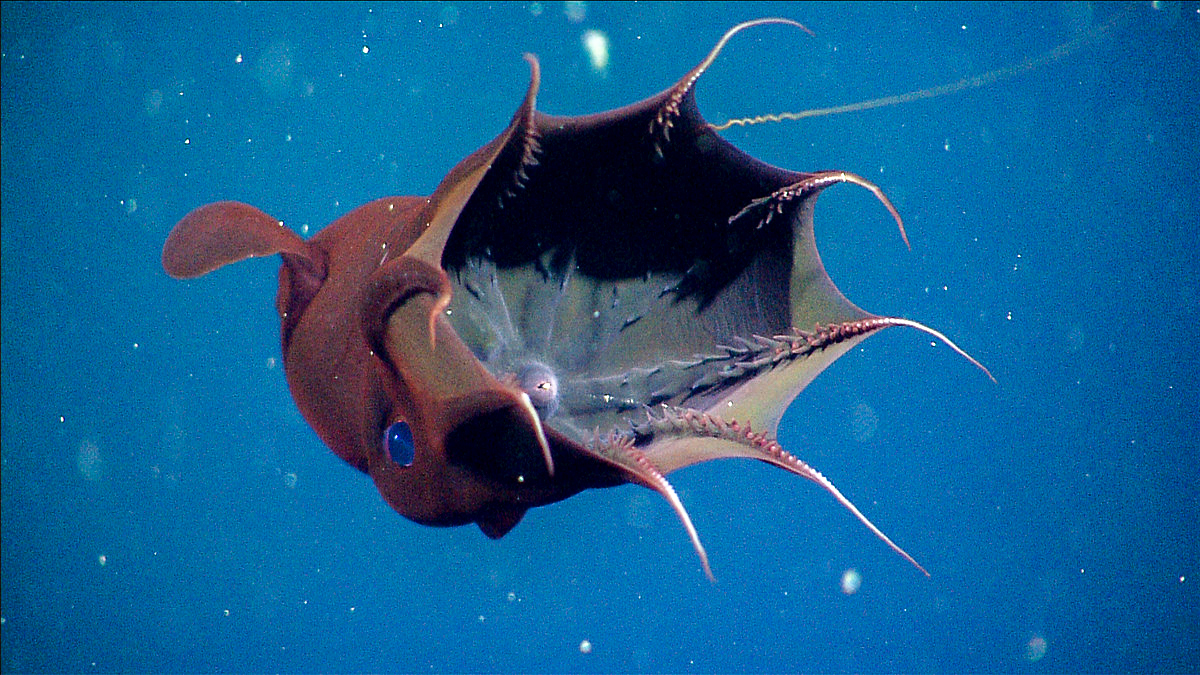
The vampire squid has two fine tentacles, or filaments, that can extend up to eight times the length of their body.
© MBARI
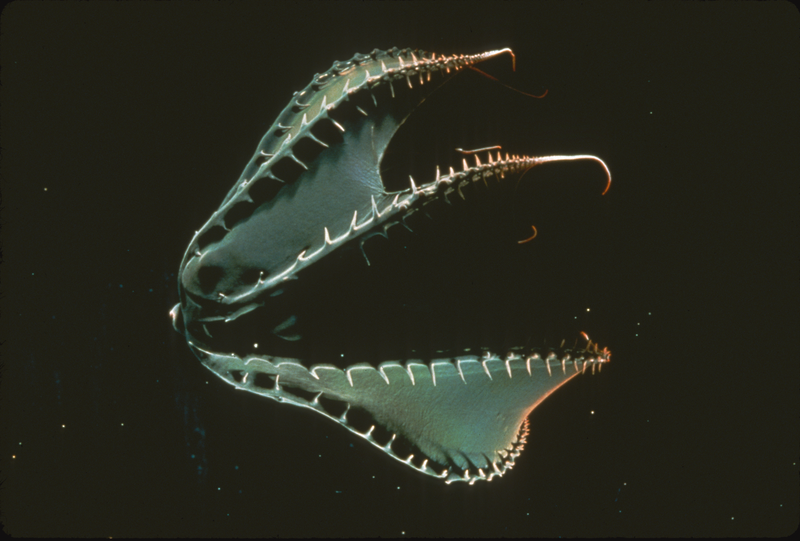
A vampire squid wards off predators using the "pineapple pose.”
© MBARI
Mating
While most cephalopods mate only once, the vampire squid reproduces multiple times in their lifetime.
A male vampire squid transfers his sperm to the female with his funnel, a cylindrical muscular structure cephalopods use for respiration and movement. The female uses the sperm to fertilize her eggs then releases them into the water column. She releases only a few eggs at a time and uses relatively little energy when spawning.
Lifecycle
After the vampire squid egg is fertilized, it develops into a larva with a large head and eight short arms.
A juvenile vampire squid has four fins on the mantle. Two of these fins get reabsorbed into the animal's body as they mature, a trait unique among all living cephalopods. Confused by this mysterious species’ distinct appearance in each stage of development, scientists once thought there were 10 different species of vampire squid!
Predators
The vampire squid’s ability to thrive in the oxygen-minimum zone keeps them relatively safe from danger. They’re sometimes found and preyed upon by predators including fishes, cephalopods, sea lions, sharks, and whales.
Conservation
Though the dark and mysterious underwater world of the vampire squid may feel far away, climate change is already affecting deep-sea animals. As the ocean warms, studies show an increased number of low-oxygen “dead zones,” and the deep oxygen-minimum layer where the vampire squid lives is also expanding. To help us better understand our changing ocean, scientists study species like vampire squid that can survive in the oxygen-minimum layer then compare them to species that live outside these harsh conditions.
Cool facts
- The vampire squid is the only living cephalopod species known to be a scavenger.
- A vampire squid’s eyes are the largest in the animal kingdom by proportion.
Want to see amazing deep-sea creatures up close?
Visit our exhibition, Into the Deep: Exploring Our Undiscovered Ocean (En lo Profundo: Explorando Nuestro Océano Desconocido).
Up next in deep sea
Animal
Sea spider
Sea spiders swim and crawl along sandy seafloors around the world.
Keep exploring
Animal
Giant siphonophore
When startled, the giant siphonophore glows with bright blue light.