

Blue whale
Balaenoptera musculus
- Not on exhibit
- Animal type
- Marine mammals
- Ecosystem
- Open ocean
- Relatives
- Other baleen whales
- Diet
- Krill, occasionally pelagic crabs
- Range
- All oceans
- Size
- Average maximum length is 88 feet (27 m); the largest measured 110 feet (33 m), 200 tons (181 kg)
A whale of a whale
The blue whale is the largest known animal to have ever lived on earth. This massive and majestic marine mammal has a heart as large as a small car, and a tongue weighing two to four tons.
Watch in real time
Monterey Bay Cam
Check out this live cam – Monterey Bay CamStatus: Endangered
Least concern
Near threatened
Vulnerable
Endangered(active)
Critical
Extinct in wild
Extinct
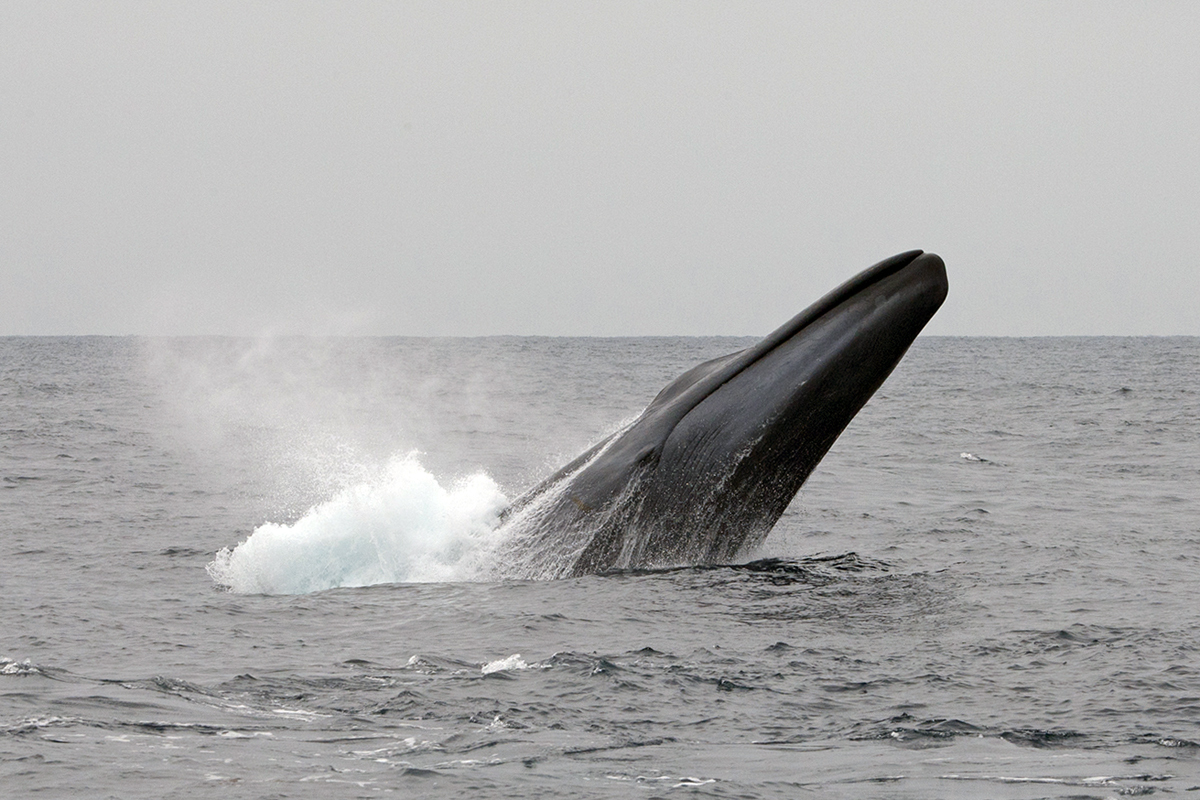
A blue whale (Balaenoptera musculus) breaching off the coast of Southern California.
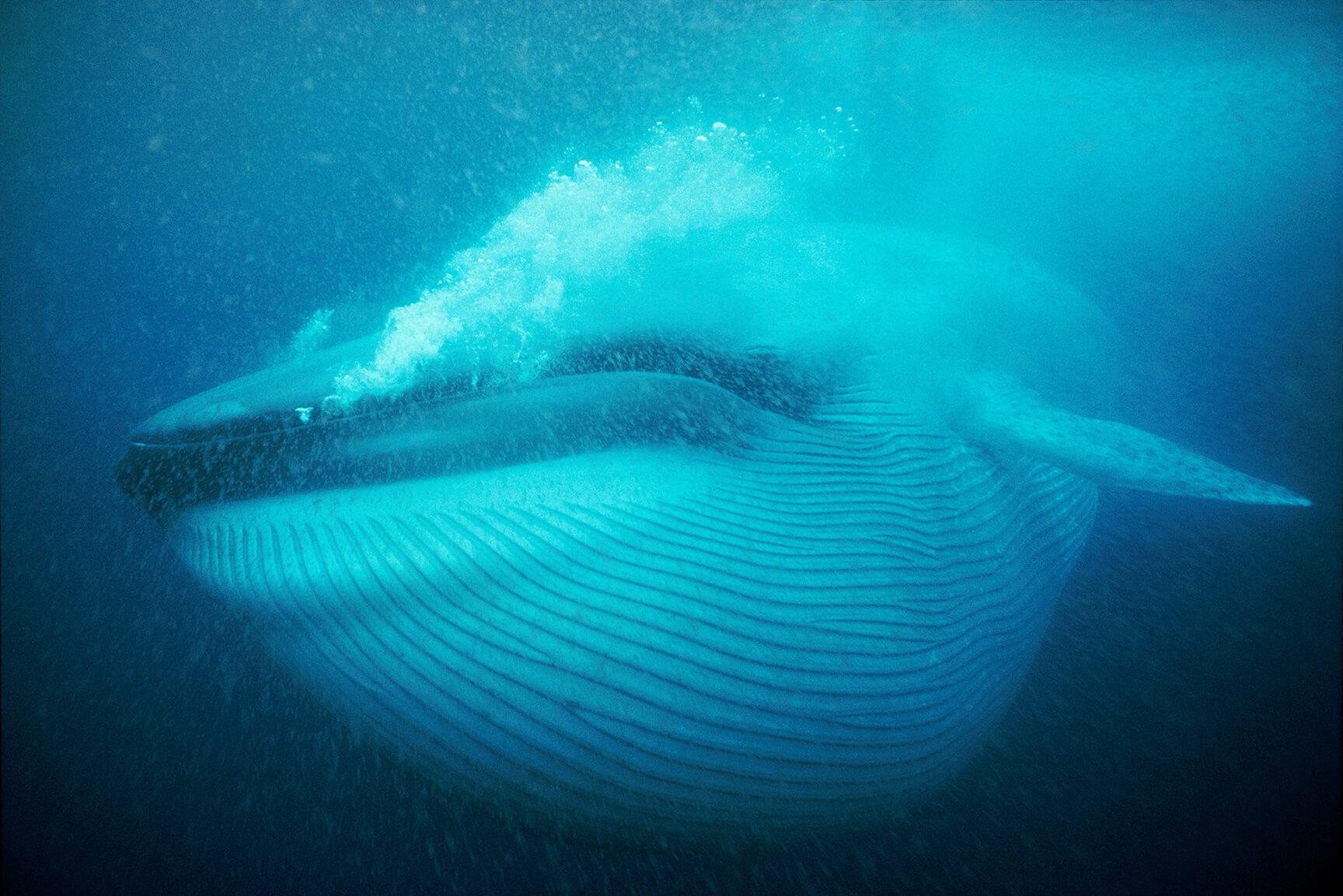
The blue whale has many adaptations to survive life in the ocean.
© Doc White/Seapics
Size
The blue whale is the largest known animal to have ever lived on Earth. They can grow to 108 feet (33 m) in length and weigh as much as 200 tons—the weight of 30 elephants!
Even the weight of their body parts is staggering. This cetacean has a heart as large as a small car, and a tongue weighing two to four tons.
With an average length of 88 feet (27 m), the blue whale is the largest animal on Earth.
Eyes bigger than its esophagus
Despite their incredible mouth-stretching abilities, a blue whale's esophagus is only four inches (10 cm) in diameter. Swallowing large prey isn't possible, so keep the krill coming!
Range
Blue whales are found worldwide in every ocean except the Arctic. Scientists estimate their current population is about 15,000 individuals.
Breathing
Like all baleen whales, the blue whale has two blowholes located side-by-side on the top of the head. This placement lets blue whales breathe with only the top of their head above water. Unlike baleen whales, toothed whales like sperm whales only have one blowhole.
The spout produced when a blue whale exhales can reach 30 feet high. Before diving back underwater, a flap covers the holes and seals them closed so no water can get inside.
Eating
The blue whale feeds with baleen—300 to 400 fringed plates up to 3 feet (1 m) long that hang from their massive upper jaw. Baleen are a lot like a spaghetti strainer; they help the whale drain a big mouthful of seawater while keeping the goodies inside. A blue whale gulps down a mouthful of water and krill, closes their mouth, pushes the water out with their tongue, then swallows the catch of krill.
Millions of krill
A blue whale eats krill almost exclusively, consuming up to 7,900 pounds (3,600 kg) of these tiny, shrimp-like invertebrates daily. That’s about 40 million krill every day! To meet the needs of their gargantuan diet, blue whales must seek out larger and more dense concentrations of prey than other baleen whales.
Pleats and thank you
What do some whales and certain skirts have in common? Pleats!
Rorqual whales—a group including blue whales, fin whales, and humpbacks—have an area that looks like an accordion on the underside of their massive mouth. These “pleats” perform amazing feats of stretching and expanding.
When a rorqual whale takes a dive, they open their mouth wide and let water rush in. The pleats stretch open to hold a gigantic volume of water that can be even greater than the whale themself!
Reproduction
Finding a mate
The blue whale reaches sexual maturity at about six to ten years old. After that, they mate every two years. Blue whales may stick with the same mate for multiple years but are not known to pair for life.
How many elephants is that?
After an 11-month pregnancy, a blue whale female gives birth in the winter, usually in tropical or subtropical waters. Her newborn calf weighs 4,000 pounds or more—about half the weight of a full-grown elephant.
For the first six months of life the baby blue nurses on their mother’s fatty and nutritious milk. The calf drinks 100 gallons of milk daily, can gain nine pounds each hour, and grow up to one inch and a half per day! At seven months, a blue whale calf is 50 feet long, the length of a Mack truck, and weigh 46,000 pounds—the weight of four elephants!
Predators
To date, the only known natural predator of the blue whale is the orca. Otherwise, this gentle giant has little to fear in the ocean other than the dangers posed by human activity.
Population
Scientists estimate the present population worldwide to be 15,000 blue whales. There are three main blue whale subpopulations in the Antarctic, Eastern Pacific, and Indo-Western Pacific oceans.
The only population of blue whales that may be thriving is a group of about 2,000 individuals who summer off the coast of California. Unfortunately, the mortality rate this species faced from whale hunting was so high that some populations may never recover.
Whale calls
The blue whale is one of the loudest animals on Earth. By some accounts, they can produce the loudest sustained sounds in the animal kingdom at 188 decibels. Blue whales call out to each other from hundreds of miles away—a shout across the open ocean.
An ultra-sensitive underwater microphone developed by our partners at MBARI tunes into sounds beneath the surface of the ocean. This groundbreaking technology lets researchers to listen to blue whale calls, only audible when sped up by computer software and played back through subwoofer speakers. As it turns out, a blue whale call sounds a lot like a semi-truck downshifting.
Habitat
The blue whale usually lives in the open sea in relatively cold water. They have an extensive range from the poles all the way to tropical and temperate waters. Blue whales may embark on a long annual journey, from the equator in the winter to the distant seas of Antarctica in the summer.
Between ice and a cold place
Blue whales sometimes swim near icebreak, islands, and along seamounts—which can sometimes land then in trouble. In 2014, nine blue whales died after getting stuck in ice patches off the Canadian coast.
In Monterey Bay
When summer rolls around, Monterey Bay is a great spot for a blue whale to gulp down tons of krill. Since they’re picky eaters who only eat krill and pelagic crabs, blue whales travel up to 30 miles a day in search of their prized food. The California coastline sees the largest concentration of blue whales in the world. Scientists estimate the present population worldwide to be 15,000 whales—with 2,000 of these living seasonally in California coastal waters, including Monterey Bay!
Thinking about coming to Monterey for a whale watching trip? In the summer, it’s common for whale watchers to see blue whales near the canyon that crosses Monterey Bay—a magical sight to behold.
Tips for spotting a blue whale
Keep an eye out for a high, vertical eruption of water—a blue whale’s spout looks like an exploding fire hydrant! Aside from their enormous size, you can spot a blue whale by their blue-gray color mottled with blue, white and grey spots. They also have a distinctively small and stubby dorsal fin three-quarters of the way down their back.
Whale-less winter
The blue whales leave Monterey by winter, the season when they return to the warmer waters off Central America to give birth and mate. Since krill is scarce or nonexistent in these warm waters, the blue whale lives off reserves of body fat from the summer until they can feed again.
Related videos
Marine mammals of Monterey Bay montage!

Enjoy a magnificent montage of Monterey Bay's marine mammals.
Conservation
Decimated by whaling
Whalers began hunting blue whales in earnest after the invention of the harpoon gun. The pre-whaling population of blue whales quickly fell from an estimated 350,000 to 1,000 in the mid-1920s. Blue whales became so scarce that in 1966 the International Whaling Commission belatedly declared them a protected species worldwide. The Endangered Species Act also protects the blue whale.
Is the blue whale endangered?
Yes—the blue whale is listed as Endangered and legally protected by the Endangered Species Act. They’re also classified as endangered on the International Union for the Conservation of Nature and Natural Resources (IUCN) red list.
Threats
Blue whales are considered endangered due to the impacts of the fishing industry and climate change. Although the fishing industry no longer directly hunts whales, blue whale deaths have been tied to direct ship strikes.
Climate change may cause a decline of their primary food source, Antarctic krill (Euphausia superba) and Antarctic coastal krill (E. crystallorophias). Warmer temperatures lead to lower krill populations overall, and ocean acidification impacts the krill’s ability to develop shells.
Plastic pollution also poses a growing risk to blue whales. One study showed that per day, a blue whale may ingest 10 million pieces of microplastic, while a fish-feeding humpback whale likely ingests 200,000 pieces of microplastic. These findings show an urgent need to address plastic pollution, especially to protect vulnerable species like blue whales that are still struggling to recover from whaling.
Cool facts
- In Arctic or Antarctic waters, yellow plankton called diatoms often stick to the blue whale’s underbody, giving them the nickname "sulfur bottom."
- A blue whale sleeps while swimming, though they never fall fully unconscious. Instead, the blue whale lightly naps as they slowly cruise along the surface of the water.
Up next in open ocean
Animal
White shark
Earth's largest predatory fish, the white shark has captured the imagination of people around the world.
Keep exploring
Animal
Moon jelly
This dreamy jelly is named for their translucent, moon-like bell.