

Gray whale
Eschrichtius robustus
- Not on exhibit
- Animal type
- Marine mammals
- Ecosystem
- Coastal waters
- Relatives
- Other baleen whales; Order: Cetacea; Family: Eschrichtiidae
- Diet
- Mostly bottom-dwelling crustaceans; also schooling fishes, shrimp, and worms
- Range
- Alaska to Baja California; also found near Sakhalin Island, Russia
- Size
- Up to 46 feet (14 m) and 35 tons (31,750 kg)
Meet the gray whale
The gray whale undertakes migrates 12,000 miles each year—the longest migration of any mammal. Calves and their mothers are commonly spotted in Monterey Bay on their long journey north each spring.
Watch in real time
Monterey Bay Cam
Check out this live cam – Monterey Bay CamNatural history
A newborn gray whale calf is dark, wrinkled, and barnacle-free. In the warm calving lagoons in Baja California, a calf remains in close contact with its mother, often swimming onto her back or tail flukes. Before making the trip north, the baby grows and fattens on 50 gallons (190 l) of milk each day.
A calf grows is about 17 feet (5 m) at birth, growing to 20 feet (6 m) long by the time they pass through Monterey on the journey north with their mother in spring. Female gray whales are usually larger than males.
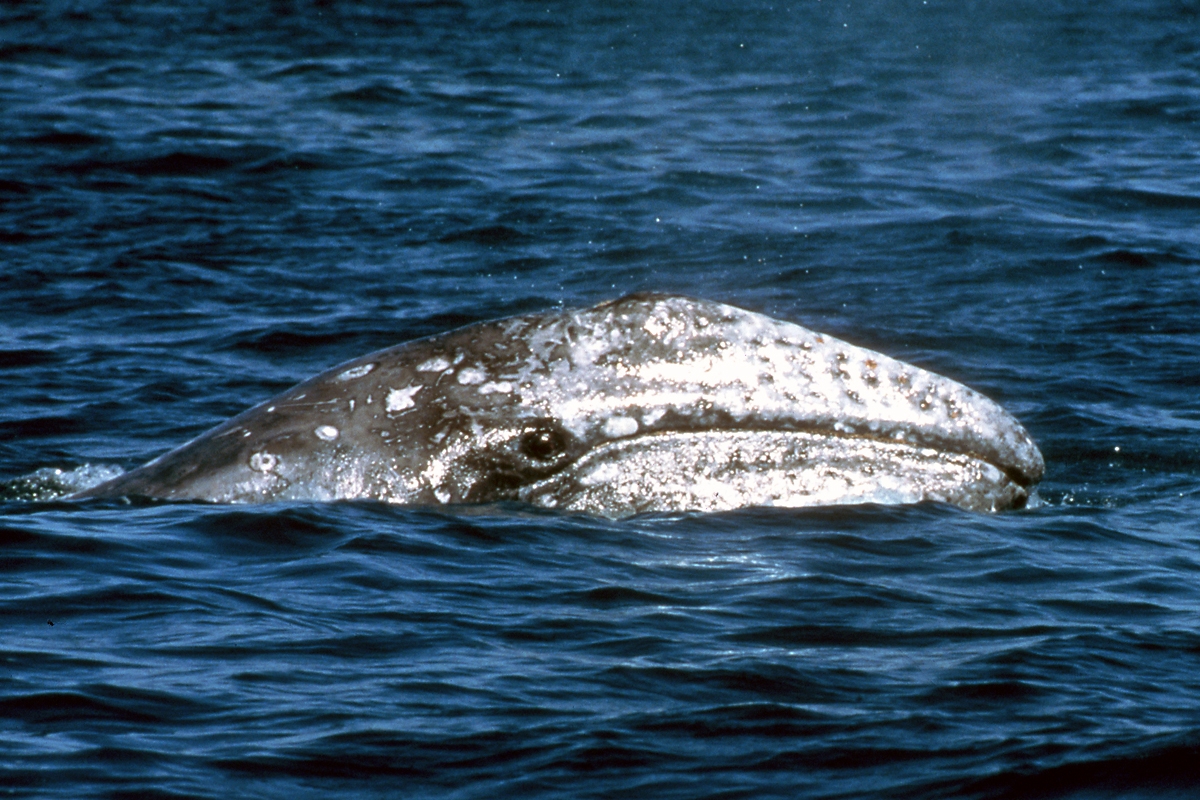
A young gray whale at the surface of the water.
© Laura Francis
Conservation
Like all species of great whales, the gray whale was in danger of extinction until they were protected by United States law in the 1970s. Legal protections helped grey whale populations recover, and the species was removed from the Endangered Species list in 1994. In the late 1990s, there were as many as 26,000 grey whales, but today the population has declined somewhat and is estimated to hover around 22,000.
A thin-ice diet
The impacts of climate change, such as reduced sea ice cover, may already be affecting gray whales. Research shows that gray whales now feed farther north and stay there longer than they have in the past.
The Arctic lost 95 percent of its oldest, thickest sea ice in recent decades. The remaining ice is thinner than ever before, affecting the gray whales’ food supply.
In winter, a thick blanket of sea ice covers the surface of the Arctic, casting the waters below in darkness. When the ice retreats and sunlight hits the water, tiny organisms called phytoplankton burst into life. These algal blooms provide food for zooplankton, including the minuscule crustaceans and worms gray whales eat.
Climate change is causing phytoplankton to bloom earlier in the season as Arctic ice thins. Science suggests this longer season of sunlight exposure may begin so early that plankton blooms will grow and collapse while still entirely under the ice.
A new route to explore
Melting sea ice may allow gray whales to repopulate the Atlantic Ocean where they haven’t lived for centuries. Commercial whaling wiped out the Atlantic gray whale population in the 1800s, and sea ice has blocked the whales’ passage from the Pacific until now.
Gray whales aren’t the only animals expanding into the less-icy Arctic–humans are, too. Today, more sea stays open for industrial use like shipping, oil exploration and commercial fishing. International cooperation is essential to ensuring Arctic waters are managed responsibly.
What's next for gray whales?
Gray whales have dealt with big changes in their history, enduring previous instances of climate change, hunting, ocean pollution, ocean noise, and shipping traffic. But the growing rate of plastic pollution is an unprecedented threat to grey whales. A November 2022 study a krill-eating blue whale may ingest 10 million pieces of microplastic per day, while a fish-feeding humpback whale likely ingests 200,000 pieces of microplastic every day.
Grey whales and some populations of humpback whales also suction feed on seafloor sediment to extract invertebrates. Since the seafloor is a primary sink for plastic and other marine debris, feeding on substrate may pose considerable risk to these gray and humpback whales.
Related videos
A gray whale mom and calf stopped by the Aquarium!

You never know what a day on the Monterey Bay will bring! Here's a "gray-t" video of a whale encounter seen from our back deck!
Cool facts
- When feeding on the seafloor, grey whales lie on their sides and sucks in sand or mud. The large pit they leave behind then determines the kinds of animals that live in that part of the seafloor.
- The white patches on a grey whale’s body are spots where barnacles and whale lice have attached themselves. Grey whales can carry over 400 pounds of barnacles and whale lice on their bodies!
Up next in coastal waters
Animal
Northern elephant seal
The elephant seal is named for its enormous size and the male’s inflated, trunk-like nose.
Keep exploring
Animal
Sea otter
Beyond their cute faces and fluffy fur, sea otters play an irreplaceable role in their coastal habitats.