

California sheephead
Semicossyphus pulcher
- On view
- Kelp Forest
- Animal type
- Fishes
- Ecosystem
- Kelp forest
- Relatives
- Rock wrasses, señoritas; Family: Labridae
- Diet
- Prefer hard-shelled animals like sea urchins, molluscs, lobsters, and crabs
- Range
- Monterey Bay, California to Sea of Cortez; not common north of Point Conception except when carried north by warm El Niño currents
- Size
- Up to three feet (91 cm) and 36 pounds (16.3 kg)
Meet the California sheephead
This fish sports a white chin and large, protruding canine teeth that can pry hard-shelled animals from rocks. After powerful jaws and sharp teeth crush the prey, modified throat bones (a throat plate) grind the shell into small pieces.
Watch in real time
Kelp Forest Cam
Check out this live cam – Kelp Forest CamNatural history
This fish hunts actively during the day, but at night, as with many wrasses, they move to crevices and caves and wraps themself in a mucus cocoon. Predators on the hunt can't detect the fish’s scent through the mucus cover. A sheephead appears to be asleep, but since fishes don't have eyelids, we can only assume they're sleeping.
Male and female sheephead have different color patterns and body shapes. The male is larger with black tail and head sections, a wide reddish-orange midriff, red eyes, and a fleshy forehead bump. The female is dull pink over most of its body.
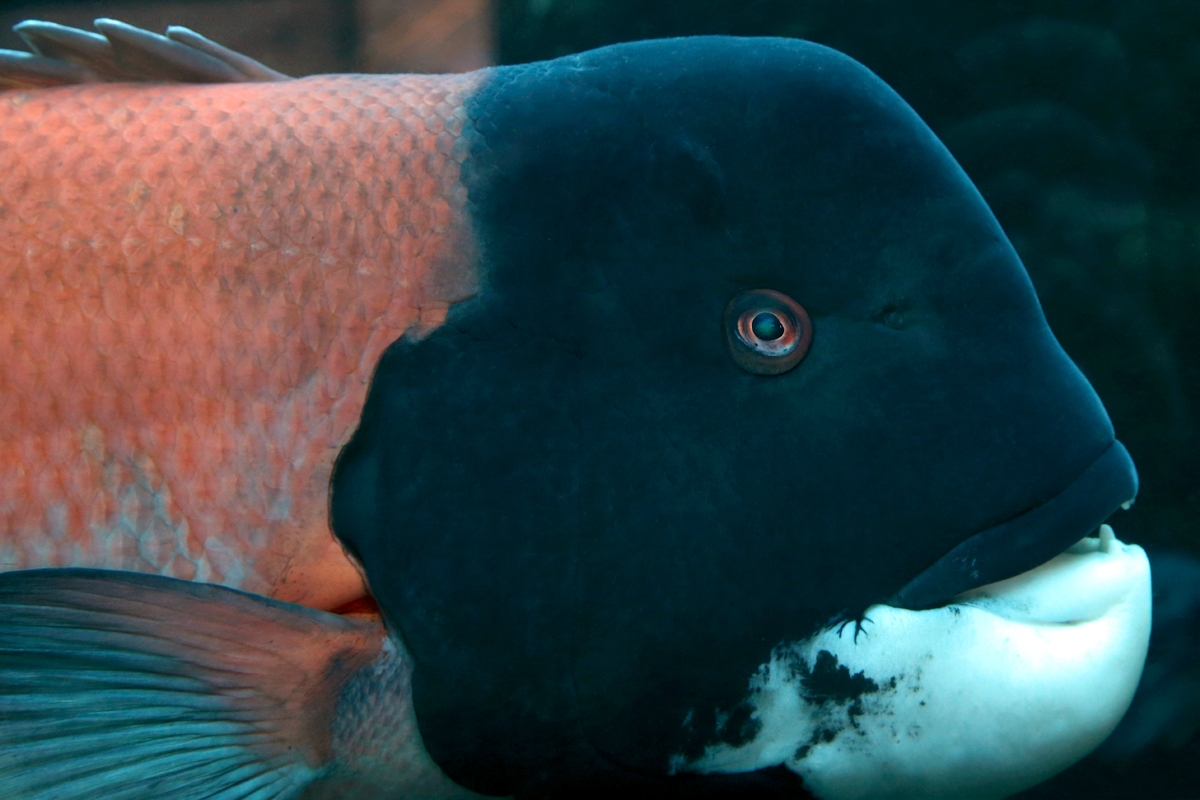
Una mirada de cerca a un pez cabeza de oveja macho de California.
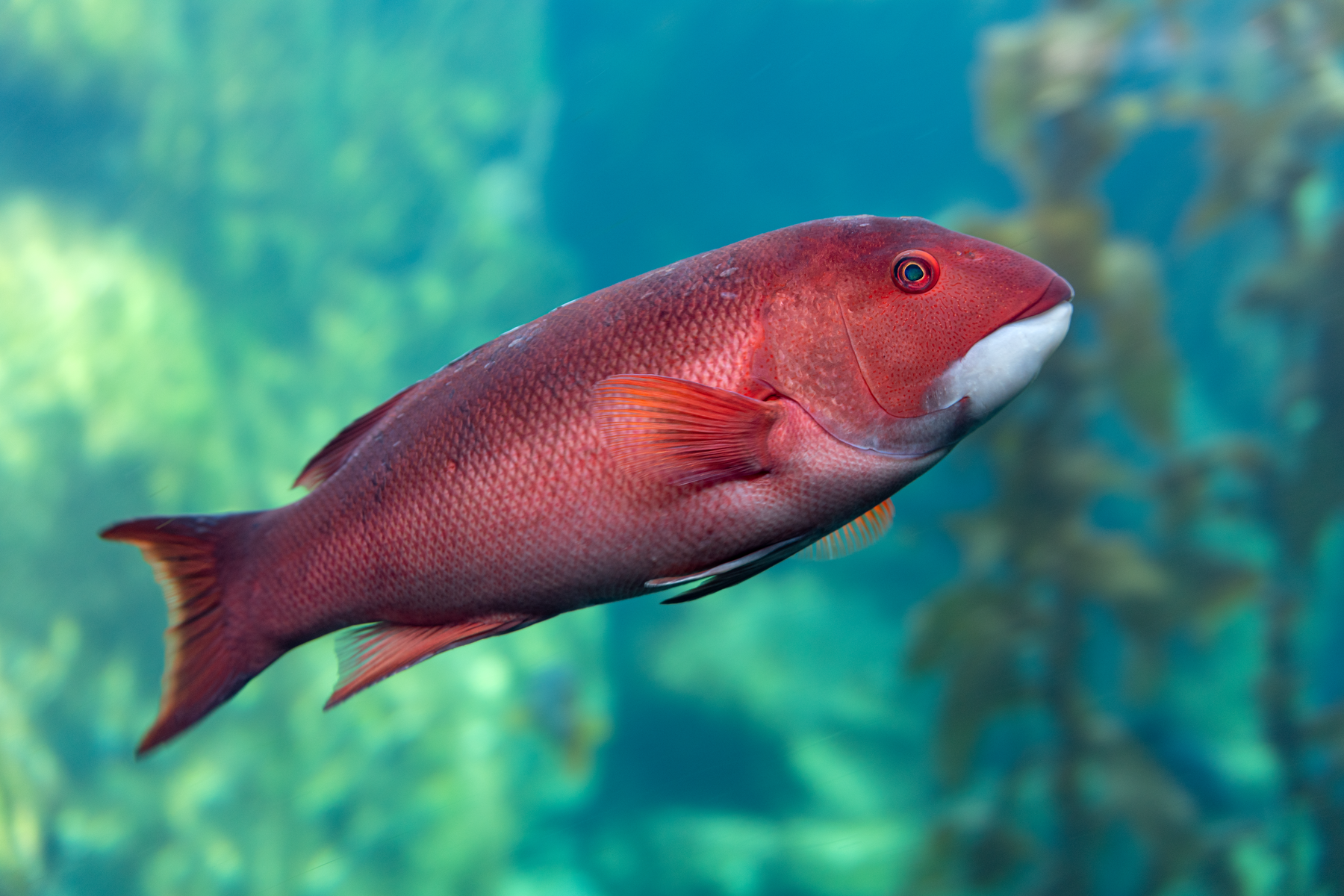
Una hembra de pez cabeza de oveja de California recorre la exhibición del Bosque de Macroalgas.
Conservation
During the late 1800s, Chinese fishermen caught large numbers of sheephead for drying and salting. Except for brief periods, fishermen didn't target sheephead again until the late 1980s when commercial fisheries began to supply live fish to Asian markets and restaurants. The fisheries grew rapidly, with sheephead becoming a large share of the catches. Because restaurant aquariums are small, commercial fisheries seek small, pre-adult sheephead, usually females before they've reproduced. To control the catches of sheephead and prevent overfishing, the California Department of Fish and Wildlife established regulations in 2002 that restrict the catch size of sheephead and the areas where these fish may be caught.
The California sheephead is listed as "vulnerable" by the International Union for the Conservation of Nature and Natural Resources (IUCN).
Cool facts
- During mating season (between June and September) the male sheephead becomes territorial and defends his spawning territory. A dominant male leads the female in a circular pattern as they broadcast sperm and eggs, respectively. If a smaller male approaches, the larger male interrupts spawning activity to chase away the intruder. A female may spawn between 130,000 and 375,000 eggs in one day which hatch into larvae.
- A young-of-the-year sheephead doesn’t resemble an adult. It’s bright reddish-orange,with large black spots on the dorsal and upper tail fins and a white stripe running the length of their body.
- All sheephead are born female and can develop into males when the ratio of males to females becomes imbalanced in a local population. In 1990, Robert Cowen studied sheephead at four sites where the availability of food varied. In the area with the most food, females changed sex at about 13 years old and lived about 21 years. In the area with the least food, females changed sex at five to six years old and lived about nine years. At least in these two areas, the females changed sex about two-thirds of the way through their life spans.
Up next in kelp forest
Animal
Giant sea bass
This top predator snatches up stingrays, squid, and even small sharks with a sudden gape of an immense mouth.
Keep exploring
Animal
Leopard shark
Leopard sharks live in shallow waters of bays and estuaries and occasionally patrol the kelp forest.