

Garibaldi
Hypsypops rubicundus
- On view
- Kelp Forest
- Animal type
- Fishes
- Ecosystem
- Kelp forest
- Relatives
- Damselfish, clownfish. Family: Pomacentridae
- Diet
- Sponges, coelenterates, bryozoa, worms, nudibranchs, small shellfish
- Range
- Monterey Bay to southern Baja California
- Size
- Up to 14 inches (35.6 cm) long
Meet the garibaldi
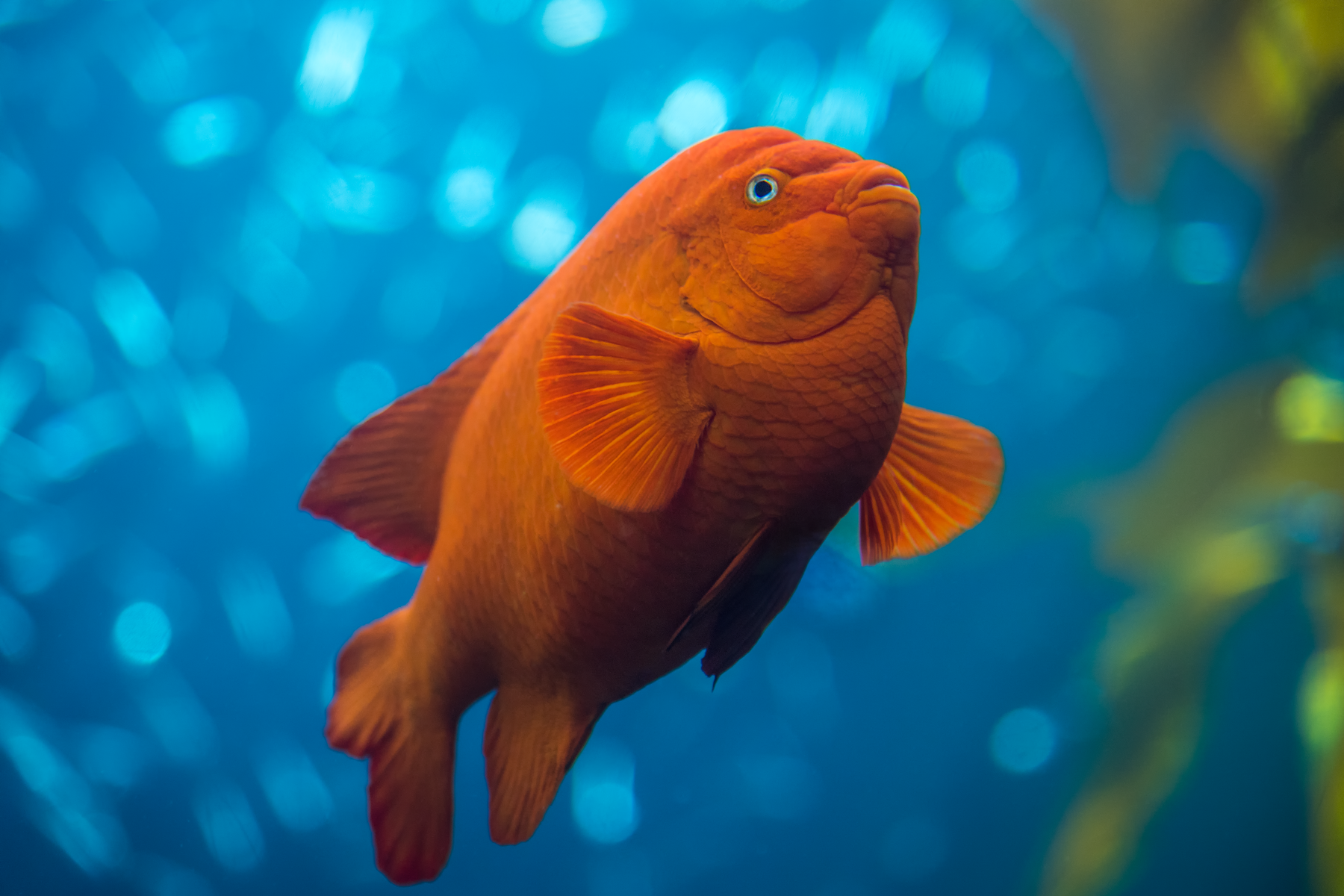
The garibaldi is a bright orange fish with a heart-shaped tail fin. Swimming through dark reefs and kelp forests, it’s a jolt of glowing orange, a reminder that the garibaldi is a relative of coral-reef damselfish. The juvenile garibaldi is a deeper orange, with sparkling spots of electric blue and blue-trimmed fins.
Watch in real time
Kelp Forest Cam
Check out this live cam – Kelp Forest CamNatural history
The garibaldi lives as far north as Monterey Bay, but is especially common in the warmer waters of Southern California and the Channel Islands.
Diet
The garibaldi eats sponges and algae that grow around its rocky home, as well as small animals such as tubeworms, nudibranchs and bryozoans. Its diet of sponges may contribute to its bright colors.
Territoriality
A garibaldi has a clear idea of exactly where its territory ends, and two males may be seen peacefully grazing less than two feet (.6 meters) apart—as long as each remains on his own turf. The female garibaldi tends to be less protective of her territory, perhaps because it contains no eggs.
Territoriality seems to be tied to the rocky reef—periodically, garibaldis gather without drama in the waters above the reef. These “kelp socials” seem to be a way for garibaldis to investigate each other and may help females choose their mates.
How the garibaldi got its name
In the 1840s, an Italian named Giuseppe Garibaldi decided to start wearing bright red shirts as part of his personal style. He went on to fight for the reunification of Italy, became a general and died a national hero. So when biologists discovered a brilliant red-orange fish cruising the rocky reefs of California—one that sallied out to bare its teeth at any intruder—they knew exactly what to name it.
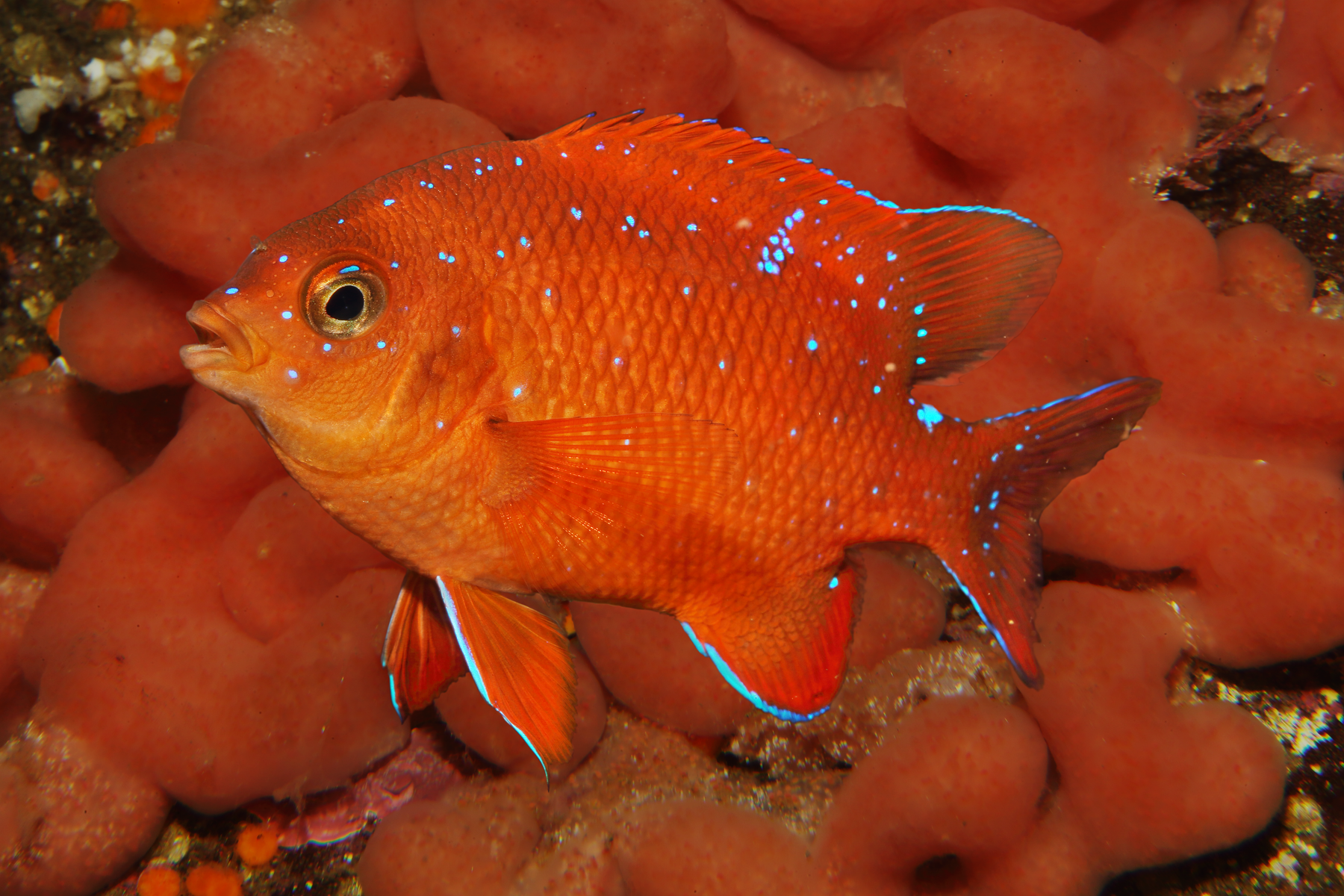
Juvenile garibaldi
Reproduction
Much of the work of raising eggs is handled by the male. Upon becoming an adult, a male garibaldi picks a promising stretch of reef—a sheltering nook plus a smooth expanse of rock wall—where he will live for the rest of his life.
Nesting
Each spring, the male works feverishly to tidy its nest by removing debris, carrying away sea stars or urchins that wander along, and biting away all the plant growth except for a few species of red algae. These he trims so they’re about an inch long (2.5 cm)—perfect places for thousands of eggs to rest.
Once a male’s nest is perfectly trimmed, the next challenge is attracting the attention of a female garibaldi. Females who are ready to lay eggs make outings to look for good nests. This begins in the spring and lasts until fall.
The mating dance
The female signals her interest by swimming with all her fins strongly erect. The male tries to entice the female by swimming loops.
At the same time, he makes a low frequency thumping sound by grinding his pharyngeal teeth. If she takes notice, he swims straight to his nest, hoping she will follow. The female is very choosy, often visiting 15 nests or more before deciding.
What makes a good mate?
In the end, how well-tended a male’s nest is or how well he swims in loops may only be part of the attraction. The female is reluctant to lay eggs in an empty nest—she looks for a nest with eggs from at least one (and up to 20) other females.
This means a male garibaldi has to work hard to attract his first female. After that, many others come, sometimes lining up to lay eggs at a popular nest.
The female is also picky about the age of the eggs in a male’s nest. She prefers to deposit hers alongside other freshly laid, bright-yellow eggs. In a bizarre turn of events, a male will sometimes eat the older eggs in its nest, gambling that it will attract even more females in the next day or so.
Now, scram!
The male garibaldi doesn’t get sentimental after attracting a mate. As soon as a female has laid her eggs, the male chases her away before fertilizing the eggs by scattering sperm over them. He also chases off any other creatures that venture too close, including divers.
Conservation
The garibaldi has a restricted range—it’s found from Baja California to Monterey Bay and nowhere else in the world. Within that range populations are stable. The garibaldi is especially numerous in Southern California’s warm waters, and much less common around Monterey.
Because of its appealing looks and bright colors, the garibaldi is a popular aquarium fish. But it’s illegal in California to collect or keep a garibaldi without a permit, or fish garibaldis for food. The garibaldi is the state marine fish of California, which gives it protected status.
Cool facts
- The male garibaldi doesn’t get sentimental after attracting a mate. As soon as a female has laid her eggs, the male chases her away before fertilizing the eggs by scattering sperm over them. He also chases off any other creatures that venture too close, including divers.
- A garibaldi has a clear idea of exactly where its territory ends, and two males may be seen peacefully grazing less than two feet (.6 meters) apart—as long as each remains on his own turf. The female garibaldi tends to be less protective of her territory, perhaps because it contains no eggs.
- Territoriality seems to be tied to the rocky reef—periodically, garibaldis gather without drama in the waters above the reef. These “kelp socials” seem to be a way for garibaldis to investigate each other and may help females choose their mates.
Up next in kelp forest
Animal
Giant kelp
Under ideal conditions giant kelp can grow two feet each day, creating towering underwater forests that serve…
Keep exploring
Animal
Leopard shark
Leopard sharks live in shallow waters of bays and estuaries and occasionally patrol the kelp forest.